 洪承樹
洪承樹
洪承樹
저자는 서울대 문리대를 졸업하고 , 뉴욕주립대학원에서 이 학박사 학위를 획득했다 . 그리고 네덜란드 레이덴대학 천체물리연구소 초빙연구원과 미국 플로리다대학 우주천문실험실 객원연구원을 역 임 했다 . 「 A Unif ied Model of Inte r st e lla r Gra i ns 」외 20 여편의 논문이 있고, 현재 서울대 자연대 교수로 있다.
 Aa pSra Tti cRa l Oapp Pro YachS toI C S
 a pra cti ca l ap pr oach to
 a pra cti ca l ap pr oach to
CONTENTS
One : Continuum Radiation in Thermodynamic Equilibrium1.1 Introduction1.2 Black Body Radiation before Planck1.2.1 Facts on Black Body Radiation1.2.2 Wien's Dimensional Analysis1.3 Planck's Law of Black Body Radiation1.3.1 First Step : Lucky Guess1.3.2 Second Step : Quantum Assumption1.4 Description of Radiation Field and Planck Curve1.4.1 Specific Intensity : I1.4.2 Flux: F 1.4.3 Planck Curve1.5 Astrophysical Applications of Black Body Radiation1.5.1 Black-Body Approximation for Stars1.5.2 Steady State Equilibrium Temperature1.5.3 Gaseous Emission NebulaReferencestwo : Dynamics of Discrete Bodies under the Gravity2.1 Introduction2.2 Keplerian Motion2.2.1 Implications of Kepler's Empirical Laws2.2.2 Newtonian Description of Keplerian Motion2.2.3 Time-Dependent Positions in the Orbit2.2.4 Some Applications of Keplerian Motion2.3 Differential Gravitation2.3.1 Tidal Force, Friction and Torque2.3.2 Tidal Evolution of Earth-Moon System 2.3.3 General Characteristics of Tidal Evolution2.3.4 Tidal Disruptions2.4 Encounters between Gravitationally Interacting Bodies2.4.1 Single Encounter2.4.2 Virial Velocity and Crossing Time2.4.3 Relaxation Times 2.4.4 Relaxation of Clusters2.4.5 Dynamical Friction2.5 Stability of Star Clusters2.5.1 Disruption by Encounters with Interstellar Clouds2.5.2 EvaporationReferencesThr : Hydrostatics in Astrophysics
3.1 Introduction3.2 Star as a Polytrope 3.2.1 Examples of the Polytropic Relation3.2.2 Lane-Emden Equation3.2.3 Macroscopic Stellar Quantities from Emden Solutions3.3 Polytropes in the uv-Plane3.3.1 Homology Theorem and Homology Invariant Variables3.3.2 Meanings of 𝒖 and 𝒗 Variables3.3.3 𝒖𝒗-Curves 3.3.4 Comments on the Fowler- and Milne - Solutions3.3.5 Composite Polytrope3.4 The Isothermal Polytrope 3.4.1 Equation and solutions for the Isothermal Polytrope3.4.2 Isothermal Solution in the uv-Plane3.4.3 Interstellar Clouds3.4.4 Isothermal Model of Globular Clusters3.5 Further Applications of Polytropes3.5.1 Polytropes of Negative Index3.5.2 Two-Component Isothermal Sphere3.5.3 Extension to Other GeometriesReferencesFour : Boltzmann Transport and Hydrodynamics4.1 Introduction4.2 Boltzmann Transport Theory4.2.1 Distribution Function4.2.2 Measurable Properties of Fluid4.2.3 Boltzmann Transport Equation4.2.4 Boltzmann Equation in terms of Peculiar Velocity4.2.5 Enskog's Equation of Change4.3 Basic Equations of Hydrodynamics4.3.1 Conservation Equations4.3.2 Other Forms of Energy Equation4.4 Sound Waves4.4.1 Propagation of Infinitesimal Disturbances4.4.2 Incompressible Fluid Approximation4.5 Solar Wind4.5.1 Hydrostatic Model of Solar Corona4.5.2 Steady Flow Model of Coronal Wind4.5.3 Energy Considerations4.6 Gravitational Instability 4.6.1 Jeans Condition for Gravitational Instability4.6.2 Gravitational Instability of an Infinite Disk4.6.3 Free-Fall Approximation of Graviational Collapse4.7 Rayleigh-Taylor InstabilityReferencesFive : Magnetohydrodynamics
5.1 Introduction5.2 Basic Equations of Magnetohydrodynamics5.2.1 Maxwell Equations under MHD Approximation5.2.2 Lorentz Force under MHD Approximation5.2.3 Basic Equations of MHD5.3 Discussions of the MHD Equations5.3.1 Magnetlc Reynolds Number and Decay of Magnetic Field5.3.2 Alfven's Theorem: Flux-Freezing5.3.3 Consequences of Flux-Freezing5.3.4 Magnetohydrostatic Equilibria5.4 The Virial Theorem5.5 Magnetohydrodynamic Waves5.5.1 Alfven Waves in an Incompressible Fluid5.5.2 Magnetohydrodynamic Waves in a Compressible Fluid5.5.3 Self-Gravity Included5.6 Stability Analyses5.6.1 Perturbation Equation5.6.2 Normal Mode Analysis5.6.3 Energy-Principle Analysis5.6.4 An Example: Parker Instabilit5.7 Magnetohydrodynamic Discontinuities5.7.1 Formation of Shock Discontinuity5.7.2 Rankine-Hugoniot Relations5.7.3 Discussions of the Jump ConditionsReferences Subject IndexSubj e ct Index
l Conti nu um Radia t i on in Thermody na mi c Eq ui l ibr i u m 1.1 INTRODUCTION Planck's law of black body radi a t ion deserves th e very first Chap ter in astr op h y s i c s not because th e th ermody n ami c eq u i l i b riu m pr evail s in scoeulerscet iaofl ·ocob nj et cintu s u mbu rt adbie ac atuios en . th eF bulratch ker mboodrye , raraddi ia at ito ino ni hs aas pbre oetn o tty h pee only vehi c le avai lable fo r astr onomers to reach_ ou t to th ei r st u dy obj e cts fa r in th e Uni v erse. In deriv i n g th e law of black body radi a t ion, we shal;I. fo llow a rath er rugg e d road once Planck went th roug h to op e n a new era of qu ant u m ph y s ic s. Thi s ap pr oach wi ll re mi n d us of th e . impo rta nce of mode Zi따 and po wer of di m ensi o nal, analys i s in sc ien t ific e ndeavours. Then we shall ex pl.ai n a fe w ~electe d astr op h y s i c al ph enomena in te rms of th e black body radi a t ion . One small th oug h t on th e te rm black in black body may be in order. The reader can easi l y make a black body with shi n y razor blades : Save blade af ter shavi n g and st a ck more th an tw enty blades alto g e t h er. Look at . th e st a ck from th e kni fe_ e dg e si d e. You may not ice th at th e shi n y met a llic blades ~ppe ar consi d erably blacker th an any black mat e ria l what s oever. Any ph ot o ns fa llin g . o n th e blade have almost zero pr obabil ity of escap ing th roug h th e in t e r-blade sp a ce of a wedg e shap e . As th e st a ck
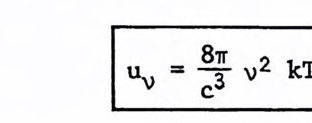
is at about 300 K, th e only ph ot o ns emerg ing from th e st a ck are of in f ra- red radi a t ion , to whi. ch human ey e s are comp l ete ly blin d. Thi s ap pr ec i- at ion of th e meani n g cont a i n ed in 11black11leads us to belie ve th at a black body can be even whi te i f it is suf fici e nt l y hot . 1.2 BLACK BODY RADIATION BEFORE PLANCK At th e end of ni n ete ent h cent u ry th e th eory of radi a t ion was an unsat isf a ct o ry st a t e in sp ite of an enoug h accumulat ion of exp e rim ent a l fa cts on th e black body radi a t ion. 1. 2 . 1 Fact s on Black Body Radi a t ion The radi a t ion seen th roug h a hole on th e wall of a hollow cavit y held at a fixed te mp e ratu re has fol lowi n g pr op e rti es: a) Kirc hhof f's Law: The sp e ct r al di s t r i b ut ion of po wer emi tted fr om a uni t area of th e black body in uni t fr equ ency in t e rval is in dep e ndent of shape , si z e· a nd mat e ria l of th e cavit y wall. The black body r.a d i - at ion should be describ ed by a uni v ersal fu nct ion of fr equ ency and te m- pe ratu re. b) St e f a n-Boltz mann's Law: The to t a l 禪 ! Oun t of radi a t ion energy em itted in uni t time in all freq u enci e s is pr op o rti ona l to th e fo urth po wer of th e te mp e ratu re . c) Wi e n's Di s p l acement Law: The fr equ ency at whi c h th e po wer becomes maxim um is pr op o rti ona l-.t o th e te mp e ratu re . As th e te mp e ratu re in creases th e locat ion of maxi m um po wer shif ts t o wards hig h fr equ enci e s or short . waveleng ths . On th e th eoret ical si d e, th ere had been tw o di ffere nt pr op o sals fo r th e sp e ct r al di s t r i b ut ion of black body radi a t ion: d) Ray l eig h -Je ans Ap pr oxim ati on : Usi n g classic al st a t ist i cs, Lord Ray l eig h deriv ed a relat ion fo r th e energy densit y, uv, of th e cavit y radi a t ion in uni t fr equ ency in t e rval as
 二
二
Here uv is in uni ts o f erg cm -3~ .H.- z1· , and c, v, k and T are th e sp e ed of lig h t , fr equ ency , Boltz mann const a nt and te mp e ratu re, respe ct;1 .v ely. Exp e rim ent s show th at th i s relati on is asym pto t ica lly correct in th e low freq u ency limi t but in ap plica ble to th e ot h er end of th e fr equ ency sp e c- tru m. e) Wi e n's Ap pr oxi m at ion: Wi e n's pr op o sal fo r th e radi a t ion densit y was uv = 검 v3 exp [ -hv/kT], where A and h are const a nt s . Thi s fo rmula is asym pto t ica lly correct in th e reg ion of hig h fr equ enci e s but ir reconci l able in low fr equ enci e s. Problem 1-1: Verif y th e di m ensi o n of u\) as give n by th e Ray l eig h -Je ans ap pr oxim at ion. What di m ensi o ns should th e const a nt s A and h in Wi e n's ap pr oxim at ion have? What one needs is a si n g l e fo rmula whi c h, fo r ext r eme li m i ts v+o and 따 co would recover Ray l eig h -Je ans and Wi e n's fo rmulae respe ct ivel y, and whi ch would ag r ee wi th e x pe rim ent s in th e whole rang e of fr equ enci e s. Thi s was done successfu l ly b y Planck in December, 1900. Befo r e di s - cussin g Planck's result, we should pa y a sp e cia l at ten t ion to Wi e n'.s uniq u e ap pr oach to th e pr oblem. L 2 . 2 Wi e n ' s Di m ensi o nal Analys i s Wi e n emp l oy e s th e met h od of di m ensi o _n a l analys i s to unt a ng l e th e pr oblem of black body radi a t ion. From ex pe r imen t a l fa cts it is qu i te clear th at th e sp e ct r al energy densit y di s t r i b ut ion of th e black body radi a t ion should be exp r essed by a. un i v ersal fu ncti on of fr equ ency and te mp e ratu re. In add ition to v and T, th e sp e ed of lig h t and Boltz n'lan n consta nt are to be in cluded_ in th e fu nct ion, si n ce c and k are th en tw o fu ndament a l consta nt s of relevance to th e pr oblem. Wi e n th en fo rms a dim e nsio n less qu ant ity E by ta ki n g a pr oduct of th ese fou r ph y s i c al qu ant ities and energy . d ensit y each bein g rais ed to a certa i n po wer:
I: = u\} \}a Ts cY ko. The exp o nent of u_v , is ta ken to be I , whi c h does not cos t any ge neralit y . Expr essin g th e five qu ant ities in fo ur fu ndament a l uni ts, time (t], leng th (7,) , energy (e) and te mp e ratu re [a] , we may rewrit e E as [r] = [e] 1+0 [ t] -3+Y [t] 1-a-Y ( e] a-o . Problem 1-2: Usually, time , leng th and mass are consid ered th ree fu nda- ment a l uni ts i n mechani c s, however, Wi e n repl aced mass by energy fo r conveni e nce. Wi th m ass in st e ad of energy yo u may pe rfo rm th e same di m ensi o nal analys i s as Wi e n di d . Ray l eiWge h n oawp p rh oaxviem ua .”t. i =on E tvh2 oukgT h/ c3w e. st Tilalk i nc og n fs ri o m np tl y th e1:= 8d1ir ffrieccuol t vye rso f ths oe cina fl ilnedi tue l wtr i atvh i ot hl ee t R caya lt ea isgt rh o pa ph per: o xiT mh ae t tioo nt a. l ,e Inte rgisy , dui f=fi Jcuu .”l. dt v t, o bime caogm inees th at addi tiona l ph y s i c al varia bles ot h er th an fr equ ency and te mp e ratu re are requ i r ed fo r descrip tion of sp e ct r al energy di s t ribut ion of black body radi a t ion . Hence, one has to give up th e assump tion th at c and k are th e only fu ndament a l consta nts ; th ere seems t_o be a mi s sin g con- st a nt ot h er th an c and k. Si n ce in -dim ensio n -w ise v2kT/c3 :i.s a correct combi n at ion fo r th e leensesrg fy u ndecnt sioit ny o, f 1: vsh,Tou,cld,k b aen idn dt_he pe e mnid es snit n go f cou” .n. s bt au nt t .c ouldW i be ne at r di ie ms etnos i o n'- ex pr ess 1: as a di m ensi o nless fu nct ion E = E ( EvTn) , where E; is th e miss in g consta nt with c and k lump e d to g e t h er with it. Wi thou t losin g ge neralit y he chooses unit y fo r th e po wer to th e fr equ ency , and dete rmi n es th e in dex n with ai d of th e St e f a n-Boltz mann's law. Namely, th e to t a l energy , u, over all fr equ enci e s
CX) v2kT n h u = r — E(f;, v T .. )dv a: T 0 C3 should be pr op o rti ona l to th e fou rth po wer of th e te mp e ratu re. In ot h er words, th e fu nct ion I: should act as a cut - off pa ramet e r in th e reg ion of hig h freq u enc ies so as to avoi d th e ultr avi o let cata str op h e. Problem 1-3 : You may verif y th at t.h e in dex n should be -1 fo r the in t e g r al over fr equ ency to be pr op o rti on al to T4. From th e result of th e. pr oblem we now know th at th e unknown l: should be a fu nct ion of a si n g l e pa ramet e r ~\//T of no di m ensi o ns. A repl acement of ~\)/T by h\)/ k T looks qu i te. n a tu ral for us who are fa mi l i a r wi th P lanck const a nt h, we si m p l y writ e u\) _\言)2k.T E (h百\)) . Wi e nI s analys i s of th e black body radi a t ion leads us to ant icip a t e th e Planck const a nt as fa r as its d i m ensi o n is concerned. Furth er di s cussio n s will be give n in sect ion 1.3. Alth oug h Wi e n's analys i s doesn't yiel d an exact fu nct iona l fo rm for E neverth eless th i s for mal exp r essio n for uv.. give s a nat u ral ex pl an- at ion to th e di s p l acement of maxi m um in t e nsit y of th e black body radi- at ion. Eq u at ing th e deriv at ive of u with respe ct to v to zero, we have 눙kT {2E(z) + zE• (z)} = O, C where z=h\)/k T and 2:( z)=dE(z)/dz. If th e qu ant ity in th e curly bracket s becomes zero at z=zm, zm should be a real po sit ive number because only th en it•c a n be ph y s i c ally meani n g ful . We th us obt a i n Wi e n's di s p l acement law -as \Im_ = k7hT z m' where v.m.., is th e maxi m um-in t e nsit y fr equ ency . As th e te mp e ratu re in - creases th e locat ion of maxi m um in t e nsit y shif ts t o wards hig h fr equ enci e s.
-5 -
In th i s sense u .v. = (kT/c3)v2 E(hv/kT) is somet ime scalled as Wi e n's di s p la cement law. On th e ot h er hand, th e for mal exp r essio n fo r th e energy densit y can be rewrit ten as u \) = hcv33 E (zz ) Taki n g an exp o nent ial fu nct ion exp (-hv/kT) for I: (z) /z as a cut - of f pa ramet e r, Wi e n pr op o ses a hig h fr equ ency ap pr oxim at ion fo r th e black body radi a t ion as u = 令 hv3 ex p (-hv/kT) , \) C whic h has to be modi fied by Planck late r. Problem 1-4: Use the meth o d of dim e nsio nal. analys i s to deriv e th e Schw ax-z schi Z d radiu s of an obj e ct havi n g mass M. If all of th e mass M is cont a i n ed wi thin th e Schwarzschi l d radi u s, th e gr avi tat i ona l fo rce at the radi u s is so enormous th at even a ph ot o n can not escape the obj e ct. 1.3 PLANCK'S LAW OF THE BLACK BODY RADIATION On Oct o ber 19, 1900 Planck repo rte d to th e German Phy s i c al Soci e t y on hi s first emp iri c al relati on whi c h ag r ees wi th e xp e rim ent s over all fr equ enci e s and becomes Ray l eig h -Je ans' ap pr oxi m at ion fo r v+o and Wi e n's fo r v-+a>. Wi thi n less th an tw o mont h s, he assig n ed to hi s empiri c al relat ion a fa r reachi n g im p o rta nce. Thi s second result was repo rte d on December 14, 1900. We fo llow hi s tw o st e p s in th i s sect ion. 1.3.1 Fi r st St e p : Lucky Guess Planck realiz ed th at th e fr equ ency -tem p e ratu re relati on fo r th e black b 여 Y radi a t ion should be obt a i n ed by understa ndi n g th e st a t e of eq u i -
-6 -
li b riu m betw een elect r omag n et ic r adi a t ion and cavit y mat e ria l . For th i s pu rpo se he modeled th e cavit y mat e ria l as a collect ion of si m p l e harmoni c osci l lato rs driv en by th e electr omag n et ic w aves in si d e th e cavit y. Hi s st r ate g y was to use classic al electr ody n ami c s to connect energy densit y of th e elctr omag n et ic w aves to mean energy of th e osci l lato rs, th en, to emp l oy th ermody n ami c s in relat ing th e osci l lato r energy to th e wall te mp e ratu re. We know th e cavit y mat e ria l is much more comp l i c at e d th an a sim pl e collect ion of osci l lato rs. However, Planck chose th e harmoni c osci l lato r as th e si m p l est model fo r th e descrip tion of th e in t e ract ion betw een th e electr omag n et ic w ~ve and th e cavit y mat e ria l, si n ce he knowsf r om ex pe rim e nt s th at th e mat e ria l has no consequ ences to th e sp e ctr al energy di s t r i b uti on of th e black body radi a t ion. i) Elect r ody n ami c s: Mot ion of an osci l lati ng elect r on driv en by electr omag n et ic w ave is describ ed by m(~ + fx + W~ x) = -eEXO(w) ex p [iwt) , where dot s repr esent time -deriv at ives . An oscil lati ng electr on tied to a nucleus has mass m and charge e, and its c haract e ris t ic f r equ ency is denot e d by w0。 . The driv i n g for ce e Ex0 (w) ex p (iwt) comes fr om an osci l lati ng electr ic field of freq u ency w. EXxO0 (w) is th e mag nitud e of th e electr omag n et ic r adi a t ion havi n g a uni t ang u lar fr equ ency in t e r- vtiaol naa tl wto. th Te hee leracdtir o a nt ivvee l odacmitp yin xg wfoi tr ch er, mber:iicn , gi st ha ses udmamepd intog bcoe npsrt oa pn ot . r - Problem 1-5: Why have not we in cluded the cont ribut ion by mag n et ic f ield of th e electr omag n et ic w ave to th e driv i, ng fo rce? Ju sti fy th e velocit y- pr op o rti ona li ty of th e radi a t i-ve damp ing fo rce , and give -an ap pr oxim a t e ex p;re ssio n fo r th e damp ing consta nt: r ' —23me2c 3 u2 0
Solut ion to th ~ eq u at ion of mot ion is X[((-ue: /군 m=) )2E x+o (w(~ r)w )2] t exp [i{wt -ta n- 1 (, 구。rw 구 안] · One obt a i n s th e mean energy of th e osci l lato r by ta ki n g average of 건1 m x·22 + 1l -m w~ x2 over time . The first te rm in th e sum repr esents th e ki n et ic e nergy and th e second does th e po t e nt ial energy of th e osci l lato r. Problem 1-6: Carry out th e averag ing pr ocess to obt a i n a di ffere nt ial mean ·en ergy dUw:..' whi c h th e osci l lato r ta kes in the exci tat i on by a 。 monochromat ic r adi a t ion of fr equ enc y w: dUw 0 = 으4m2 Ex2 o (u ) (u2_UU°2 2 +) 2 u 2+ (ru) 2 。 where the subscrip t w_0 t.o U is meant to id ent ify th e osci l lato r wi th its c haract e ris t ic f r equ e nc y. As an osci l lato r sees radi a t ions of all rang e of f.re qu e1·ic y , we in t e g r ate the dif fere nt ial me~n energy over w U%,., = t4m f Ex~_o (w) (w。~ U-w2。 2+)2 u2+ (rw)2 dw ta ge t th e to t a l mean energy of th e osci l lato r. The Lorent z pr of ile, b(euco2o 군 me )s /q [u((I i) 2co 군 kly ) n 2 e+g li(grwib) 2l )e fion r thI w e。 ~ i-wn t| 가e g r• and vFaurrithe es rmsto rr oen , g rl y iws iitnh gwe annedr al much smaller th an w;0., a-n-- d E-x_ _o_ (w) does not vary as st r ong l y as th e Lorent z pr of ile w ithi n l wO 젝 I< r • We may th us repl ace Ex;,.o.. Cw ) by E!x,...o (wo,... ) and move this te rm out s i d e of th e in t e g r -a l sig n . In ot h er words, as of f-
r.es onance radi a t ions
whi c h can be writ ten in te nns of fr equ ency as 曰 In th i s tr ansfo rm fr om w to v a not e is made to uw. . d w = u \_)_ d \) . Due to th e di s crete nat u re of osci l lato rs, U doesn't in volve th e comp l i c at ion of fr equ ency in t e rval. However, th e cont inuo us nat u re of th e radi a t ion demands a scale fa cto r dw/dv in chang ing uw. . to u .\). . Not e th at U=kT give s th e Ray l eig h ap pr oxi m at ion. Problem 1-8: Ex pl ain how <군E(w ) + B-+(-2~ )> can be eq ua t e d to 3 E! 。 (w) in deta i What are the dim e nsi o ns of E2x o (w) and u u ? ii) Thermody n ami c s: Planck, a mast e r of th ermody n ami ( ;s, fe lt correctl y th at an in t r o- duc:tf.on of ent r op y S in t o th e pr oblem would help hi m relate th e osci l lato r mean energy to its t e mp e ratu re. For a sy s t e m of const a nt volume we have d—dUS =- l-T· -솔 Correct relati on betw e en S and U was gu essed fr om tw o ap pr oxi m at ions th at hold tr ue at op po sit e e nds of th e fr equ ency sp e ct r um .. Wi e n's ap pr oxim ation sug ge sts u = f; hv exp [-hv /kT) , or lo U = lo (金 hv) - 문 器 .
Hence, as an asym pto t ica lly correct relat ion at th e hig h fr equ ency li m i t, we have 틀= -문 갑 • On th e ot h er hand, Ray l eig h ap pr oxim at ion sug ge sts dS/dU=k/U, and its deriv at ive give s dZs―d = 훑as anot h er asym pto t ic r elati on군 at th e low fr equ ency limi t. Now, Planck pr op o ses dd 2Su2 = - hvuk + u2 as th e correct relat ion betw een S and U over th e whole fr equ ency sp e ctr um, and obt a i n s 器=-훑 ln 需됴 • Problem 1-9: Deriv e dS/dU fr om a2s;au2. Exp l ain how yo u det e rm ine the in t e g r al consta nt in yo ur deriv at ion. Thus, osci l lato r's mean energy U is relate d to and T as u=ex p (~h\I /k T) -1 We fina lly have th e energy densit y di s t ribut ion of th e black body radi- at ion over whole fr equ enci e s: u v -- 3C쁘 v 2 ex p (hhv\/Ik T] -1
In hi s Nobel Priz e in aug u ral address del ivere d in 1920, Planck describ ed hi s result as an in t e rpo lat ion fo rmula resulte d fr om a lucky gu ess . HCMever , we shou 꾜 rot underest imat e hi s result as si m p l e gu ess because Max Karl Ernst Ludwi g Planck was th e only one th at deserved th e luck, no one else in th e world at th at time. Planck's fo rmula pe rfe ct l y ag r eed wi th a ll th e exp e rim ent s , however, it was as ye t hardly no m::ireth an an emp iri c al fo rmula, as he hi m self describ ed, si n ce hi s pr op o sed relati on fo r d2S/dU2 had no th eoret ical ju st ificat i on s. 1. 3 • 2 Second St e p : Qu ant u m Assump tion Consi d er a_ sy s t e m of n osci l lato rs of fr equ ency \1, and _su p po se !in amount of energy A is in th ese osci l lato rs. Planck assumes th at th e amount A is made up with eq u al di s crete element s , each havi n g energy e:, and th at th ere are alto g e t h er p such element s in n osci l lato rs . What is im p o rta nt in hi s assump tion is th at ~ radi a t ion bv th e osci l lato rs ta ke olace not cont inuo uslv but bv a di s crete amount c . _ He evaluate s th e ent r op y of th e sy s t e m fr om Boltz mann's law Ent r op y = k ln {Thermody n ami c Probabil ity}. The th ermody n ami c pr obabi l it y of a sy s t e m havi n g energy A is pr op o rti ona l to number of po ssib le way s of at tai n i n g th i s pa rti cul ar energy st a t e , i. e., number of way s in di s t r i b ut ing p eq u al energy pa cket s to n osci l lato rs ; (n+p - 1) !/(n-l) !p! . Usi n g St irri n g ' s fo rmula, we have th e ent r op y of n osci l lato rs as l Sn ' k ln [틀 )T 뿡 .] . For n>> 1 and p» 1, we have Sn = k n [0 뎅) ln . (1당) - 흥 1n 응 ] ..
On th e ot h er hand, A=nU=p e:, hence npi =~ u:) Theref o re, th e ent r op y S correspo ndi n g to mean energy of an osci l lato r becomes S = Sn/n = k [(1 단) ln (l+폰) -폰 ln 폰] . Taki n g a deriv at ive of S wi th_ r espe ct to U and eq u at ing it to 1/T, we obt a i n c u = ex p (e: /kT] -1 From Wi e n's di m ensi o nal analys i s we know U must be of th e fo rm Vi :( v/T). Thi s condi tion is sat isf i ed by pu t ting 巨 where h is th e consta nt named af ter Planck. The average energy of any osci l lato r of fr equ ency \) must be an in t eg e r multi pl e of h\), whi c h is th e smallest energy th at can be em itted or absorbed. By show ing hi s lucky gu ess bei n g root e d in th e qu ant u m nat u re of osci l lato r-radia t ion in t e r- act ion, Planck th us op e ned a new era of qu ant u m ph y s i c s. A deep e r in sig h t in t o th e ph y s i c s underlyi ng th e Planck's deriv at ion of mean energy U was pr ovi d ed by Lorent z in 1910. The pr obabi l it y for a sy s t em in te mp e ratu re T to have an energy e:m_ is pr op o rt iona l to th e Boltz mann fa ct o r exp 〔궁 m/kT] . If an osci l lato r can ta ke energy in in t e g e r multi ple of h\), th en th e pr obabi lity for a pa rti cul ar osci l lato r to have energy e:nn =nhv is exp (-nhv/kT] / /ii ex p( -mhv/kT] = exp (-nh\)/ k T] (1-exp (-h\)/kT)) .
The mean energy of th e osci l lato r is th eref o re h\) (1 -ex p (-h\/ /kT] ) ~ m exp (-mh\/ /kT) , fr om whi c h we have u = h\} exp [hv/kT] -1 Thi s leads us at once to Planck's result. Pwrhoi bc lhe mm o1m-e1n0t u: m -pSh ohwa s tha a tc o tnhs te a nnut mmbaegr n io tf updhe aps e inc etlhl se iran n gu en i tdp voils u msie m pi sl y 81rv2/c3 in uni t fr equ ency in t e rval. The volume of moment u m sp a ce fo r 41rp 2 ap and fo r ph ot o ns p= hv/c. 1.4 DESCRIPTION OF RADIATION FIELD AND PLANCK CURVE Bef o re usin g th e black body radi a t ion to understa nd some ast r o- ph y s i c al ph enomena, we are to learn a fe w te rms whi c h charact e riz e radi - at ion field s. Sp e ci fic i n t e nsit y, fl ux, emi ttanc e and th ei r relat ions to th e radia t ion energy densit y are very basic and essent ial concep ts in astr oph y s i c s. 1.4.1 Sp e ci fic I nt e nsit y: I \/ i) Def ini t ion: The sp e cif ic i n t e nsit y l_ , (구 r , n^ , t) of radi a t ion at po sit ion 수r 1 tr avel ing \/ in di r ecti on n, with fr equ ency \/, at time t is def ined in such a way th at th e amount of energy tr anspo rte d by radi a t i_on of fr equ ency bet w een v and \)+dv across an element of area dA in t o a solid ang l e
where dA cos e = d-A+ • n is th e pr oj ect e d area of th e areal element dA to th e pr op a g a t ion di r ect ion of th e radi a t ion n. The sp e cif ic i n t e nsit y I __ ap pe ars as a pr op o rti on ali ty const a nt in th i s def ini t ion. \/ The energy of th e radi a t ion fa llin g on uni t area is , obvi o usly in versely pr op o rti ona l to th e sq u are of th e di s t a nce fr om th e source. At th e same time th e solid ang l e ext e ndi n g th e uni t area also decreases wi th t h e sq u are of th e di s t a nce. Hence , I_ _ is in dep e ndent of di s t a nce V bet w een th e source and observer, as long as th ere are no addi tiona l sources or si n ks along th e li n e of sig h t . The di s t a nce in varia nce of sp e ci fic i n t e nsit y resul ts f rom th e fa ct th at I.. is a qu ant ity def ined \} fo r uni t sol id a ng l e. ii) Relat ion to th e Energy Densit y: Consi d er a small volume V th roug h whi c h radi a t ion fl ows fr om all di r ect ions . The amount of energy flowi n g fr om a pa rti cul ar solid ang l e dQ th roug h dA is dE. = I dA cos e an d\J dt . \) \) Dn th e ot h er hand, if we consi d er only th ose ph ot o ns in fl ig h t withi n V, dA cos e c dt is th e di ffere nt ial volume element dV th roug h whi c h th e ph ot o ns sweep , where a is th e sp e ed of lig h t and dt is th e time in t e rval th e ph ot o ns are wi thi n th e volume. Hence we may rewrit e d E_\)_ as dE \) = -C1=- I \I dQ d\) dV, and th e monochromat ic e nergy densit y becomes u V =-=C1 -J• 4'I I' I v dQ . If we def ine th e mean in t e nsit y J __ by J 三 J I .. dfl /4 '!T , th e monochromat ic \) \) \) energy densit y becomes U\ I =~CJ \).
For an is ot r op ic radi a t ion field I .\). =J\ .). , and th e black body radi a t ion is an is ot r op ic field , hence, . th e sp e cif ic i n t e nsit y B.\ .) (T) fr om a black body at te mp e ratu re T is B = _2v_2 hv \) c2 exp (hv/kT] -1 iii) Geomet r y and Di m ensi o ns: In astr onomy we are in t e reste d most l y in st e ady st a t e and one dim ensi o nal pr oblems in pl anar or sp h eric al ge omet r y . It is conveni e nt to in t r oduce po lar and azim ut h al ang l es (0,
1. 4 . 2 . Flux : F \} Consi d er an arbi trar il y orie nt e d surfa ce area d니A wi thi n a radi a t ion ebnateh r g. y fTl ohwe vaeccrot os sr dfAlu. x FVB . y ins odt einf gi n deA니d • ~s=udcAh ctoh as te , 홍V w •h deAr ei 8s tihs e tnh ee t anrag tl ee of bet w een th e pr op a g a t ion di r ect ion 요 and th e normal to dA, we can have F = JI (?,요) ; 백 \) \) Thus, th e fl ux is def ined as a .ve ct o r qu ant i t y whose di r ect ion dep e nds on th e orie nt a t ion of th e surfa ce area under consid erat ion. In most ast r op h y s i c al pr oblems, however, it is suf fici e nt to consi d er only surfa ce area pe rpe ndi c ular to th e radi a l di r ect ion, because net tr anspo rt of radi a t ion energy occurs only along th i s di r ect ion. Theref o re, th e fl ux is usually tr eate d as if it were a scalar qu ant ity: F.\ ). = 2,r f 1。T I .\). (. ➔r ,8) cos 8 si n 8 d8 , where azi m ut h al syu nne t r y has been assumed fo r th e radi a t ion field . One ..m ay sepa rate th e fl ux in t o tw o comp o nent s: Out w ard fl ux is obt a i n ed by F+\ ) = -21T- f 1。T ./-2 -I ,\) +(r ,e ) COS O si n 0 d0 , and in ward fl ux by Fv_ = 27T f 77TT /2I_ V (,+r ,0 ) COS O si n 0 d0:; The net fl ux F. V. =-FV +' -F-~-V , '-an·d - for th e is ot r op• ic radia tion field F+:V. = F. -V. , hence, th e fl ux of an is ot r op ic radi a t ion field is alway s zero. Insid e a radi a t ion bat h /sta r, th e fl ux is a· us efu l concep t fo r th e net fl ow of energy , whi l e at th e out e r boundary of a black body or st a r, th ere is no in ward radi a t ion F-=O. !n such cases we call th e out w ard fl ux V as th e emi ttanc e. Black body radi a t ion is .co nsta nt over e=O to 1r/2, th erefo re , th e emi ttanc e of a black body is 1rBV .. (T) .
1. 4 • 3· Planck Curve Allen ta bulat e s many usef u l in f or mat ion on th e Planck curve in hi s excellent book, Ast r oph y s ia a l Quan t ities (19 73) p • 104-107 • In many ap pl i c at ions , however, it is conveni e nt to use th e gr aph shown in Fig 1-1 fo r qu i c kly obt a i n i n g ap pr oxi m at e values of B • The curve st e rns fro m Wi e n's scalin g relati on whi c h reduces Planck's fo rmula to a uniq u e fun cti on al fo rm of v2 E(v/T). We normal ize B(T) to its m axi m um value Bm_ _a_x_ and exp• re ss B_·./ B m__a_x_ in te rms of z=v/T as BBm\ ) ax = 7.78 x l0- 3 2 exp [ c4zz 3] -1 .wh ere c,..=h/k=4. 7993xl0--1,1. deg sec . To use Fig 1-1, read Bv,/·B ,,m,,,a,vx fr om th e curve at z=\)/T of one's in t e rest, th en mul tiply it by Bm_ _a_x_ . A sim ila r gr aph can be easil y const r ucte d fo r BA exp r essed as a fu nct ion of AT. Problem 1-12: Fi n d out th e value of z at whi c h B).. becomes maxim u m, and evaluat e the maxim u m value Bm_ _a_x_ fo r a give n te mp e ratu re T. Problem 1-13: From Planck's law, deriv e Ray l eig h ap pr oxim a t ion, Wi e n's ap pr oxim a t ion and Wi e n's di s p l acement law fo r maxi m um in t e nsit y. Deriv e St e f a n-Boltz mann ' s law, f'IfB .\ ). d\J =aT 4 , and show cr=2'If s k-4 /1·5 c2 군 . Di v i n g t~tal energy densit y by to t a l number of ph ot o ns in cm3 , obt a i n the mean ph ot o n energy of black body radi a t ion.
1.5 ASTROPHYSICAL APPLICATIONS OF BLACK BODY RADIATION Havi n g underst o od th e in t e ract ion betw een radi a t ion and mat ter in the:nno dy n ami c eq u i l i b riu m, we are now to in t e rpr et cont inuu m sp e ct r a of st a rs in te rms of tem p e ratu res in th ei r at m osp h ere where th e cont inuu m orig ina t e s. It is th e te mp e ratu re th at go verns an overall shap e of th e freq u ency di s t r i b ut ion of th e black body radi a t ion . We may th us develop at least some fe elin g s fo r surfa ce te mp e ratu res by comp a rin g observat ions of st e llar sp e ct r a with black body radi a t ion. We also in t r oduce vario us concep ts in st e llar ph ot o met r y wi th t h e use of black-body ap pr oxi m at ion. Furth er examp l es of such ap pr oxim a t ion will be soug h t fr om ph enomena occurrin g in in t er pl aneta ry and in t e rste llar sp a ce as well. 1. 5 .1 Black-Body Ap pr oxim at ion fo r St a rs Temp e ratu re is nei ther _a di r ect l y measurable nor a uniq u ely def inab le qu ant ity fo r most celest ial obj ect s . Temp e ratu re ap pe ars only as a pa ra-met e r in eq u at ions whi c h are to ex pl ain how th e te mp e ratu re and ot h er ph y s ic a l pr op e rti es are consp ire d to yield th e observable qu ant ities as final pr oduct s . Examp l es of such observables are fr eq u ency di s t r i b uti on of st e llar cont inuu m, wi d t h s of sp e ct r al li n es , in t e nsit y rat ios of sp e ct r al li n es, et c . Planck's fo rmula, Boltz mann's di s t r i b ut ion, Saha eq u at ion combi n ed with Boltz mann ·equ at ion, et c are fr equ ent l y used relati ons whi c h all cont a i n te mp e ratu re as an im p o rta nt pa ramet e r fo r th e det e rmi n at ion of such observables . Hence , fo r a si n g le obj ect one may deriv e many di ffere nt tem p e ratu res dep e ndi n g on th e combi n at ion of eq u at ion and observables. If th e obj e ct is in a st a t e of pe rfe ct th ermody n a mic eq u i l i b riu m, a uniq u e value of tem p e ratu re may be obt a i n ed. Theref o re, one should v!°ew· a tem p e ratu re of an obj e ct in th e sense th at if th at pa rti cul ar value is pl ugg e d in t o pa ramet e r T in an ap pr op r i a t e relati on, th e relat ion give s a result whi c h is consi s t e nt wi th t h e observat ion under consi d erat ion. i) Cont inuu m Temp e rat4 res We select th e cont inuu m energy di s t r i b ut ion over fr equ ency as an observable qu ant ity and adop t th e Planck fo rmula as an ap pr op r i a t e eq u ati on fo r th i s observable. Si n ce st a rs do not · radi a t e as a pe rfe ct black body ,
even wit h t h i s si n g l e observable many di ffere nt te mp e ratu res may be def ined dep e ndi n g up o n t'lle aspe ct of th e cont inuu m th at is comp a red with th e black body radi a t ion . Ef fec t ive Temp e ratu re Te f f Temp e ratu re of a black body th at radi a t e s over th e whole sp e ct ru m th e same amount of energy as th e st a r radi a t e s: Denot ing th e di s t r i b ut ion of cont inuu m fl ux by FV , we def ine th e ef fec t ive tem p e ratu re, T_e.f., f..,', by St e f a n-Boltz mann's law: f 。0 F\. ). d\) = f O。3 1TB v (T ef f )d\) = cThe f f . Eff ec t ive te mp e ratu re is , th eref o re, a go od measure of th e to t a l fl ux emi tted by a st a r. We have a pr acti ca l di fficul ty , th oug h , in ge t ting tohn ely t oi nt a al flli u m xi t, edb e rcaanugs ee eofa rtthh e ast mp eo cspt rh u emre. tr aBnoslmomi tett rs i sc t ec ollrarerc rta idoin a it si on ap p}-ied to account fo r th e unt r ansmi tted po rti on of th e _to t a l fl ux. Radi a t ion Temp e ratu re Tr ad Temp e ratu re of a black body th at r'a d ia tes th e same amount of energy in th e observed fr equ ency rang e as th e st a r does : Dep e ndi n g on th e freq u ency rang e observed one may have many di ffere nt rad;i. a t ion te mp e r- atu res. Of course if th e st a r radia tes really like a black body , only one te mp e ratu re· r esults rega rdless of th e fr equ ency rang e consi d ered. Brig h t n ess Temp e ratu re T b Temp era tu re of a b .... ack body whi ch radi a t e s th e same amount of energy at a sp ec if ied freq u ency as th e st a r does: Brig h t n ess tem p e ratu re is a 111easure of monochromat ic f l ux, whi l e ef fec t ive te m pe ratu re th at of to t a l flu x·· Sin ce th e monochromat ic f lux is di r ectl y pro p o rti ona l to th e te mp e r- atu re, as th e Ray l eig h -Je ans ap pr oxi m at ion shows, in radi o fr equ enci e s, it is custo mary fo r radi o astr onomers to use Tb in ste ad of F\I • However, only- i n cases of th ermody n ami c eq u i libr i um th e br igh t n ess te mp e ratu re in di c at e s th e 111ean kine t ic e nergy of pa rti cle s in th e radi o source. For maser sources
Tb becomes even as hig h as m.i l lion deg r ee9 ;ln Kelv:i. n . Such hig h te mp e ra~ tu res· a re not h i n g to do wi th t h e act u al energy st a t e of th e source, only in di c at e s its e xt r eme dep a rtu res fr om th e st a t e of th ermody n ami c eq u i l i b ri- um. Color Temp e ratu re TC Temp e ratu re of a black body th at has in th e observed fr equ ency rang e th e same slop e in th e fl ux di s t r i b ut ion as th e st a r shows : When givi n g th e color te mp e ratu re, it is essent ial to st a t e in whi c h sp e ct r al in t e rval th e te mp e ratu re has been def ined . Most commonly used fr equ e ncy in t e rval is betw een th e vi s ual M a 따 th e blue (B) fr equ enci e s , and usual color te mp e ra-tu re correspo nds to th e color in dex B-V, fo r whi c h fu rth er di s cussio ns wi ll be foll owed. Gradi e nt Temp e ratu re TG Temp e ratu re of a black body th at has at a sp e ci fied fr equ ency th e same gr adi e nt in th e freq u ency di s t r i b ut ion of fl ux as th e st a r does: Thi s def ini t ion st e ms fr om a pr op e rty of black body radi a t ion th at it has all di ffere nt slop e s, at a give n fr equ ency , dep e ndi n g on its t e mp e ratu re. Wi e n Temp e ratu re T.w~ Temp e ratu re of a black body whose emi ttanc e becomes maxi m um at th e waveleng th where th e st a r shows maxi m um fl ux. Table l-;-1 : Classif icat ion of Temp e ratu res h.v fr equ ency rang e F\) !::,.v energy F shap e Av+0 Tef f Av 누 Trad TC AVv=Rvo max T-b TTGw In Table 1-1 we have classif ied all th ese te mp e ratu res accordi n g to whet h er amount of energy or slop e of th e sp e ct r um is used fo r vario us fr equ ency in t e rvals.
Problem 1-14: Deriv e all th e tem p e ratu res fo r th e su n. Use th e solar cont inuu m as giyen in Allen (19 73) p. 172-173 . ii) Color-Color Di a g r am Di a g r ams const r uct e d fro m vario us combi n at ions of ph ot o met r i c color in di c es have pl aye d fu ndament a l roles in th e det e rmi n at ion of im p o r- ta nt st e llar pr op e rti es, li k e surfa ce te mp e ratu r~, surfa ce gr avit y, met a l abundance, ag e , et c . Usi n g th e black-body ap pr oxi m at ion we can have qu alit at i ve understa ndi n g s how st e llar te mp e ratu re mani fest s on such a di a g ra m. Mean Waveleng ths :>0._ , :>1. ,, :>. e Neg l ecti ng comp l i c at ions aris i n g fr om at m osph eric and in t e rste llar ext inct ions , we may rep r esent th e observed fl ux, F。_ , of a st a r by an in t e g r al F0_ = f• 003 F().) S().) d)., where F(X) and S(X) are sp e ct r al di s t r i b ut ion of th e st e llar flux and sp e ct r al respo nse fu nct ion of th e det e cto r sy s t e m, respe ct ivel y. The respo nse fu nct ion is usually normaliz ed as JC O S(>-) d>- = 1, 。 and it cont a i n s at least th ree respo nse fu nct ions fo r op tica l sy s t e m of th e te lescop e , filt e r-, and ph ot o g r aph i c pl ate or ph ot o electr i c ph ot o cell. We now def ine th ree mean waveleng ths : charact e ris t ic w aveleng th X0_ , is op h ot a l waveleng th ~1 and ef fec t ive waveleng th ~e · The first moment of th e respo nse fu nct ion A。 三 IAS(A) dA is a usef u l mean waveleng th in characte riz i n g th e det e cto r sy s t e m. Usually th e observed value, F。_ , is not th e st e llar fl ux at th e charac- te ris t ic w aveleng th 。- • So we ap pl y th e mean value th eorem to F(A),
whi c h is assumed to be cont inuo us over th e wi d t h of S().) , in th e def i- ni tion of th e is op h ot a l waveleng th ).~i as F 。 = J F( A) S(>.)d>. = F( Ai) • Due to many absorp tion li n es in st e llar sp e ct ru m in . pr act ice it is dif f:l,cu lt to det e rmi n e a uniq u e value fo r 1.i4 fr om observed sp e ct r um. Thus, we need one more rnear., e' called ef fec t ive waveleng th , whi c h is def ined by Ae 三 J >.. F(>..) S(>..) d>./J F(>..) S(>..) d>... The is op h ot a l and ef fec t ive waveleng ths dep e nd on sp e ct r al charact e ris t ics of bot h source and det e ct o r, whi l e th e charact e ris t ic w aveleng th ). 。 dep e nds only on th e det e ct o r sy s t e m as a whole. In order to det e rmi n e di ffere nces bet w een th ese waveleng ths we exp a nd th e cont inuu m sp e ct ru m F(,-) as a Tay l or serie s about -。 · Then, th e observed value F_。 becomes F00 = F().00 ) + F'().00 ) f( ).-).00 )S().)dA + 전1 F().O0 ) f( ).->.O0 )2- S().)d>. + 6l F' (>.oo ) J (>.->.oo ) 3 S (>.)d>. + …· We know fr om th e def ini t ion of ).。- th e second te rm in th e exp a nsio n is id ent ical ly ·zero. And th e fou rth fe rm becomes almost neg l ig ibl e, becau.s e most respo nse fu nct ions are, as shown in Fig 1-2, more or less sym me t r i c about ).。- · Theref o re, th e observed fl ux is si m p l y give n by F 。 = F(>.o) + ½다 。)균, where µ2 = f( ;>.-;>。.~ )L2 S().) d:>. is th e second moment of th e respo nse fu nct ion. From th i s Tay l or exp a nsio n of F。- o ne can easi l y evaluat e th e di ffere nces Li- }. o and ;>e._ -;>.o_ in te rms of µ, F' (;>o._ ) and F(;>.o_ ) •
Problem 1-15: Show th at AJ .. -AO = -12 u 2 FF' ((•>A .. o。 )) and A e -A o = µ2 FIF,`(^,A ' o ‘, O1) Resp o nse fu nct ions of ultr avi o let (U), blue (B) and vi s ual (V) filt e rs of Jo hnson's ph ot o elect r i c ph ot o met r y sy s t e m are shown in Fig 1-2. Also give n in th e same figu re are respo nse fu nct ion of human ey e . Not e th e si m i l arit y in sp e ct r al respo nse bet w een th e V filt e r and human ey e . Table 1-2 list s ef fec t ive waveleng ths of th e UBV fiHe rs. In order to show th e source dep e ndence of ef fec t ive waveleng ths , we have give n values of ;i.e_ fo r th ree di ffere nt type s of st a rs. Also give n in th e ta ble are di ffere nces betw een in verse values of ef fec t ive waveleng ths : lhnU - lhnB and 1/>•. .Bn - 1/).v·. Please not e an ap pr oxi m at e eq u ali ty of th ese color bases: It is usef u l to make th e in t e rval in 1/). be eq u al bet w een U, B and V filters , because deriv at ive of log BA, (T) wi th r espe ct to 1/X is roug h ly li n ear wi th 1 /).. Table 1-2 : Ef fec t ive Waveleng ths of Jo hnson Sy s t e m Tc efu f ec t ive waBv eleng th )V.J 차 coUlo-Br base ll>B.;-1V{µ rn 크] 25,000 3550 4330 5470 0.50 0.48 10,000 3650 4400 5480 0.46 0.46 4,000 3800 4500 5510 0.41 0.42 Mag n i tude s at ~i • )._e and ). o Ex pa ndi n g )..F()..) as a Tay l or serie s about )..e_ and subst itut ing th e serie s in t o th e def ini t ion of )..e_,' we ge t F(.X i) = F(.Xe ) [ 1 +(A7 F(' (IAe T· ) + 1) 운A -eA ] · By ta ki n g a common log a rith m we fo rm fr om th i s eq u at ion a mag n i tude
di ,ffer ence AF'(A) A 나 m(\) - m(\) ' -1.08 6 [~ + 1] 으근 , e· e where mO1,)· -mO• ~e·) is -2.S lo~g F(' 1.1, )· /•F O• _e ) . Si m i larly w e obt a in th e di ffere nce mO1, )-mO_0 ) by usin g th e Tay l or exp a nsi o n of F_o about ).o_ : m(:>-i ) - m(:>-o) ::: -o.s43µ2 IF T(:>-T- ) . 。 Problem 1-16: Ap pr oxi m at e th e sp e ct r um of an OSV st a r by an ap pr op r i a t e black body radi a t ion and est imat e th e above di ffere nces at th e U wave- leng th. The most id eal repr esent a t ion of ph ot o met r i c observat ions of F 。 would be made when th e is op h ot a l mag n i tude or m。_ is pl ot ted ag a i n st th e is op h ot a l waveleng th Al~. - As di s cussed bef o re, however, usin g :i.~l. po se~ a pr act ical di fficul ty . We have to choose ei ther :i.o_ or :i._e fo r th e . waveleng th correspo ndi n g to th e observed mag n i tude m。_ . It tu rns out th at m(;l. 0_ )-m(;l. 1~ ) is somewhat large r th an m(:i. e_ )-m(:i. l~. )- For examp l e, f1o0 - r 2~ 0 m5Va g ns it ta ursd e ws;i twh hUi l fe imlt (e;l. er_ ,) msh(o:iw. 。_ )s da i fdif fefres ref nr ocme mof( :i. lo~. )n=lmy 0 10b- 3y ambagru n it tude s fro m m(;l. l.~ ). The observed mag n i tude m0_ is pr act ical ly same as th e mag n i tude at th e ef fec t ive waveleng th ;i.e_ . Theref o re, th e sp e ct r al energy di s t r i b ut ion is usually repr esent e d by a di a g r am const r uct e d fr om mo in th e ordi n at e and Ae in th e absci s sa. Color Index When we let U, B and V repr esent mag n i tude s at correspo ndi n g wave- leng ths , color in dex B-V is def ined by B-V = -2.5 log FF((;\BU) + C1. V Si m i larl y U-B in dex is def ined by
U-B = 2.5 l.og FF((ABu言) + c2. The zero po i: n t correct ions c1 and C?2 are chosen such th at B-V and U-B become zero fo r AOV st a rs. For st a rs earlie r or hot ter th an AO th e B-V in dex becomes neg a t ive and fo r st a rs late r or cooler th an AO it becomes po sit ive. Problem 1-17: Ap pr oxim a t e an AOV st a r by a black body of T ' 11,000 K, evaluate ef fec t ive waveleng ths of u, B, and V filt e rs, and det e rmi n e correct ion fa ct o rs c1 and c2. Do th e same fo r an ext r emely hot black body (T+
 (U-B) 。
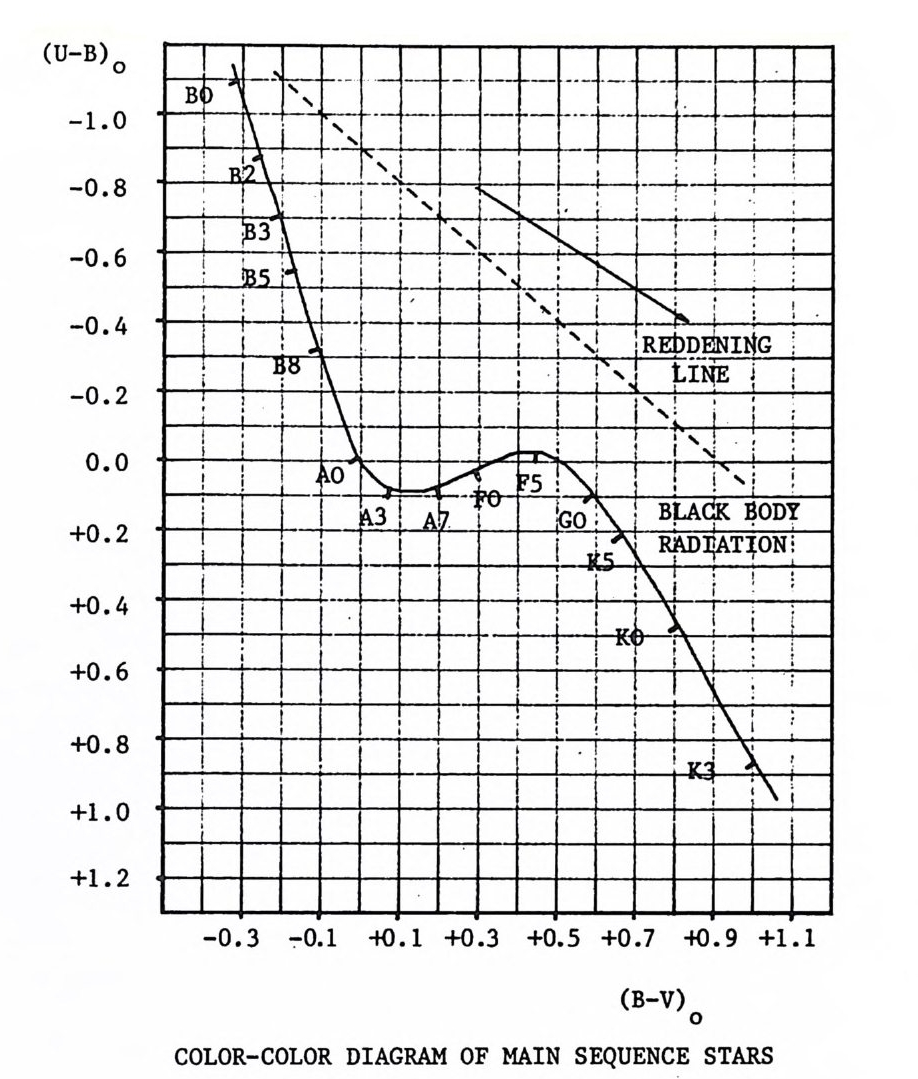
Fi g. 1-3 : Posi tions of mai n seq u ence st a rs (solid line) are shown in a color-color di a g r am (U-B) 。 VS (B-V) 。• Black-body po si tio n s are also give n fo r comp a ris on. The arrow rep r esent s in creasin g di r ect ion of in t e rste llar ext inct ion.
Alth oug h th e black-body line runs pa rallel to th e st e llar line in overall sense, th e latt e'r has a di s t inct fe at u re wi th i t. St e llar sp e ct r a show ju mp s in fl ux di s t r i b ut ion at ). = 3646A。 where Balmer li m i t locate s. As give n in Table 1-2, U measures fl ux ju st below th e Balmer li m i t fo r early type st a rs; whi l e B measures above th e li m i t, Hence, fo r a give n B-V, th e big ge r th e ju mp is , th e big ge r th e U-B wi ll be. Surfa ce te mp e ratu re and gr avit y becomes most fa vourable, at - AOV st a rs, fo r th e fo rmat ion of Balmer li n es, as a result most st r ong U- def ici e ncy occurs to ~AOV st a rs. The U-def ici e ncy decreases fo r st a rs earlie r th an AOV because th ey are to o hot fo r hy d rog e ns to remain neut r al. For st a rs late r th an AOV, th e def ici e ncy is also di m i n i s hed because th ey are to o cool fo r hyd rog e ns to be excit ed to th e firs t level fro m th e gr ound. Thi s ·re sults in a charact e ris t ic h ump on th e U-B versus B-V di a g ra m. Int e rste llar Ext inct ion A brie f di s cussio n on th e in t e rste llar ext inct ion may be in order. The waveleng th dep e ndence of st e llar energy di s t r i b ut ion F(;.) observed even out s i d e th e earth at m osp h ere, is - n ot th at of in t r i n si c di s t r i b ut ion f().,). The select ive ext inct ion by in t e rste llar dust gr ain s modi fies th e st e llar sp e ctr u m to F (). } = f (.A ) exp [--r,_] , where -rA, is th e to t a l op tica l dep th over th e di s t a nce betw een th e st a r a~d u_s fo r th e give n waveleng th ;\ . The observed in dex has to be correcte d fo r th e in t e rste llar ext inct ion befo r e relat ing it to in t r i n si c pr op e rty of th e st a r: (B-V) 。 = (B-V) - (TAB - TAV) and (_lJ- B) o = (U-B) - (-rA U - -rA B) •
Si n ce color excesses (,AB -'AV) and (,::>.U - 'A. a) are po sit ive qu ant ities, mai n seq u ence 9.t a rs suf fer ed fr om in t e rste llar ext inct ion dep a rt fr om th e in t r i n si c relat ion shown in Fig 1-3 to wards th e di r ect ion of reddeni n g li n e. Once slope of th e reddeni n g li n e is known, one can easil y det e r- mmio nv ei n gt h et h aem ooubnset sr veodf pcoo il on rt ebxacckewssaerds dupu e tot o thi ne t ei nr st rt ei nl lsair c lduinste b ayl onsgi m pw l iyt h th e slop e of reddeni n g li n e. However, th i s met h od is of li m i ted success fo r st a rs late r th an about A5V st a rs, unless sp e ctr al classes are known by ot h er met h ods. Problem 1-19: In the op tica l waveleng th reg ion the in t e rste llar ext inc- tion in creases li n early wi th 1/>.. . Comp a re th e slope of black body li n e wi th t h at of reddeni n g line on the (U-B) vs (B-V) di a g r am. Desig n a ph ot o met r i c sy s t e m of filt e rs whi c h is reddeni n g fr ee in the _ op tica l regi o n of th e sp e ct r um. iii) Radi a t ion Densit y in Int e rste llar Sp a ce Radi a t ion in sp a ce orig ina t e s fr om tw o mai n sources; The cosmi c backg r ound radi a t ion pr ovi d es its s hare of uc = 4 x 10-13 erg/ c m3, and th e st e llar radi a t ion give s u_s = 7 x 10--1•3 erg/ c m3 . The fo rmer, relic s of th e Big -B ang exp l osio n, pr evai l s in th e mi c rowave reg ion . Ap a rt fr om its c osmolog ica l conseq u ences, th e backg r ound radi - at ion does not pl ay much role in th e in t e rste ;J. l ar at o mi c chemi s t r y , because ph ot o ns of th i s radi a t ion have energy to o weak to io n ize or excit e a t o ms. However, th i s radi a t ion is th e sole source of exci tat i on fo r molecules li k e CO and HzCO, si n ce only radi a t ions of such long wave- leng th can pe netr ate deep in t o dense in t e rste llar clouds where molecules can surviv e. The cosmi c backg r ound radi a t ion act s fo r us as a pr obe of dense clouds, ot h erw ise , pr obi n g would be di fficul t.
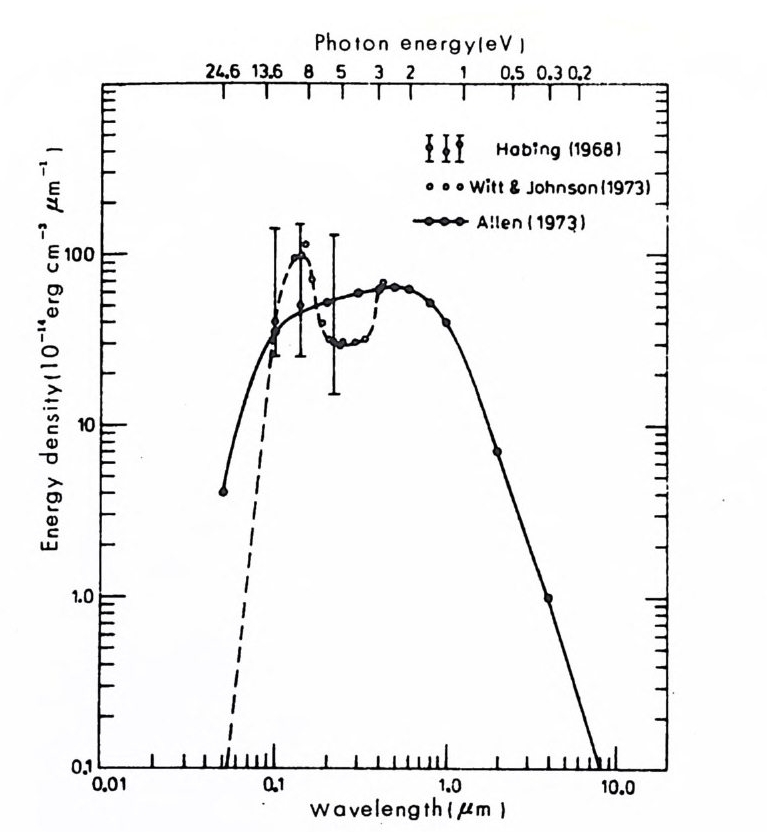
The latt er , st e llar radi a t ion, consi s ts of tw o comp o nent s ; di r ect ste llar il lu!ll.i n a.ti Q n 1? and tl:iei r s.c ~ .t t ere d ra.di a t ion fr om in t e rste llar dust. Thi s radi a t ion is di s t r i b ut e d over in f rar ed to fa r ultr avi o let and pl ays an im p o rta nt role in in t e rste llar chemi s t r y . Current l y known sp e ctr al di s t r i b ut ion of th i s comp o nent in in t e rste llar sp a ce is dep icted in Fig 1-4, where th ree results are combi n ed to g e t h er. In old day s of Eddi n g ton , th e energy densit y of in t e rste llar radi - at ion field was ap pr oxi m at e d by a di l ute d black body radi a t ion of te rn- p era t냐 :e 10,000 K, u A = w 쓰C~ BA. ( T = 104 K) . The di l uti on fa cto r W was usually assumed to be 10- 1-4• . Even to day th i s is a qu i te g o od repr esent a t ion. Black body of T = l.l x 104 K wi th W = 10- 1..k. give s th e to t a l energy densit y of 7 x 10 -1• 3.., erg cm -3~ in correct amount . From th e si m i l arit y in te mp e ratu re betw een sp a ce radi a t ion and AO st a r, we may say th at most domi n ant cont r i b ut ion comes fr om AO st a rs to th e in t e rste llar radi a t ion field . Problem 1-20: Charact e riz e radi a t ion field in in t e rste llar sp a ce, whi c h is fille d wit h an ensemble of black-body st a rs di s t ribut e d over sp e ctr al type accordi n g to the lumi n osit y fu nct ion cl> (M) as give n by Allen (1973) , wit h di lut io n fa ct o r and radi a t ion tempe ratu re. Ig n ore th e di ffuse scat tere d comp o nent . Gi v e di s cussio ns on th e di ffere nce betw een yo ur canp o sit e s p e ctr al di s t r i b ut ion and tha t shown in Fig . 1-4. Problem 1-21: Chang e the uA, - >. di a g r am in t o nE~ -E di a g r am fo r in t e rste llar radi a t ion densit y, where nE~ repr esent s di s t r i b ut ion of ph ot o n numbers in cm3 over uni t energy in t e rval cent e red at E. Use electr on volts , eV, fo r th e uni t of energy . What ki n ds of ph ot o ns are most common in sp a ce? What ki~d s of at o mi c sp e ci e s have io ni z at ion/ excit at i on po t e nt ials comp a rable to such conunon ph ot o ns?
 Phot o n energ y(e V I
Fi g. 1-4 Di s t r i b ut ion of radi a t ion densit y in in t e rste llar sp a ce is rep r esent e d as a fu nct ion of wdeanvseilt eyng itnh . u. ni tT hwe avoerldeni gn atht e ign ti ve er vs atlh. e eFnoerrg y conveni e nce energy correspo ndi n g to th e waveleng th in th e absci s sa is also marked in uni t of elect r on volts . The uni t of th e ordi n at e is 10-14 erg/ cm3/µm.
iv ) Ot h er Examp l es Gi a nt and Dwarf By th e def ini t ion of ef fec t ive te mp e ratu re we can exp r ess th e st e llar lumi n osit y L i:n te rms of radi u s R and ef fec t ive te mp e ratu re Tef f as log L = 4 log Tef f + 2 log R + const _. On th e ot h er hand th e ordi n at e of th e H-R di a g r am is pr op o rti ona l to log L and th e absci s sa in creases left wa rd wi th l og Tef f' Hence st a rs of same si z e would lie o n a st r aig h t li n e ext e ndi n g fr om up pe r-left to lower-rig h t of th e di a g r am. And th e eq u al radi u s li n e moves to up pe r-rig h t as th e radi u s in creases. Thi s exp l ain s why such ge neric names as gian t and dwarf are give n to st a rs. Bolometr i c Correct ion Bolometr i c mag n i tude correspo nds to th e to t a l amount of st e llar radi a t ion over all fr equ enci e s. In pr i n cip le , one can det e rmi n e th e bolomet r i c mag n i tude of a st a r fr om a st a t ion ju st out s i d e th e earth at m osp h ere ·us i n g a det e ct o r sy s t em whose sp e ct r al repo nse is const a nt over th e whole sp e ctr um. In pr act ice, however, th e bolomet r i c mag n i tude is usually obt a i n ed by ap pl y ing a correct ion to th e gr ound base obser- vat ions fo r th e vi s ual mag n i tude . • The bolomet r i c correct ion def ined by th e di ffere nce betw een bolomet r i c mag n i tude and vi s ual mag n i tude is obt a i n ed fro m th eoret ical st u di e s of st e llar at m osp h ere. In recent ye ars th e bolomet r i c correct ions f1;_om st e llar models have been checked and impr oved with th e ul trav io le t dat a fr om sate llit es. In th e usual UBV mag n i tude sy s t e m th e bolomet r i c correct ion becomes mini m um fo r FS to F7 st a rs of ef fec t ive te mp e ratu re 6500 K. For our sun BC is 0.07 mag n i tude . Bolomet r i c correct ions are large fo r bot h very hot and very cold st a rs; fo r hot st a rs most of th e radi a t ion is in th e ultr avio le t whi l e for cool st a rs in th e in f r ared. . Problem 1-22: Rep l acin g th e st e llar sp e ctr a by black body radi a t ions of ap pro p r i a t e te mp e ratu res, exami n e how th e bolomet r i c correcti on varie s in si z e fo r st a rs fr om osv to MSV.
Black Body as a Calib rat ion Source Phot o elect r i c measurement s are usually done in relati ve scale. Somet imes th ere is a necessit y to calib rat e such relat ive measurement in absolut e scale. Black body radi a t o rs are freq u ent l y used in such calib rat ions as a pr i m ary st a ndard. The usef u lness of th e black body in th i s cont e xt st e ms fr om th e si m p l e uniq u e dep e ndence of th e radi - at ion po wer on te mp e ratu re as give n by Planck's law. Det a i l ed examp l es and refe rences are give n by Gray (19 76) . 1.5.2. St e ady St a t e Eq u i l i b riu m Temp e ratu re A pa rti cle in sp a ce will ga i n energy by absorbi n g radi a t ions and collid i n g wi th o t h er pa rti cle s havi n g energ ies hig h er th an its o wn. At th e same time th e pa rti cle wi l l lose its e nergy by emi tting radi a t ions correspo ndi n g to its t e mp e ratu re and collid i n g wi th o t h er pa rti cle s of lower energy . In a st e ady st a t e th e pa rti cle at tai n s an eq u i l i b riu m tem p e ratu re where th e rate of energy loss exact l y balances-o f f th e ga i n . In th i s sect ion we shall restr i c t th e heat ing and coolin g mechani s ms to radi a t ive pr ocesses only, and exami n e te mp e ratu res of in t e rste llar dust and solar sy s t e m bodi e s. i) Temp e ratu re of Int e rste llar Dust The heat ing rate r due to th e in t e rste llar radi a t ion field is give n by r = f-0。0 7Ta2 Qa_ b,_s_ (a/X) c u,A dX, where a is th e ·pa rti cle radi u s, 1ra2 Qa_.b__s (a/>.) th e absorp tion (emi s sio n ) cross-sect ion of th e pa rti cle at waveleng th ). and u). is th e energy den- sit y of th e radi a t ion field in sp a ce. Act u ally th e ef fici e ncy fa ct o r Qa bs(a/>.) dep e nds not only on th e rati o a />. but also on si z e, shap e and op tica l pr op e rty of th e mat e ria l . Fi x i n g th e shape wi th s p h ere fo r a give n mat e ria l, we repr esent all th e op tica l characte ris t ics of th e pa rti cle by Qa_ b._s_ (a/>.).
If th e pa rti cle is a black body at te mp e ratu re T, it would radi a t e '1TB >. (T) fr om uni t surfa ce area, in uni: _t ti:me and wavelen$t h in t e rval. Parti cle is ~ in ge neral, not a black body , hence it modi fies th e black body emi ttanc e to Q_a b.. s_ (a/).) '1T B,A (T) accordi n g to its o p tica l charact e r- is t ics. Then, th e to t a l coolin g rate of th e pa rti cle becomes A(T) = 4 군 J: Qa bs(a/).) 1r B,.(T) d).. If we let TE be th e eq u i libri u m te mp e ratu -.:e at tai n ed by a pa rti cle in a st e ady st a t e , TE can be obt a i n ed fr om th e eq u at ion of heat ing - coolin g balance fa:) Qa bs (a/).) u d>.. = 문'·- f a:) Qa b/a/x ) BX (TE) d). , where th e left hand si d e comes fr om th e heat ing rate and th e rig h t fr om th e coolin g rate . Alth oug h th e same Qa bs(a/).) .ap pe ars in bot h si d es of th e balance eq u at ion, one should realiz e a big di ffere nce in waveleng th reg ion where absorp tion and emi s sio n ta ke pl ace. Absorp tion occurs pr i n cip a lly at th e ultr avi o let waveleng ths , si n ce uA, is ap pr ecia ble, as shown in Fig 1-4, in th e sp e ctr al reg ion from 0.1 to 1. 0 µm. On th e cont r ary emi s sio n ta kes pl ace in th e fa r in f r ared waveleng ths , si n ce th e eq u i - lthi be rihu e ma t itne gm p re artae t u orpe et ru artne s s oiunt av eqruy i tloe wd ,i. f nfaemree lnyt, wabaovuetl e nlSg Kth. reTgh iuosn, Qfra o ,bm s. (a/).) in th at in th e coolin g rate does. Solut ions of th e heat ing - coolin g balance dep e nd ent irel y on th e wave- leng th dep e ndence of th e ef ficien cy fa ct o r. Ju st to ·ge t a fe el ing for th e tem p e ratu re, we first consi d er a black body or gr ay pa rti cle , fo r whi c h th e ef fici e ncy fac t o r is in dep e ndent of th e waveleng th. Then th e balance eq u at ion yiel ds th e eq u i libri u m te mp e ratu re TBB of such a black body eq u i v alent as TBB = [옮 (us + uc)] 1 /4 = 3.5 K,
where th e co~mi _c l,,a ckg r ound radi a t ;/ .on i~ ;/.ncluded as well as th e st e llar radi a t; J:on . I.t i:;h ould. Qe po i n t e d out th at tl,le eq u i v alent black body te rn- pe ratu re :J:s in dep e ndent of th e pa rti cle si z e, Alth oug h t}:le value of TE dep e ndson th e det a i led p r op e rti es of Qa bs(a/>.), we can make a bet ter est imat e fo r th e dust te mp e ratu re th an th e si m p l e black body eq u i v alent tem p e ratu re with a use of Ray l eig h ap pr oxi m at ion fo r th e absorp tion ef fici e ncy fa ct o r. For small values of 2,r a /A where th e Ray l eig h ap pr oxi m at ion holds th e absorp tion ef ficien cy fa ct o r Qa_ b,_s_ (ah) is pr op o rt iona l to a/>.. For in t e rste llar dust it is a very go od ap pr oxi m at ioq in pa rti cul ar fo r th e evaluat ion of th e cool ing rate , si n ce th e domi n ant coolin g waveleng ths are in orders of 100 µm whi l e th e siz e of in t e rste llar dust is in sub-m icr on rang e . Adop ting th e Ray l eig h ap pr oxi m at ion for bot h th e cool ing a nd heat ing and subst i- tu t ing th e di l ute d black body radi a t ion in t o u,A , we may easi l y solve th e balance eq u at ion to obt a i n th e eq u i l i b riu m tem p e ratu re of in t e rste llar dust as T_E ' W.5., -10 4 K = 16 K • As long as th e same si z e-dep e ndence is assumed fo r th e ef fici e ncy fa ct o r in bot h coolin g and heat ing rate s, th e eq u i l i b riu m tem p e ratu re is in de- pe ndent of th e pa rti cle si z e in a ste ady st a t e . Numeric al solut ions co th e balance eq u at ion wi th u 1A give n in Fig 1. . 4 yield TE ' 15 K for o ic y gr ain s of 0.15 µm si z e, and TE ' 20 K fo r si licat e gr ain s of 50 A si z e. Normally th e linea r in crease of Qa_ .b... s_ with th e rati o a h levels of f fo r 2na/x gr eate r th an unit y and ,Q-<_ a ..b.. _s ap pr oaches an asym pto t ic v alue fo r t2'oII ' a thh a.>t > i1n. th e Tuhults r atvh ieo rl aett i oo ro vf i Qs i_a b.b.. . _sle ;J..wn htehr ee f2na ar/ Xi n f' ra1r, e di fw ah e=re 0 2.1'II' a µhm ,« 1 in creases wi th i n creasin g radi u s. Under typica l in t e rste llar condi tions small gr ain s, th eref o re, te nd to be hot ter th an large ones. On th e ot h er hand if pa rti cle s are as large as 100 µm, 2na/X exceeds unit y even in th e fa r in f r ared. Such large pa rti cle s act li k e gr ey bodi e s in th e pr ocess of ph ot o n emi s sio n and absorp tion . In th ese. . c ases th e eq u i v alent black body te mp e ratu re is a go od esti ma t e of th e pa rti cle te mp e ratu re.
Problem 1-23: Exp r es& th e heat in';l' rate r of.. th e in t e rste llar radi a t ion field in te rms of ph ot o n number densi t y n.,E,. J.n ste ad of u,A How long does 0.1 µm-si z e gr ai n ta ke to absorb ph ot o ns of 1 ev energy in in t e r- st e llar sp a ce? For th e ef fici e ncy fa ct o r use Qa~ b--s~ (a/;\)=41ra/;\ and fo r ~ use yo ur result obt a i n ed in Problem 1-21 . Est imat e th e time req u i r ed fo r the gr ain to cool of f th e 1 ev energy . Can we say th at th e gr ain s are in a st e ady st a t e in heat ing and coolin g pr ocesses? Problem 1-24: The eq u i l i b riu m te mp e ratu re is meani n g ful only when th e in t e rnal energy of a gr ain is subst a nt iall y large comp a red wi th t h e energy in p u t resulte d fr om a si n g l e absorp tion event . Usi n g Deby e ap pr ox±'tl la t ion fo r th e sp e ci fic h eat yo u may comp a re th e in t e rnal heat energy of an averag e gr ain wi th t he energy of most fr eq u ent ph ot o ns, say , one electr on yo lt. For what gr ain si z e th e eq u i l i b riu m te mp e ratu re st a rts to lose its m eani n g ? Deby e t핵\P era t ures are about 500 K fo r most of th e pl ausib le gr ain mat e ria l. ii). Temp e ratu res in th e Solar Sy s t e m Most of th e solid obj e cts in solar sy s t e m behave li k e gr ey bodi e s in th e th ermal balance, because th ey are much large r th an any waveleng ths of relevance. Consi d er a rap idl y rot a t ing sp h eric al body in th e in t e r~ pl aneta ry sp a ce and evaluate its e q u i v alent black body te mp e ratu re. Wi thi n th e solar sy s t e m th e sun is th e most domi n ant heat ing source, th erefo re, ·th e heat ing - coolin g balance can be in nnedi a t e ly writ ten as 1Ta2/ o。o 1T(l-A)BA ( T o ) —4411TT— 군R2_ dA = 41Ta2 / OoO 1TB A• ( TB B ) dA , wh~re T_。 is th e ef fec t ive te mp e ratu re of th e sun, 1' th e di s t a nce fr om th e !>Un to th e obj e _c t and R is th e radi u s of th e sun. The albedo A repr esents th e fr act ion of in ci d ent solar radi a t ion whi c h is refl ecte d r::. ck in t o sp a ce. From St e f a n-Boltz mann's law we im medi a t e ly obt a i n T BB = Te (1-A) 나1 (2요r )1T = 277 (r보 )21 K.
In th e second eq u alit: y we have in Rerte d ap pr op r i a t e values fo r th e sun and ign ored th e te rm in volvi n g albedo because what really mat ter s wi th th e te mp e ratu re is only qu arte r of A and A
We have comp a red in Table 1-3 th e black body eq u i v alent te mp e ratu re and subsolar tem p e ratu re of pl anet s and th e moon wi th t h ei r observed values. Albedo is ta ken in t o account fo r th e te mp e rat u re evaluat ion . For Mercury whi c h has no at m osp h ere th e observed te mp e ratu re is qu i te close to th e subsolar tem p e ratu re, whi l e fo r ot h er pl anet s havi n g at m os- ph eres th e black body eq u i v alent te mp e ratu res are bet ter rep r esent a t ions fo r th ei r act u al si tuat ion s. Bot h te mp e ratu res are fa r below th e observed value fo r Venus, fo r whi c h one has to recog n i z e th e im p o rta nce of th e gre en house ef fec t . Problem 1-25: Ex pl ain why met a llic bot tons on cot ton clot h es are ge ner- ally hot ter th an th e cloth i n g s under di r ect solar il lumi n at ion . What is th e pr i n cip a l cause fo r th e gr een house ef fec t in th e Venus at m osp h ere? Problem 1-26: Est imat e th e time scale fo r comp l ete evapo rat ion of an ic e ball of 10 µm radi u s at one AU di s t a nce fr om th e sun. 1. 5 • 3 Gaseous Emi s sio n Nebula Hubble di s covered an in t e rest ing emp iri c al law th at emi s sio n nebulae occur only around st a rs of sp e ct r al class B2V and earlie r, whereas refl ecti on nebulae are associ a t e d wi th s t a rs of late r sp e ct r al type s: Gaseous emiss io n nebula owes its e xi s t e nce to a cont inuo us sup pl y of io n izi n g radi a t ion fro m a hot st a r. And we know th at th e emi s sio n rate of io ni z i n g ph ot o ns should crit ical ly dep e nd on te mp e ratu re in th e surfa ce of th e st a r. Thi s leads us to seek a th eoret ical underst a ndi n g of Hubble's in t e resti ng observat ion fr om th e black body radi a t ion. In th i s sect ion we will ex pl ain how a clear demarcat ion betw een emi s sio n and ref l ecti on nebula is pu t at sp e ct r al type B2V. Si m p l e consi d erat ions based on th e black body radi a t ion- w i l l te ll us how cent r al st a r go verns ext e nt s of io n ize d reg ion s fo r H and He, and th ei r relati ve ext e nt s . i) Phot o i o ni z at ion of Hy d rog e n Cloud Sup po se a hot st a r is surrounded by a pu re hy d rog e n cloud of uni form densit y ~• Near th e st a r th ere is a large sup pl y of io ni z i n g ph ot o ns whi c h are capa ble of susta in ing io n iza t ion. In causin g io ni z at ion, however, th e ph ot o ns are dep l ete d th roug h absor ption . Furth er out in t o th e ga s th e io ni z in g fl ux ge t s smaller and smaller unt il a po i n t is reached where
he io ni z i n g ph ot o ns. are comp l ete ly u향ed up :1-:n th e ion i z ati on , and th e ;as bey o nd tl:ii.s p9 :l- n t remai n $ neut r al . The charact e ris t ic t h i c kness of th e tr ans·it ton zone bet w een io ni z ed and neut r al ga s is roug h ly one mean free pa t h fo r th e io ni z i n g ph ot o n. At th e po i n t where th e deg r ee of io ni z at ion i:s beg inn i n g to drop , th e mea.n fr ee pa t h is · ext r emely small comp a red to th e characte ris t ic e xt e nt of th e io ni z ed reg ion . Thus we have th e pict u re of a nearly comp l ete ly io ni z ed St r o”m g r en sp h ere or H+' reg ion sepa rate d by a th i n tr ansit ion laye r fr om an out e r neut r al ga s cloud or H。- reg ion . Problem 1-27: Absorp tion cross-sect ion of hy d rog e n at th e Ly ma n lim it is about 6xl0- 1• 8- cm2~ . Evaluat e th e· mean fr ee pa t h of ph ot o ns havi n g energy 13.6 ·ev at th e reg ion where to t a l number densit y is 10 cm--3 , and the deg r ee of io ni z at ion is SO% . Def ine SH(r) as th e number of ph ot o ns fl owi n g in uni t time th roug h a shell of radi u s r wi th a n energy -gr eate r th an th e bi n di n g energy of hy d rog e n at o m i_n th e gr ound level. Reduct ion in SH(r) over a di s t a nce dr results fr om io ni z at ions of hy d rog e ns in th e shell of th i-. c kness dr. On th e ot h er hand th e io ni z at ion rate must balance, in a st e ady st a t e , th e recombi n at ion rate . From th i s eq u i l i b riu m condi tion we may obt a i n d S8(r) = -4ir r 2 dr n 硏 ne j~ 2
The recombi n at ion coef fici e nt , a2(J。I - }, fo r all exc ited levels is a slowly var~i n g fu nct ion of elect r on tem p e rat u re, fu rt h ermore, th e elect r on tem p e ratu re itsel f varie s very li ttle wi thi n an HI! reg ion . These tw o ef fec t s make th e coef ficen t almost in dep e ndent of th e di s t a nce fr om th e cent r al io ni z i n g source. Even in a cloud of uni form densit y,, 닙만 .and n e are fu nct ion of r, because in a st r i c t sense th e deg r ee of io ni z at ion chang e s fr om cent e r to boundary . However, we are fo rtu nat e enoug h to have St r o”rc g r en ' s pict u re of HI! reg ion : a comp l ete ly io ni z ed reg ion bounded by sharp tr ansit ion laye r. Theref o re, we may pu t ne=n!f += nH and tr eat 1¾f+ and nee as const a nt s . For our pu rpo se th i s is a pe rfe ct l y go od ap pr oxi m at ion, because our in t e rest _li e s in th e si z e of HI! reg ion s not in th e det a i l ed io ni z at ion st r uct u re over th e tr ansit ion laye r. We may in t e g r at e th e eq u at ion over dr out to th e radi u s rH' def ined as th e value of r where SH., (r) has decreased to zero: 산? 댑 땝 a2 (H0) = SH(o) . The St ro ”m g r en radi u s r8 is now give n by th e to t a l number .of ph ot o ns emi tted by th e st a r pe r second bey o nd th e Lym a n limi t . Rep l acin g th e st e llar sp e ct r um by th e black body radi a t ion , we may est imat e th e emi s sio n rate of th e Ly ma n-cont inuu m ph ot o ns SH(o) = 4'II' R 2 f 00 'II'B \J ( T)/h\}. d\}, \} 1 \} where \}1 is th e fr equ ency of Ly ma n li m i t , R and T are radi u s and surfa ce te mp e ratu re of th e st a r, respe ct ive ly. If one knows color te mp e ratu res of early type st a rs in th e shortw ard of th e Ly ma n li m i t QI 2 A。. 1 bet ter est imat e s would be made by Tc- th an by Te_f,: f,:·• However, we si m p l y used ef fec t ive te mp e ratu res along wi th t h e st e llar radi i comp ile d_ by Panag ia (19 73) fo r mai n seq u ence st a rs of early type . Log a rit hm of SH0( 0) is pl ot ted ag a i n st ef fec t ive te mp e ratu re in Fi g 1-5, where sp e ct r al type s are also marked. For a late r use we also pl ot ted th e emi s sio n rate , SHne_ (o), of He-io ni z i n g ph ot o ns.
Bet w een B2V and 04V th ere is some fo U 'r orders-of - mag n i tude di ffer- ence in SH'1-l ( o) , hence at least one-order di ffere nce in rH is exp e c te d . Thi s di ffere nce is enoug h fo r Hubble to not e th e clear demarcat ion bet w een emi s sio n and ref l ect ion nebula at B2V st a r. Table 1-4 : Ext e nt s of H+'- Reg ion s fo r D; tffer ent St a rs ~pe ctr al Ty pe Tef f R/R 。 [S~eHc (-o1)) [ssHec e- (1o)) r[Hp c ~c2m/-32] 04 V 50,000 K 15.1 8,39xl0 硏9 l.66 xl049 135 05.5 V 45,000 12.6 3.Slxl01+ 9 5.35xl048 101 06.5 V 40,000 10.2 l.25xl049 l.36x1Q t+B 72 09 V 35,000 7.9 3.53xl048 2.49xl047 48 BO V 30,000 7.6 l.25 xl048 4. 90xl046 35 Bl V 22,500 6.2 9.43xl046 9.30xl044 15 B2 V 20,000 5.6 2.88xl046 L42x10 10.3 Values of ruH comp u t e d fo r early- type st a rs are give n in Table 1-4 pteo gr ae tt hu erer . withA 1 tsho eg uivsee nd vina luteh se otaf b1raed ai ur es sign }s:)o laanrd uSniH tes( oa) ndco mePfU fet ce dt ivfer o mt e m, th e Planck fo rmula. The values of rH ~'1 have been comp u t e d for a ki n et ic t em p e ratu re of 8,000 K typica l of Galact ic H +' -r eg ion s, fo r whi c h th e recombi n at ion coef fici e nt becomes 3.4xl0-13 cm3 sec-1. It should be po i n t e d out th at our values· o f rH are li k ely to be overest imat e s of th e act u al si z e of HII reg ion s, because, fo r a give n ef fec t ive te mp e ratu re, mtho adne lt ha etm bo slapch ke reb odcya .l culaSti ni ocne s tgh ii vs e d elef sisci pe hn ocyt o onfs sbte ye o l nlad r tph he oL t yo mna sn f lo ir m i t· ). ~ 912 A。 results fr om absorp tion by neut r al hy d rog e ns in th e at m osp h ere, th e ef fec t becomes neg ligibl e for very early ·ty pe st a rs where hy d rog e ns are all in io ni z ed fo rm. However, fo r st a rs late r th an BlV black body ap pr oxim at ions give rH seven to te n times large r th an model at m osp h eres. ii) Phot o i o ni z at ion of Cloud cont a i n:ing H and He Ef fec t of hel ium has been ign ored in .th e last di s cussio n. A much bett er p~ ct u re of an act u al io ni z ed cloud can be pr ovi d ed by ta ki n g th e second most abundant element in t o account . The io ni z at ion po t e nt ial of
Hf i is 24.6 eV, whi le t h !; io ni z ati on po t e nt ial of H: is 54.4 eV. Si n ce even th e hot tes t O st a rs emi t pr act ica lly no ph ot o ns havi n g energy hig h er th an 54.4 eV, th e po ssi b i lity of He* -reg ion does not exi s t in ordi n ary emi s sio n nebulae. Alth oug h th e si tuat ion is qu i te d i ffere nt in pl aneta ry nebulae , we li m i t our di s cussio n to Hi - reg ion only . Phot o ns wi th e nergy bet w een 13.6 eV and 24.6 eV can io ni z e H only, whi l e ph ot o ns wi th e nergy hig h er th an 2'4 .6 eV can io ni z e bot h H and He. As a result we exp e ct tw o di ffere nt type s of io ni z at ion st r uct u re dep e ndi n g on th e sp e ct r um of io ni z at ion source. At one ext r eme, if th e source emi tts p h ot o ns most l y ju st above 13.6 eV and very little above 24.6 eV, th e io ni z at ion st r uct u re consi s t s of a small cent r al (H+' He+ )-reg ion surrounded by a large r (H+ • He0 )-reg ion . At th e ot h er ext r eme , if th e io ni z i n g st a r pr oduces a large fr act ion of ph ot o ns in th e energy rang e hig h er th an 24.6 eV, th e out e r boundary of bot h io ni z ed reg ion s coi n c ide : There is a si n g l e (H+' He+ ' )-reg ion . We shall pu rsue th i s qu ali tat i ve pict u re a li ttle fu rth er. For th e ext e nt of He+ -reg ion we may st ill use th e same condi tion fo r ph ot o i o ni z at ion eq u i l i b riu m as fo r H+' -reg ion . 누 갑 e 날 广 + nHi ) a2(He0 ) = SH/o). Please not e ne is now repl aced by th e sum (%f-_+ nHl ) , si n ce th e electr ons come fr om io ni z at ion of bot h · H and He in th e H 장 -r;gio n . Ioni z at ion cross-sect ion decreases as 1/\)3 fo r fr equ enci e s above th e th reshold. As a conseq u ence , ph ot o ns capa ble fo r io ni z i n g He at 'o m s are almost com- pl ete ly consumed by He. In th e above eq u at ion we have, th us ign ored absorp tion of He-io ni z i n g ph ot o ~s by hy d rog e ns in Hit+ ° - reg ion . Ju st as hy d rog e n deg r ades an ultr avi o let ph ot o n in t o a ph ot o n of Ly man a and ot h er ph ot o ns, so hel.iu m converts each ph ot o n of ul trav i o let radi a t ion in t o a ph ot o n whose waveleng th is ei ther 584 A0 or 304. 0A , resonance li n es of H 정 and He+ , respe ct ivel y, in addi tion to pr oduci n g ot h er ph ot o ns whose waveleng ths are most l y gr eate r th an 912 _R. If th ese ot h er ph ot o ns are ign ored, si n ce most of th em can not io ni z e hy d rog e n, th e fl ux of ph ot o ns cap a ble fo r ion i z i n g hy d rog e n is unal tere d by th e pr esence of
 1.0
1.0
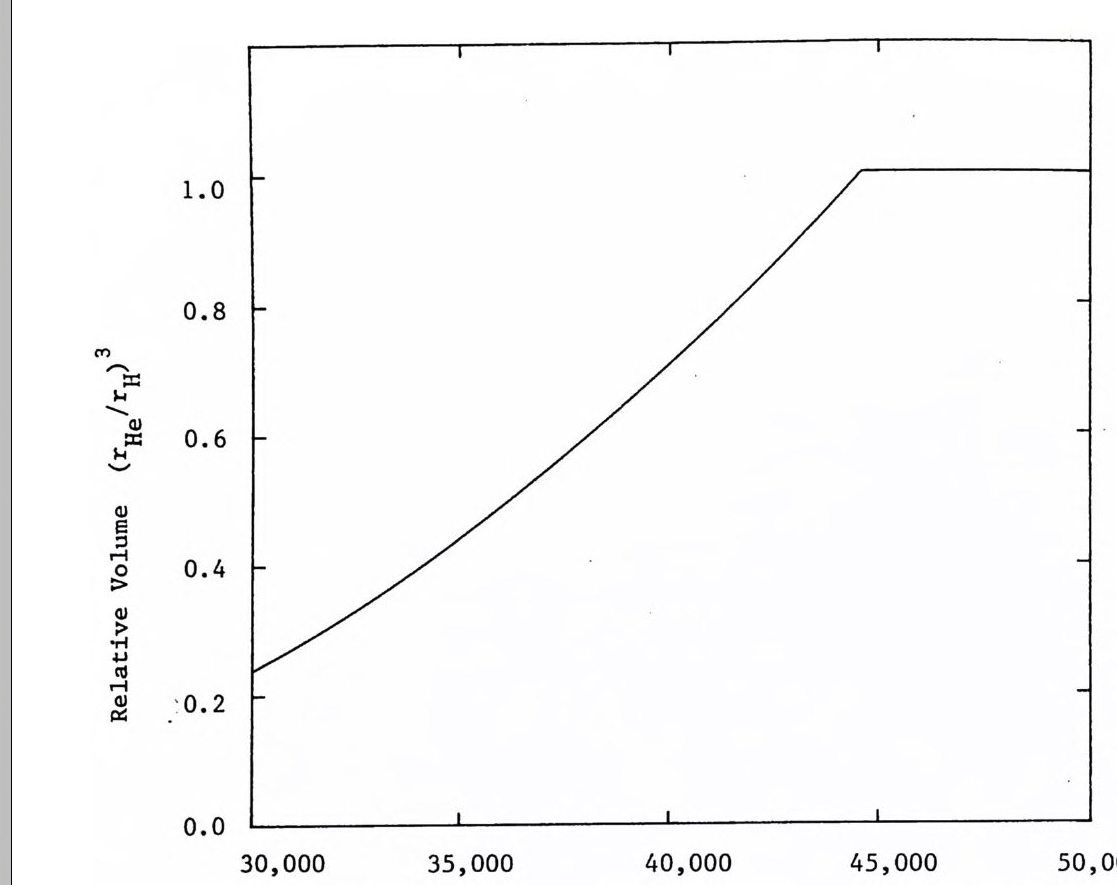
Eff ec t ive Temp e ratu re [K] Fi g. 1-6: Relat ive volume of He+' -reg ion to H+ - reg ion is shown as a fu nct ion of ef fec t ive tem p e ratu re of exci ting st a r.
hel ium. As a result th e radi u s rH of lr+- reg ion is st ill g ive n by - t h e same eq u at ion of pu re hy d rog e n case wi th S Hu (o) unchang e d. Di v i d i n g th e io ni z ati on eq u i libriu m condit ion for He in H/-only reg ion by th at fo r H in H+' and He+' reg ion , we obt a i n fo r r .H. e <• r- H [단3 [:] [ n 硏沖+ nHe+] [三广言] -[ 건 We have shown in Fig 1:-6 a pl ot _ of (rH/rH)3 calculate d for nHe+/~ 三 ~/~ = 0 • 15 . As we exp e ct e d , for Te ,ff ~ 40 , 000 K th e He+ and 단 zones are almost coi n ci d ent wi th e ach ot h er, whi l e at sig n i fican t l y lower tem p e ratu res th e He+' -reg ion is much smaller. The det a i l s of th e curve in cludi n g th e pr ecis e te mp e ratu re at whi c h th e tw o reg ion s coi n ci d e are not sig n i fican t . What is im p o rta nt , th oug h , is th e fa ct th at th e ge neral tr ends obt a i n ed fr om our si m p l e analys i s based on th e black body radi a t ion are in deed correct. We c01,c l ude th i s sect ion by st a t ing th at th e st r ong .de p e ndence of ph ot o n emi s sio n rate on te mp e ratu re makes th e ext e nt s of io ni z ed reg ion s very sensit ive to th e sp e ct r al type of th e exci ting st a r. pr cblem 1-28: Est imat e th e ext e nt of o+·· -reg ion surroundi n g an OSV st a r, and comp a re the .O+ • + • -ext e nt wi th t h e He +• -exte nt fo r the same st a r.
REFERENCES All th roug h th i s · monog r aph , mo~t fr equ e nt use~ are -ma de to a wonderfu l collecAtli leonn , ofc .was·. . - tr 1 o9.n 7 o3m, : i:.c Aa slt rd oapt h a y, s ic al (Juanti't·ic'e lJ ', th :i: rd edit ion (At h lone; London). Good hi s t o ric al overvi e ws on th e black body radia tion are give n by Whi ttake r, E. 19. 7 3, A Hi· s t o ry of tlie Theorie s of Aet h er and EZectr ic i'ty J;I' (Jfum anit y Press; New York) , p , 78-87 , Sommerfe ld, A. 19.7 3, Thermody n ami c s and St a t ist i cal Mechani c s (Academi c Press; New York), p, 135.,...152, Those who are fa scin at e d wi th t h e po wer th e di m ensio nal analys i~ has should read Ci tterm an, M. and Halpe rn, V. 1981, Qu a Zit a ti硏 e Analys i s of Phy s ic a l Problems (Academi c Press ; New· York} , p . 36~83 • Imp o rta nt concep ts and te chn:i: c al det a i l s of ph ot o met r y are give n by Golay , M. 1974, Intr o duct ion to Astr o nomi c al Pho t ome t쩝 (Rei d el; Dordrecht ). To th ose who are in t e reste d in Eddi~ gton ap pr ox:i. m at ion of th e radi a t ion densit y in sp a ce,. readi_ ng hi s classi.c pa p e r sure g:i:ve s pl easures : Eddi n g ton , A.S. 1926, Proa. Roy . Soc. (London), Ser. A. .!.!.!_, 424. Wi thou t exagg e rati on everyt hi n g about op tica l pr op e rti es of small pa r.ti cle s are in hi s classic : van de Hulst, H.C. 1957, 玩g h t Sca tt e ri따 by SmaU Parti c.Z e s (Wi ley ; New York). Ti m e-dep e ndent tem p e ratu re of small in t e rste .i. la r gr a;l:n s is th oroug h ly di s cuHssoendg , byS .S. 1~79 ., Jo 1 .'1', Kor. Astr . Soc., _g_, 27-34. An excellent book by Ost e rbrock ;J.s recoDDnended to everyo ne who is serio us enoug h to do research on pr oblems relate d to !,pn i z ed reg ion s: Ost e rbrock, D.E. 1978, Astr op h y s i c s of Gaseous Ne'b u.7,a,e (Freeman; San Franci s co). •
Ot h er pa p e rs qu ot e d in th i s chap ter are foll owi n g s : Gray , D.F. 1976, The Observat ion and Anal ye i e of $teZ Zar Phot o e ph eree (Wi ley ; New York) , p . 118-120. . Habi n g , H.J . 1968, B.A.N., 브~. 421. Panag ia, N. 1973, A.J ., 끄침, 929, Wi tt, A.N. and Jo hnson, M.W. , 1973, Ap .J., 브브, 363.
2- Dy na mi cs of Dis c rete Bodie s under the Gravit y 2.1 INTRODUCTION Thi s chap ter concerns th e dy n ami c s of astr onomi c al bodi e s under gr avi tat i ona l at trac t ion. We beg in with Kep l er's ph enomelog ica l descrip - tion of pl aneta ry mot ion and exami n e its d y na mi c al im p l i c at ions . After summariz i n g basi c pr op e rti es of th e tw o-body pr oblem we consi d er tidal evolut ion of th e earth -moon sy s t e m. We th en st u dy , on th e basi s of gr av iat iona l encount e r, vario us relaxat ion pr ocesses occurrin g in st a r- cluste rs. Fi n ally we give a brie f di s cussio n on th e st a bi l i ty of st a r cluste rs in th e Galaxy . 2.2 KEPLERIAN MOTION Jo hannes Kep l er (1571 - 1630) lived in a pe rio d when Aris t o t e l ian pr act ice was reje cte d. Among hi s cont e mp o rie s are Francis Bacon(1551 - 1626) and Galil eo G alil ei (1564 - 1642). Kep l er wa ,s for t u nat e enoug h to have accesses to Tyc ho Brahe's vast observat ions of sup e rb qu alit y. Wi th bi s in g e n iou s in str ument s Tyc ho Brahe (1546 - 1601) in creased observat iona l accuracy by a fa cto r te n or tw ent y. In hi s late r ye ars Tyc ho was able to
det e rmi n e po sit ions of pl anet s to th e accuracy even less th an a half mi n ut e of arc (~25). Thi s fine accuracy was pivo t a l fo r Kep l er to di s card all th e models made up of ep icy c les, eq u ant s and even ovals; none of th em could repr oduce th e mot ions of five pl anet s to Ty c ho Brahe's accuracy . Af ter a decade of pa i n sta ki n g ef for ts he announced in 1609 hi s tw o emp iri c al laws: The first law, law of ellip s e, st a t e s th at th e pa t h of each pl anet relati ve to th e sun li e s in a fixed pl ane cont a i n i n g th e sun and is an ellip se of whi c h th e sun oCCl !pies one of th e fo ci. The second law, law of consta nt Cl!'e al velocit y, st a t e s th at th e line (radi u s vect o r) jo i n i n g th e sun to each pl anet sweep s out eq ual Cl!'e as of its e llip s e in eq u al in t e rvals of time. Anot h er decade of pe rsis t e nce broug h t hi m hi s th i r d law: The law of harmony st a t e s th at th e sq uCZ!'e s of th e sid e real pe rio ds of th e pl anet s are pr op o rti ona l to th e eubes of th ei r mean di s t a nces (the semi - maj o r axes of th ei r ellip s es) fr om th e sun. By 1621 Kep l er had shown th at fo ur Galil ean sate llit es of Ju p iter also obey th e harmoni c law. Problem 2-1 : By pl ot ting log a rit hm of orbi tal pe rio ds ag a i n st log a rit hm of semi - maj o r axes, verif y th e harmoni c law really holds fo r pl anets and Jo vi a n sate llit es as well. If yo u not ice any dep a rtu res fr om th e harmoni c law, give qu alit at i ve reasons fo r th e di s crepa nc y. Conf e r Allen (1973) , p. 140-141 . 2.2.1 Imp l i c at ions of Kep l er's Emp iri c al Laws The dy n ami c al im p l i c at ions of th ese emp iri c al laws were ful ly a p pr ec iat e d by Newt o n (16 42-1727 ) . We wi l l fol low St e rne (19 60) in recast ing New to n's old argu ment s in modern lang u ag e . i) Cent r al Force For a body to move in a fixed ·pl ane , it is , clear th at th e resulta nt fo rce act ing on th e body must li e in th e same pl ane . If we describ e th e pl ane mot ion of a pl anet by po lar coordi n at e s 1' and 8 cent e red at th e sun, th e rate at whi c h area A is swep t out by +i: is dA/dt = jl r:£28• 三 j1 h . The consta nt h is called areal const a nt and is twice th e areal velocit y.
Let us supp o se th at at time t th e pl anet is at th e po i n t P, and af ter an in t e r- va l of time 6t , i. e. at t = t + 6t th e pla net moves to th e. po i n t Q drawi n g an arc PQ . Taki n g 6t suf fici e nt l y small we may assim i l ate th e arc 따t h chord. If no fo rce were act ing , th e pl anet would move to R' at t = t + 26t in such a way th at PQ =QR '. In act u alit y th e pl anet moves -to R. The mot ion of th e pla net is consi s t e d of tw o comp o nent s : one (Q- +R') due to in erti a, th e ot h er (R'-+R) due to th e fo rce of unknown natu re whi c h we are up to .
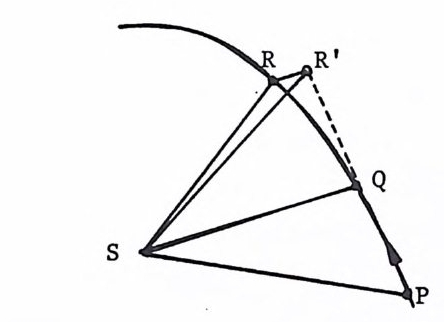 s
s
Fi g 2-1: Traj e ct o ry of a pl anet around th e sun. Now Kep l er's second law demands th e area of flSP Q be eq u al to th at of flSQR . On th e ot h er hand flSP Q has th e same area as flSQ R ' , si n ce PQ =QR ' , hence flSQR = flSQ R ' . Because th ese tw o tr i a ng l es have a common base SQ , th ei r heig h t s are eq u al, in ot h er words, R'R is pa rallel to QS . Therefo r e, th e fo rce must have act e d up o n th e pl anet along th e radi a l di r ect ion to ward th e sun. The const a nt areal velocit y does im p l y a cent r al fo rce. ii) Inverse Sq u are Nat u re of . th e Force From Kep l er's first law we may writ e t h e orbi t of a pl anet as r = a(l-e.2) . 1 + e cos u where a is th e sem i-m aj o r ax is, e th e eccent r i c it y and th e tr ue anomaly u is th e po lar ang l e 8 measured fr om pe rih el ion. From th i s orbi t we can evaluate th e second deriv at ive of th e radi u s r as
드 : [l - a (1 \』 . Problem 2-2: Deriv e the above relati on fo r r. Show th e radi a l comp on ent of accelerat i. on +a i. s eq u al to r•• -r9.2' in po lar coordi n at e s. Usi n g th e above r and th e areal consta nt h = r:2£ •8 , we easil y find th e radi a l comp o nent of th e accelerati on: a_r = r -r 합- = -a ( l h-2 e2)r2 Si n ce a, e and h are all consta nt durin g th e mot ion, th e fo rce acti ng on th e pl~ net is an at trac t ion vary ing like l/r2. iii) Law of Gravi tat i on For any si n g l e pla net, th e area of its o rbi t is na2(1-e2)½, and th e areal velocit y is h/2, hence th e pla net ' s orbi tal pe rio d P is give n by 1 P = 2na2 (1 -e 정 /h . Def ini n g th e mean mot ion n of th e p lanet as 2n /P , we have n = h/a2 ( 1 군 )뉴 and n2a3 =. h2/a( l-e2 ) , hence th e accelerat ion of each pla net to ward th e sun is n2a3/ 군, i. e. exr_ = -n2 균 /r2. On th e ot h er hand th e harmon ic law te lls us a3 a: P2 a: n-2, th erefo re n2a3 is a consta nt , µ, fo r all th e pla nets : ar = - -r: ,- •
By Newt o n' s second law th e fo rce act ing on th e pl anet is -mµ/ 군 wf th m bein g th e pl anet ' s mass. By Newt o n's th i r d law ac t ion and react ion are eq u al and op po si te; each pl anet exerts an at tra ct ive fo rce on th e sun vary ing li k e th e mass of th e pla net, th eref o re, th e gr avi tat i on al at trac - tion varie s in ge neral li k e th e mass of at tra ct ing body as well as li k e th e mass of at tra cte d body . Thus th e law of gr avi tat i on was in f e rred: The mut u al at trac t ive fo rce bet w een m_1 and m2 is di r ect e d along th e line jo i n i n g th em and eq u al to G m1 딴 1 은 where G is a uni v ersal const a nt of nat u re. 2.2.2 Newt o ni a n Descrip tion of Kep l eria n Mot ion i) Eq u at ion of Relat ive Mot ion We now consid er th e mot ion of pl anets in th e vi e w of Newt o n's law of uni v ersal gr avi tat i on. In .so me in erti al fr ame th e eq u at ions of mot ion of sp h eric al bodi e s havi n g masses m1, and m2,, are give n by m1 +r•.• 1 = - --G- -mr-21. ; m; 2- - r and m2 +r•• 2 =+G m1_~m 2 r^ , r2 respe ct ivel y. Here r is th e un it vect o r of th e relati ve po sit ion vecto r, i.e. 니r 三 니r1 - 거r2 , The sum of th ese tw o eq u at ions give s m1, 구.-r. 1, +• m-2n 나.-r.·~ 2 = o, or m1 +r. 1 + m2 우r2 = const.
Thus th e to t a l li n ear moment u m of th i s tw o-body sy s t em must be conserved, puon sliet ssi one x vt ee crnt oa rl Rfo frco ers tha ere cgenivt ee nr otof mtha es s syi ss t ge miv. e n bOyn th e ot h er hand th e 士R -- m1.-m-+r-1.1. ++•• mm······_2 2 - +r-- 2 Ttihmeer e fd oe rriev, atth i ve e c oofn s-Re누 r visa tc ioonn s ot af ntt h: e Ttoh te a cle nlit en re aorf mmomaesns t mu mo viems p wl ii te hs at h caot nstht a e n t velocit y in th e give n in erti al fr ame. By , th en, chc_, o sin g an ap pr op r i a t e refe rence fr ame we may alway s consi d er th e velocit y 우R to be zero.
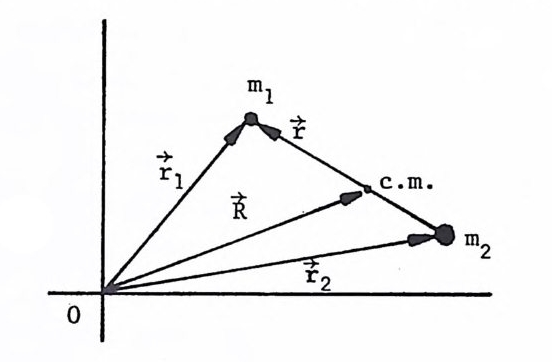 ml
ml
Fig 2-2: Coordi n at e s of m 1 and m2 in some in erti al fr ame. We may rewrit e t h e eq u at ions of mot ion as +r 1 = --ml1 G m1드 2r ^r and +2 r = + 一딴l G mr21 ~ r.
니 냐 The subt r acti on of r2 from r1 wi th a n intr oduct ion of th e reduced mass mr 三 (1/ ~1 + 1/m2? ) -1• give s th e eq u at ion of relat ive mot ion: mr +r•• = -G mr_ -21.m 2 r. We have th us simp lified th e pr oblem of tw o bodies to th at of singl e body , The mot ion of th e body one with resp e ct to th e body 如 o, i.e. r기 = r기( t) , is eq u iv alent to th e mot ion of mass mr_ around a fixe· d m-as-s- m -2_ . Here we should pay a spe ci a l at ten t ion to th e fa ct th at th e fo rce is not simply - G m2A mr_ lr2 but -G m1,m 2, .,/r2. However, th e di ffere nce bet ween th ese tw o fo rces appr oaches zero when th e rat io m 1_ /m_2 becomes small, sin ce th e act u al amount of th e reduced mass is domi n at ed by th e smaller comp o nent of th e two , as can be seen from mr_ ' m1, (1 - m1, /m,.2, ) . A comment on Kepl er's laws may be in order. From th e eq u at ion of relat ive mot ion we know th at th e accelerat ion, :r!: =- (, -.µ. /,_r2L )r, is now give n by 니r.. =G(m1- + m-2) r. r2 Hence th e const a nt µ used in th e last sect ion to deduce New t·o n 's gr avi - tat ion law should be eq u al to G(m1, +• m-2n ). In a strict sense µ is not a const a nt in th e solar sy s te m, because m1 is di ffere nt from pl anet to pl anet s . The sum m_l + m2_ , however; is almost nearly const a nt , sin ce ml th e mass of pl anet is comp l et e ly neg ligib'le to m,2., th e mass of th e sun for any pla net s : µ = G(m1 + m2 ) ' G m_0 . It is iro nica l th at th e dis covery of th e law of gr avit at i on migh t have been delay e d if Tyc ho's observat ions had been much more accurat e th an th ey were.
ii) Ang u lar Moment u m Conservat ion Rererrin g th e po si tions -r► ,l and +r ~2 of . th e tw o bodi e s to +R as th e· orig in, we may writ e +oJ u =t tmh1 e구 t1r o xt a +.rl l +angm u 2l a+rr 2 mxomr+.e n=2 t umr +x 니J ••m of r tr+h. e sy s t em as Sfoi nr ccee t(•ht• ei /;tA )o r, qu 1 e dmdut s-Jt- t =b e莊 dc o n(,+sr t xa nmt rr d+ru )r ibn egc otmh ee s oarlbwi taya sl mzeotr oi onfo ir n tmh eag nc ie tnut rd ae l and di r ect ion as well: The orbi tal pla ne form ed by +r and 4r remai n s in a same pl ane whi c h is pe rpe ndi c ular to th e di r ect ion of 니J .
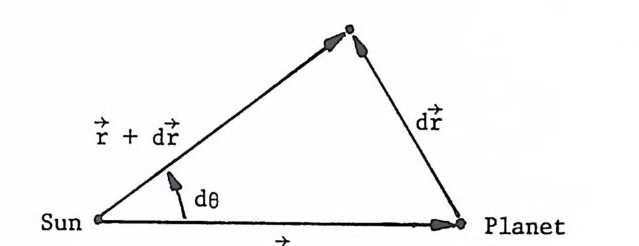 Sun +r Planet
Fi g 2- 3: An areal element fo rmed by a pl anet. Usi n g th e po lar coordi n at e s as a natu ral choi c e fo r such a pla nar polrab ni teat li mn oat isohno, rwt e twimrie t ei n at e vrvecatlo dr t elaesm seinm t p dl어A y노 doAf =t h 2e ar rexa dfro, rmwehde rbey a T 1+ .+ d+r = r우 dt . Conseq u ent ly th e vect o r areal velocit y becomes d+dtA ___ l_2+ r x .+r-- l_2+ J/ mr --- 17t~ and it must be conserved durin g th e orbi tal mot ion . The areal const a nt h, whi c h was in t r oduced in sect ion 2.2.1, has its v ecto r count e rp a rt 냐h and it has di m ensi o ns of ang u lar moment u m pe r uni t mass.
iii) Solut ion to th e Eq u at ion of Relat ive Mot ion We now fo rm a vect o r pr oduct fr om -r► and ➔h to obt a i n a ge neral solut ion to th e eq u at i7ho nx o+.rf. =re -la -r:t)SJ2 i ;- v e(, ➔ r m xo. t ?r.i:)o, n-x: - :r . Problem 2-4: Use a vecto r id ent ity 구A· x (니Bx구C ) = 니B(구A•기C ) -니C(구A•니B) to verif y th e relati on r -2L (,r!x 우r) x r^ = ~dd t ( r+ /r) . The result of th i s pr oblem enables us to rewrit e t h e vect o r pr oduct as a si m p lified form +h xr쑤= -'-µ—d dt - r^ . Up o n an in t e g r ati on we have +h x 우r = -µ r^ - +C , where +C is th e vect o r const a nt of in t e g r ati on. The const a nt +C should li e in th e orbi tal pl ane and is charact e riz ed by an in i tial condi tion of th e give n mot ion . Not ing 1+ -(.h +x우;) = 우 (+?x우1 ) = -h2 , one fina lly ge t s an in t e rest ing relati on fo r th e relati ve orbi t h2 = µr + 니r•니C . Solvin g now fo r I' we obt a i n a ge neral solut ion to th e eq u at ion of mot ion r = h2/µ 1 + e cos (0 -0 0_ ) • Here e is a consta nt eq u al to C/µ.
Thi s is a ge neral eq u at ion fo r th e coni c sect ion wi th a fo cus at th e orig in locat e d at body !112 , wi th a semi - latu s rectu m h2/µ, with eccent r i c it y e , and a maj or axi s th at makes an ang l e e。 _ wi th t h e axi s B=O . Peric ent e r is give n by 0=0 。, and th e pe ric ent e r di s t a nce by (h2/µ)(l+ e )-l. If we let a be th e semi - maj or axi s of th e coni c , we may exp r ess th e pe ric ent e r di s t a nce by a ge neral relat ion a(l-e) . Hence, ge omet r i c al pr op e rti es a and e of th e orbi t are relate d to its p h y s i c al pr op e rti es µ and h: I ―硏 = µa(1 - 리 The eq u at ion of orbi t can now be rewrit ten in alte rnat ive fo rm fa mi liar to us: r = a(l - e2) 1 + e cos u The ang l e u in t r oduced to repl ace 6-6_。 is called th e tr ue anomaly, whi c h is a po lar ang l e of th e body measured fro m th e pe ric ent e r along th e di r ect ion of orbi ting mot ion. The eccent r i c it y e can now exceed unit y: For ellip s e e has values betw een zero and unit y and th e sem i-m aj or axis a is alway s po si tive. If th e eccent r i c it y is unit y, th e coni c becomes a pa rabola wi th a n in f ini t e s emi - maj o r axi s and th e semi - latu s rectu m a( l-e 2) = 2q where q is ·th e pe ric ent e r di s t a nce. Fi n ally, if th e eccent r i c i ty exceeds th e unit y th en th e sem i-m aj o r axi s becomes nega t ive, and th e coni c assumes a hy pe rbola. Ci r cles, of course, have zero eccent r i c it y. iv ) Tot a l Energy Conservat ion Si n ce 우r.우 r = r• and 4r:.. ;r. = fdt (lj 우r•+ r ) , a scalar pr oduct of 우r to 노r yield s 읊(§냐)=옮탑
fr om whi c h one obt a i n s an im p o rta nt energy relat ion: i2 균• -브 r = canst . 三 e: , where +v=우i: is th e velocit y of mass po i n t rn1 in a non-rot a t ing sy s t e m of coordi n at e axes whose orig in moves wi th t h e ot h er comp o nent m2 of th e tw o-body sy s t e m. Problem 2-4: Show th at th e to t a l ki n et ic e nergy associ a t e d wi th t h e orbi tal mot ions of m1. and m2 is give n by ~12 mr_ v 2 The const a nt of in t e g r at ion e: is th e sum of ki n et ic a nd po t e nt ial energ ies of th e sy s t e m di v i d ed by th e reduced mass. We may evaluate e: in te rms of orbit al charact e ris t ics by maki n g use of a sp e ci a l pr op e rty th e pe ric ent e r has in th e orbi t , namely , th e velocit y +v (=-r ) becomes always pe r pe ndi c ular to th e radi a l vect o r 나r at th e pe ric ent e r . We th us have, at th e pe ric ent e r, h = Jh l = 1-; x 히 = rv = a( 1 - e)v, whi c h elim ina t e s r and V fr om th e energy eq u at ion. Now, subst itut ion of µa (l-e2 ) for h2 in th e relati on fina lly give s e: = --2;µ;a- - ' and yield s th e vi s -viv a eq u at ion .2! .•균 -브r = --:2!!a- .
Problem 2-5: Si n ce !' is alway s eq u al to a fo r ci r cular orbi ts, th e vi s - vi v a eq u at ion give s vc:,l. _r = G(rn,1 + rn2, .)/r. Thus th e rot a t iona l veloc ity of Kep l eria n mot ion is in versely pr op o rt ion al to th e sq u are root of · t he di s t a nce fro m th e cent e r; whi le th at of sol id-bo dy rot a t ion is di r ect l y pr op o rti on al to th e di s t a nce. Ap pr oxi m at e th e observed rot at ion curve of our Galaxy to a Kep l eria n pl us sol id-b ody rot a t ion, and di s cuss im- plica t ions of such a comp o si te m odel to th e mass di s t r i b ut ion in th e Galaxy . Problem 2-6: The escap e velocit y, v e__s_c , at a give n !' is th e velocit y th at causes e: to vani s h th ere. From th e vi s -viv a eq u at ion we have v2e sc = 2G (m1 + m2 ) /r = 2V2c l.. r . It is conveni e nt to remember the escap e velocit y fro m the solar sy s t e m in the fo llowi n g form : vesc = 42 Km/sec [모 무 ] h where m = m1, + m2f t . Si m iv elascr ly = w3e5 0h- aKv me/ sec [: 프톤] h where m,G... is mass of the Galax y wi thi n !'. Verif y th e numeri c al values 42 Km/sec and 350 Km/sec . The vi s -viv a eq u at ion, a st a t e ment of energy conservat ion, has a gr eat pr act ica l impo rta nce. The si gn of e: det e rmi n es th e ge neral charact e r of th e orbi t: If e: is neg a t ive, th en, si n ce v2 can not be neg a t ive, r must be bounded and th e orbi t is an ellip s e or ci r cle. If e: is po si tive, r can ap pr oach in f ini t y witho ut causi n g v to vani s h, so th e orbi t is a hy pe rbola. Wi th z ero e: V ap pr oaches zero as r becomes in f inite, th us th e orbi t is a pa rabola. In Table 2-1 we have summari z ed ch11 :r act e ris t ics of coni c sect ions in te rms of eccent r i c i ty e , energy e: and sem i-m aj or axi s a •
Problem 2-7 : Show th at e: = -h2/2a2 . (1 -e2 ) ~1 and th at e: = (e2 -1) 군 / 2h2 Table 2-1 : Prop e rti es of Coni c Secti on s Coni c s Eccent r i c it y Energ y Remarks ci r cle e = 0 e: < 0 r = const a nt = a ellip s e O
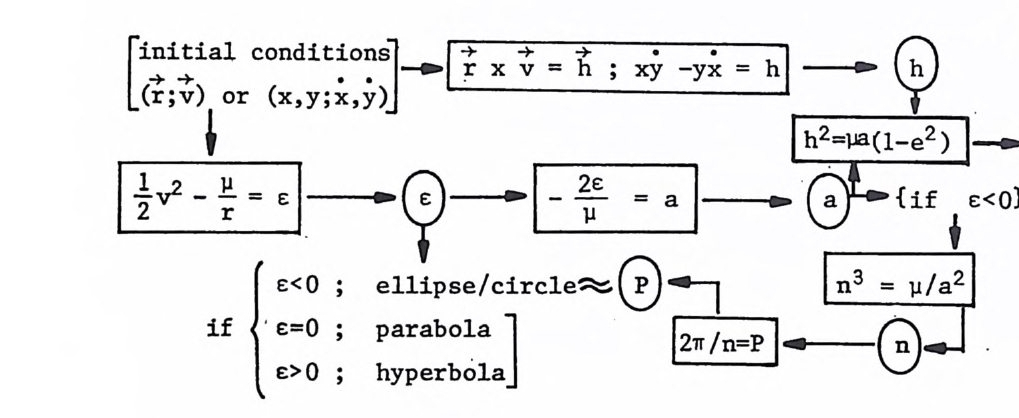 已[(만r;vi-) a1o r c?o(nxd, yit ; -x:0,기 y) ---二巴三〕 ;一孛三: 一e Q: : 0
Problem 2-8: The eq u at ion of relati ve mot ion is a vect o r di ffere nt ial eq u at ion of second order ; si x const a nt s of in t e g r ati on are necessa ry fo r its s olut ion. However, we used only fo ur exp l i c i t condi tions , namely, x,y, x and y. What are th e tw o hi d den condi tions ? Problem 2-9: One can det e rmi n e a comp l ete orbi t by numeric ally in t e g r ati ng th e eq u at ion· o f mot ion fro m th e give n in i tial condi tions . Choose arbi- tr ary in i tial conf igu rat ions of yo ur own, th en pr oceed th e orbi tal calcu- lati on. Di s cuss whet h er yo ur numeric al results are consi s t e nt wi th t he ge neral consid erat ions give n in th i s sect ion. Conf e r sect ion 9-:--7 in Fey n man ' s lectu re . Problem 2-10: Rig h t af ter launchi n g , an arti fici a l sate llit e i s movi n g pa rallel to th e earth 's fu rfa ce at a heig h t of 500 Km, wi th a velocit y relati ve to non-rot a t ing ge ocent r i c axes of 7.9200 Km/sec. Fi n d the ge ocent r i c di s t a nce of th e ap o cent e r (ap o g e e) and th e pe rio d. Do th e same fo r th e case of in i tial ge ocent r i c velocit y 7.9210 Km/sec. Problem 2-11: An arti fici a l pl anet is launched fo rward along the earth 's orbi t wi th a n in i tial ge ocent r i c velocit y at th e earth 's surfa ce of 11.50 Km/sec. Assume th e earth 's orbi t be ci r cular and ign ore the lunar at - tr act ion. Det e rmi n e a, e and p for th e pl anet. Now, it is desir ed to allow ap pr oxim at e ly fo r a close pa ssag e of th e pl anet pa st th e moon. The encount e r is such th at if th e moon were wi thou t mass, the pl anet would miss th e moon's cent e r by one earth radi u s. How can th e allowance be made ? 2 . 2 . 3 Ti m e-Dep e ndent Po.s i tions in th e Orbi t i) Elli ptic M ot ion For ellip tic o rbit s, po sit ion of th e body at a give n time is det e r- mi n ed by knowi n g th e val~e of tr ue anomaly at th e moment . For such a time- dep e ndent po si tion we need to in t r oduce th e eccent r i c anomaly E and mean anonaly M as in t e rmedi a t e st e p s .
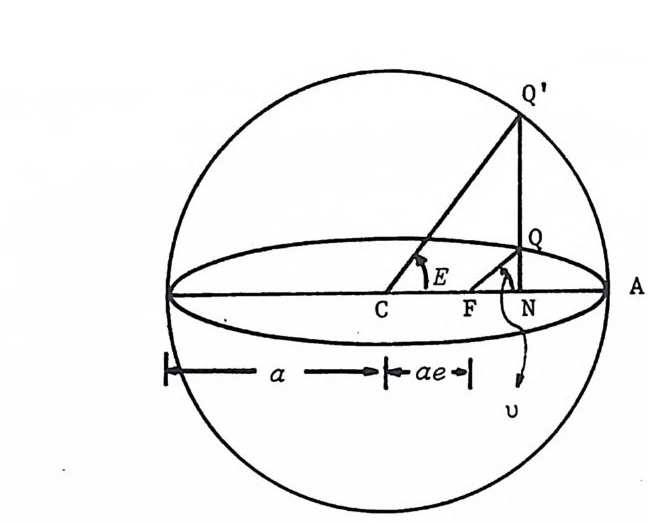 A
A
Fi g 2-4: Ellip s e, auxi l i a ry ci r cle, tr ue and eccent r i c anomalie s. In Fig 2-4 we have drawn an ellip tic orbi t of semi - majo r axi s a and eccent r ic ity e with a fo cus at F and th e cent e r at C . The ci r cle called . as th e au:ci따ry ci r cle is th e tr ace of po i n t Q ' sat isf y ing NQ =NQ ' (1- e2 )뉴 f_o r _an y po i n t Q on th e ellip s e wi th N bein g th e fo ot of th e pe rpe ndi c ular th rough Q up o n th e maj o r-a xi s of th e ellip s e. We call th e ang l e • and sim ila rly cos \) = 쁘r •= aa ( 1c o-s Ee -co as e E) -= 1c ~os E -e • from whi c h it fo llows, by tr ig on omet r y , ta n 뭉 = [~: :] 선 내근] 뉴 [} ; ::나] 뉴 Thus th e tr ue anomaly is relate d to th e eccent r i c anomaly by ta n 물 = [는] ½ • ta n 흥 with 2U and 2E ly ing alway s in th e same qu adrant . If we let T be th e time of pe ric ent e r pa ssage and t ·th e time at whi c h we want th e po sit ion of one body relat ive to th e ot h er, th en, (t-T ) /P is th e frac t ion of th e ellip s e I s area swep t by th e radi a l vect o r si n ce th e pe ric ent e r pa ssage . Thi s frac t ion is eq u al to n(t- T)/2,r , where n is th e mean mot ion. The ang l e th e body would cover if it moved wi th t h e mean mot ion n M = n(t- T) is called th e mean anomaly . On- t h e ot h er hand th e frac ti on of ellip tic areai s th e same as th e area M QI di v i d ed by th at of th e ci r cle. Thus we have 2M,r = 뇽 Ea2 - 글11a 2 si n E) where we obt a i n IM = E -e si n E whi c h is known as Kep l er's eq u at ion. The fo llowi n g flo w-chart summari z es how one can obt a i n a comp l et e solut ion of th1 e & pmr o_ blI e—m of 一ellip t住ic ·m o t i=o nG f(mri o m mma 긴ss es, a, e and T: lm l a e T E -----1 t a n 뭉 = 鬪 2 ] < __ |r(t) = 1 +a ( el -co es 2u) (t) Problem 2-12 : From th e eq u at ion of ellip tic orbi t_y o u may show i-= eh/a ( l-e2 ) • si n \) = n.ae si n E/(1-e cos E) . Now di ffere nt iat e r = a(l-e cos E) and obt a i n r = ae si n E•E. Eq u at e th ese tw o result and deriv e Kep l er's eq u at ion as
~dM = (·1- - e cos E..) 五dE · ii) Parabol ic M ot ion For a pa rabolic orbi t E=O , e= l and h2=2µq , and th e eq u at ion of coni c is si m p l i fied to r=2q / (l+c os u) . Li k e th e eccent r i c anomaly for ellip tic case, an in t r oduct ion of a new varia ble z fo r u Z 三 ta n -12::- u chang e s th e pa rabol ic e q u ati on in t o r = q(l + z2) . Alth oug h Kep l er's eq u at ion is not ap plica ble for . th e pa rabolic orbi t, th e ang u lar moment u m conservat ion r2 du/dt = h st ill hoi ds . We th us have dt = 룬 d\) = 운 (1 + Z 겁 2dz (1 + z ) Usi n g µ in st e ad of h, we find t vs z relati on [십 ½ (t - T) = z + ½균 , whi c h is analog o us to Kep l er's eq ua ti on fo r th e ellip s e. iii) Hy pe rbol ic M ot ion As fo r th e pa rabolic case we in t r oduce a new varia ble F def ined by ta n 붕 = [드] ½ ta nh f ,
th en th e eq u at ion of hy pe rbola becomes r = -a(e cosh F - 1). We now emp l oy th e conservat ion of ang u lar moment u m to obt a i n [- ~J -선:i (t - T) = e si n h F - F, whi c h correspo nds to Kep l er's eq u at ion fo r th e ellip s e. Problem 2-13 : One body moves wi th r espe ct to th e ot h er in a hy pe rbolic orbi t wi th a relati ve velocit y V at in f ini t y . The im p a ct pa ramet e r is p, pe ric ent r i c di s t a nce·q and the ang l e betw een tw o asym ptot e s of th e mot ion is e - sca tter i河 a 땅 Ze. Show th at fo r such a mot ion fo llowi n g relati ons hold: cosec 2° = (1 + qvL2 /µ) , si n 2 흥 = (1 + p로/균 )-1, and q = (p2 + µ2/v ~ - µ/v 언 2.2.4 Some Ap plica t ions of Kep l eria n Mot ion i) Close Bi n ary Sy s t e m Underg o i n g Mass Exchang e Due to th e st r ong mass dep e ndence of st e llar evolut ion th e massiv e comp o nent of a close bi n ary sy s t e m of ten fills its crit ical eq uipo t e nti al 印다 ’ace , so called Roche lobes, ~ th e less-mass comp a ni o n does . Up o n filling th e lobe th e pr i m ary is li k ely to fe ed its o wn mass in t o th e comp a n ion . We shall exami n e what conseq u ences result to th e evolut iona ry develop m ent of th e sy s t e m fr om such a mass exchang e betw een two comp o nent s .
-68 -
Si n ce model based on Roche eq u ip o t e nt ial surfa ce have pl aye d im p o rta nt roles in underst a ndi n g in t e ract ing bi n ary sy s t e ms, here, we sp e nd a lf rtle time on th e Roche model . Let us consi d er a rect a ng u lar coordi n at e sy s t e m th at has its a xi s at th e cent e r of masses m1 and m2, th e X-axi s along th e li n e jo i n i n g th em, and th e Z-axi s along th e rot a t ion axi s pe rpe ndi c ular to th e orbi tal pl ane. Bot h st a rs are in rest in th i s rot a t ing fram e, and th ere are th ree accelerat ions are worki n g at each po i n t (x,y , z): tw o are gr avit at i on al, and th e remai n i n g is cent r i fug a l . We th us wri te t h e po t e nt ial 4> (x,y , z) as
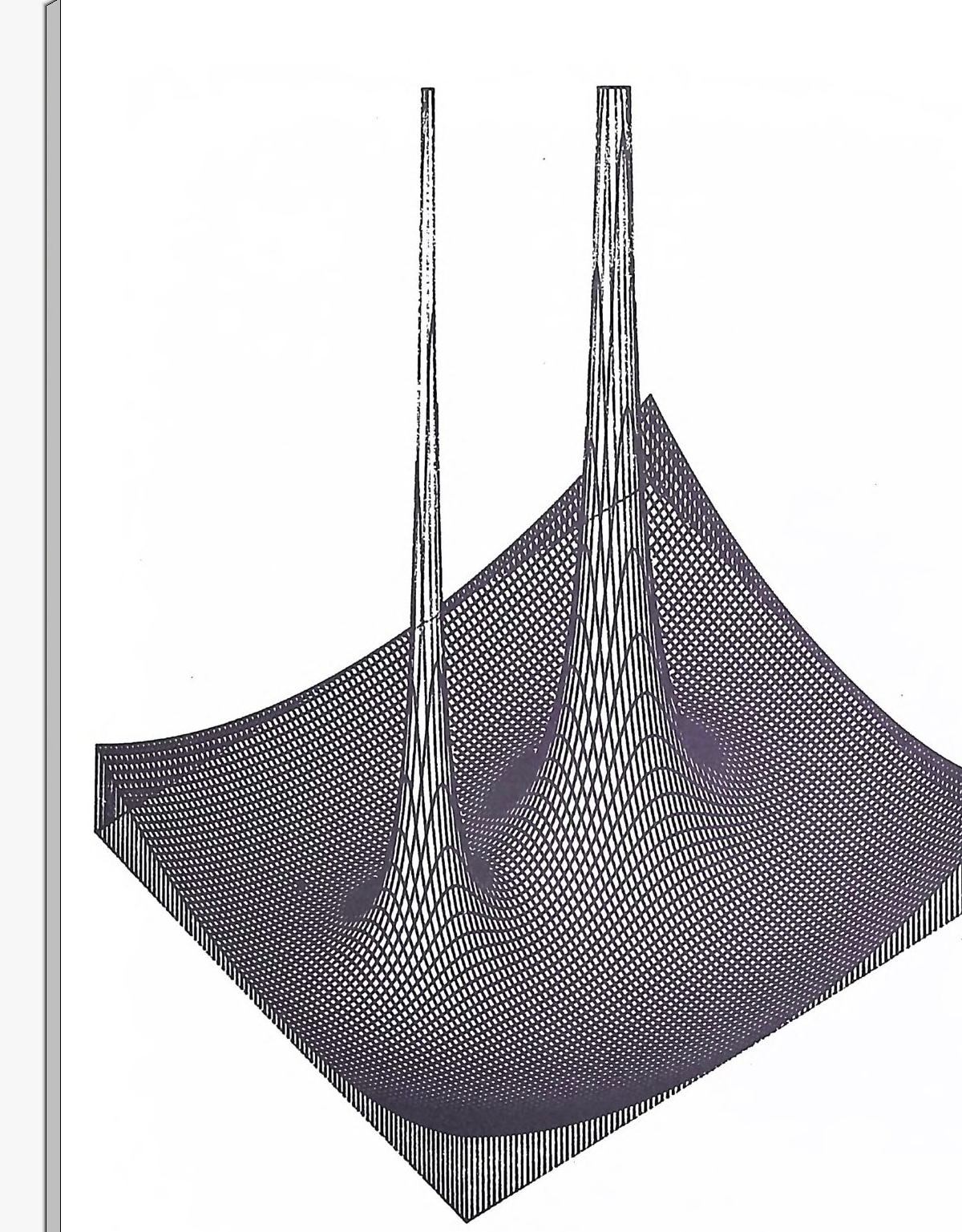 ,이. ,• '권 .•
mFiag ss 2r-a5tai: o qT h=r 3e/e1-d0.i m enTshi eo nhaeli g vhi te w reopf r etsh een tps o t -e ~n(tx ia,yl , zf;i eld fo r
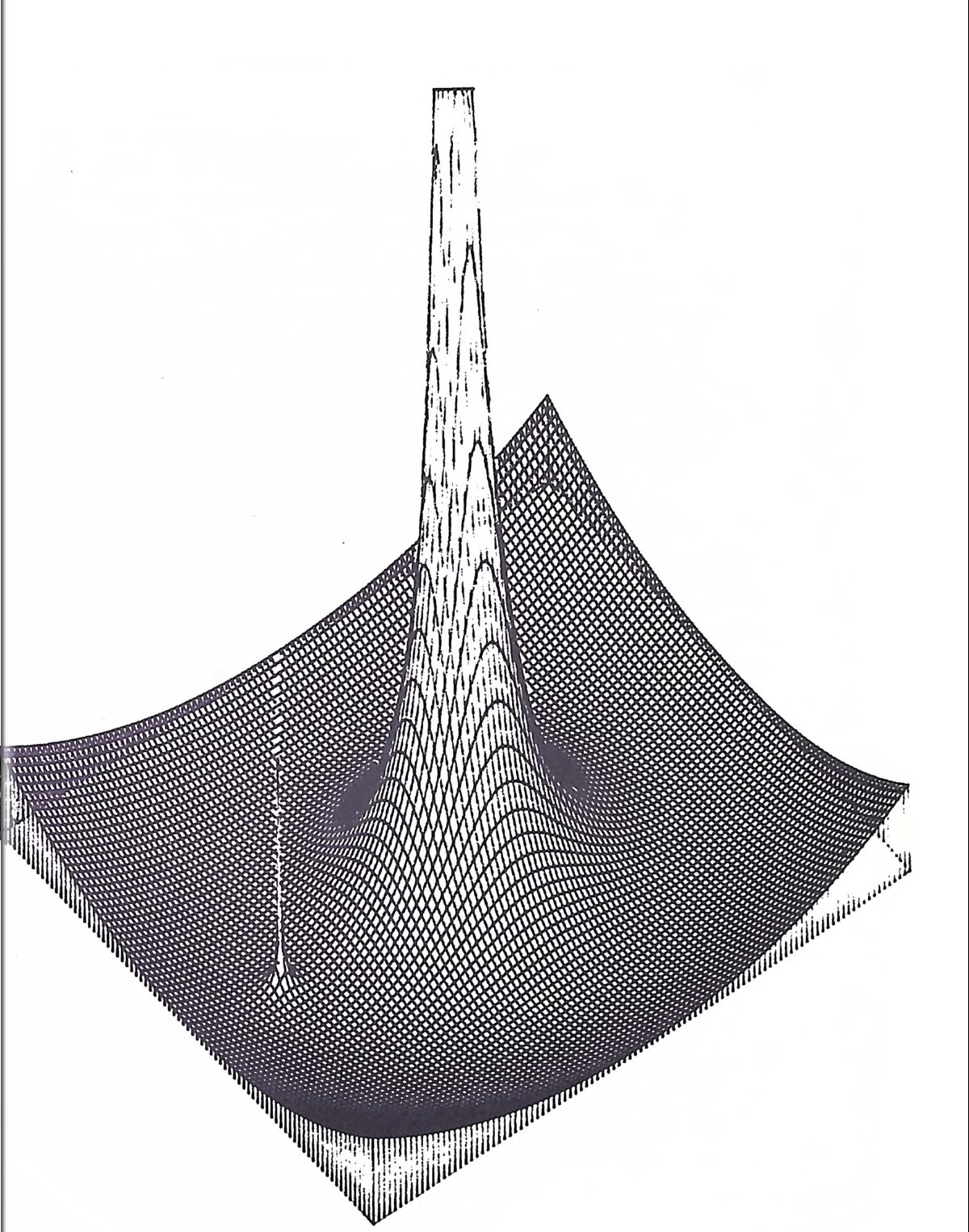 I I ’ ·I I `‘‘ ‘ I
Fi g 2-5b : same as in Fif !,ur e 2-5a' excep t fo r q = 11100 •
ci r cular orbi t alway s mai n t a i n i n g a fixed orie nt a t ion relati ve to m1 and m2~ , th at is , th e pa rti cle wi l l remai n relat ivel y at rest. However, small pe rtu rbat ions make th e mot ion devi a t e s rap idl y fro m th e pe rio di c mot ion in th e cases of L1, , L,2, and L3~ · These may be barely underst o od fr om th e shap e of po t e nt ial field shown in Fig ur es 2-5a and 2-5b . In cases of L4 and L5, th e mot ion never dep a rts much fro m th e pe rio di c one under a li m i ted rang e in mass rat io, namely, th e massi v e comp o nent should occup y more th an 96% of th e to t a l mass. Problem 2-14: Deriv e th e condi tion, (1-q ) < 0.0385, on th e mass rat io o f the massi v e comp o nent in order fo r th e mot ion of an in f ini t esi m al body at eit he r L4 or L5 to be st a ble. Conf e r Meahani a s by Sy mo n. Low po t e nt ial surfa ces fo rm common envelop e s around th e tw o comp o nent s ; whi l e hig h po t e nt ial surfa ces in cludi n g th e st e llar surfa ces th emselves surround each comp o nent sep a rate ly. In th e mi d dle somewhere bet w een th est tw o ext r emes th ere is a crit ical po t e nt ial surfa ce whi c h pa sses th roug h th e Lag r ang ian po i n t L, . Thi s crit ical surfa ce, known as Roche lobes surrounds, ·m axi m um volume in sid e whi c h an element of mass can st ill be relate d uneq u i v ocally to one of th e tw o comp o nent s . What belong s to whi c h is clear in si d e th e hig h po t e nt ial surfa ces, but fr om th e crit ical surfa ce on out w ard a clear verdi c t can not be give n to di s p u t e s over th e ownership . Furth ermore, shap e of th e po t e nt ial saddle at L_ in di c ate s a slig h t pu sh li k ely to pu t a pa rti cle th ere in t o th e op po sit e t e rrit ory . To certa i n close bi n ary sy s t e ms it hap pe ns th at an enormous exp a nsf on of th e out e r envelop e of pr i m ary comp o nent fills one of th e Roche lobes comp l ete ly and fu rth er exp a nsi o n accomp a ni e s a cont inuo us chang e in th e mass rati o q, An in t e rest ing po i n t here is th at chang e s in q demand th ei r shares on th e orbi tal conf igu rat ion; th e di s t a nce bet w een comp on ent s varie s so do th e si z es of Roche lobes. A commence of mass exchang e can th us accelerate or decelerate fu rth er developm ent s of th e orbi tal evolut ion dep e ndi n g up o n th e in i tial confi gu rat ions in masses and th ei r sepa rati on.
Problem 2-15: Int e rpr et th e st a t e ment th at radi a t ion pr essure may be consid ered as neg a t ive gr avi tat i on. Gi v e qu alit at i ve di s cussio ns on th e ef fec ts of radi a t ion pr essure up o n the st r uct u re of Roche lobes. (cf. Schuerman 1972) Let us now consi d er th e dep e ndence of sepa rat ion on mass rati o: To si m p l if y th e pr .o b lem we may assume conservati on s of to t a l mass and th e orbi tal ang u lar moment u m durin g th e pr ocess of mass exchang e . In close bi n ary sy s t e ms th e rot a t iona l ang u lar moment u m is . us ually neg l ig ibl e to th e orbi tal ang u lar moment u m, si n ce th e tidal in t e racti on sy n chroni z es th e orbi tal revoluti on wi th r ot a t ion in such sy s t e ms. Then, th e to t a l ang u lar moment u m, mr_ a2w, of th e sy s t e m becomes, in te rms of th e mass rat io q , J = q( l - q)M a2w. Wi th a n ai d of th e Kep l er's th i r d law we may elim i n ate th e consta nt ang u lar velocit y w (ci r cular mot ion assumed) in fa vour of a; th e di s t a nce bet w een th e tw o comp o nent is give n by a = GJM2 3 q2 (1 l _ q)2 The sepa rat ion becomes mi n i m um when th e tw o comp o nent s are id ent ical in mass. Such chang e s in th e sepa rat ion wi l l brin g us many po ssib i lities in th e evolut iona ry develop m ent s of close bi n ary sy s t e ms: For some cases cont inuo us mass tr ansfe r from th e pr i m ary will event u ally make th e orig ina l pr i m ary become secondary and accelerate th e evolut iona ry pa ce of th e orig i- nal secondary. For ot h er cases rap id in crease in th e sepa rat ion resulte d fro m a small tr ansfe r in mass accomp a ni e s enormous expa nsi o n of th e Roche lobe and event u ally st o p s fu rth er mass tr ansfe r in th e sy s t e m. In addit ion one can th in k of cases where bot h Roche lobes are filled ; th en, one has to drop th e condit ion of to t a l mass conservat ion and th e sy s t e m becoi ne s nonconservat ive not only in mass but also in an gu lar moment u m, si n ce th e mass leavin g th e sy s t e m undoubt e dly carrie s an gu lar moment u m with it.
Problem 2-16: Deriv e th e rat e of in crease/decrease in a pe r uni t mass- exchang e , namely, give da/dm in te rms of q, where dm is th e amount of mass giv.en to the less massi v e comp o nent by th e massi v e comp o nent . Problem 2-17: Accordi n g to comp u t a t ions of tr aj e ct o rie s fo r pa rti cle s e j e :::댜 d fro m th e second Lag r ang ian po i n t (Naria i 1975; Flannery and Ulric h 1977), when th e ang u lar moment u m carrie d away wi th a uni t mass of mat ter is denot e d by Aa2w, th e value of A is about 1.7 ir resp e ct ive of the mass rat io o f th e bi n ar y sy s t e m. Assume th e pr i m ar y mass, m,1 , is decreasi n g by mass loss pr ocess whi l e th e secondary , rn2~ , st a y s const a nt . Solve the di ffere nt ial eq u at ion fo r th e ang u lar moment u m —dmd 1. (,r .n.. r wa2 ) = Awa2 to obt a i n a(t) = a(t= O) , ~rn1 (t) + rn2 • r[rn1言 (t])1 2•A• -2. exp [r -2rn1 (A0) -m rn1 (~t) Di s cuss im p l i c at ions of th i s result up o n an event u al fa t e of th e sep a rat ion bet w een tw o comp o nent s . Problem 2-18: For th e close bi n ar y sy s t e m SV Cent a uri, th e rat e of pe rio d chang e is measured to be dP/dt = -9.4 x 10- 8~ (Irwi n and Landolt, 1972) . Show th at the req u i r ed mass tr ansf e r rat e fo r th e pe rio d decr_ea se is dm/dt = -4 x 10- t+• m。j yr . Problem 2-19: Of ten one observes in the HR di a g r ams of _ g l obular clust e rs in d ivi d ual st a rs on the mai n seq u~ nce above th e tu rn-of f po i n t . These st a rs are called blue st r a ggl ers. Devi s e yo ur own exp l anat ions fo r exi s t e nce of blue st r ag gl ers on th e basi s of close-bi n ar y evolut ion.
ii) Bi n ary Orig in of Runaway St a rs: Slin g - :Shot Model Blaauw (19 61) sug ge ste d th at many hig h -velocit y st a rs were pr evi o us members of bi n ary sy s t em in whi c h th e ot h er comp o nent s exp l oded as sup e rnovae . These runaway st a rs have fo llow ing pr op e rti es : (1 ) They are usually OB st a rs havi n g sp a ce_ veloc ity in th e rang e from 50 Km/sec to 100 Km/sec. (2) They do not comp r i s e ta i l of a smoot h veloc ity di s t r i - but ion curve; st a t e d ot h erw ise , velocit y di s t r i b ut ion of OB st a rs is bi m odal. (3) They are usually movi n g away fro m yo ung assoc iat ions of massi v e st a rs. (4) They occur at least five times less fr equ ent l y in bi n ary sy s t e ms th an ordi n ary (low velocit y) OB st a rs. Can such hig h velocit ies be po ssib ly resul ted from bi n ary di s rup tion ? Answer is it may be po ssib le: Let us deriv e th e condi tion on th e ej e cte d amount of mass in order fo r th e bi n ary sy s t em to di s rup t. Ag a i n assumi n g a ci r cular orbi t, we may writ e t h e orbi tal velocit y of each comp o nent around th e cent e r of mass as V1. = m2 { (m1 +Gm2)a }\ and v 2 = m1 { (ml +G 딴 )a } 뉴 The. m ass loss fro m an ex pl odi n g st a r, let' s say m1, can be consi d ered to ta ke pl ace in sta nt a neously and is ot r op ica lly. And we let qm 1 be th e remnant mass and ( 1-q) m ,1 be th e ej ecte d mass . Abrup t ex pl osio n results cont inuo us chang e in velocit y but di s cont inuo us chang e in energy . The ki n et ic e nergy im medi a t e ly af ter th e exp l osio n is give n by K = 21 qm lv2l +. 21 m2v22 in th e orig ina l cent e r of mass sy s t e m, si n ce th e velocit y chang e s cont inu- ously. Si m i larly th e po t e nt ial energy is give n by
Gmm n = -q a 1 2 Conseq u ent l y th e to t a l energ y becomes Et =K+n=2G-a m m1 l +m m2 2 {m1 (l-2q )-qm 2 } in th e orig ina l cent e r of mass 、s y s t em. However, af ter th e exp l osi o n, th e to t a l moment u m in th e orig ina l cent e r of mass fra me is no long e r zero and it has moment um of mag n i tude IPI : 1 비 = m2V2 - qm lV1 • We have to subt r act th e energ y, Ep. .. = ¾2 균 /(m2 + qm 1), assoc iat e d wi th t h e mot ion of th e cent e r of mass fr ame, fro m th e to t a l energ y E~t in order to ge t th e to t a l energ y in th e new cent e r of mass fra me, Et --Ep = —2Ga ~ qml lm2 2 {m1 - m2 -2q m 1 } , whose sig n det e rm ine s whet h er th e sy s t e m remai n s .af ter th e exp l osi o n bound or di s rup ted . The sup e rnova exp l osi o n wi l l, th us, di s rup t th e bi n ary sy s t e m, if |m 1 - m2 > 2q m r | Problem 2-20: Est ima t e charact e ris t ic m ag n i tude of the ej e ct ion velocit y of runaway st a rs accordi n g to th e bi n ar y-s up e rnova model. What are th e li mits on orig ina l sep a rat ions and masses of sup e rnova pr og e ni tors fo r th ~ bi n a ry-s up e rnova model to be val id? Lat e r in 1972 van den Heuvel and Hei s e ref ined th e bi n ary- sup e rnova model for th e orig in of runaway s . They in cluded in th ei r analys i s th e ef fec t s of kic k vela 다ti es, whi c h are in duced fro m asym me t r i c exp l osi o n of sup e rnova.
Problem 2-21 : Read van den Heuvel and Hei s e (1972) and analyz e a serie s of recent observat ions by St, on e (1981; 1979; 1978) as he di d in hi s most recent pa p e r (St o ne, 1982). iii) At m osp h eric Drag on Sat e llit es Art ifici a l sate llit es are to exp e rie nce th e earth at m osp h eric drag , th us, th e to t a l orbi tal energ y di s sip a t e s slowly. Such an energy decrease im p l i e s a reduct ion in th e semi - maj o r axi s , a, of th e orbi t, si n ce th e to t a l energy is -G m®_ m/2a. However, th e sate llit e s p e eds up as it loses its a lit ude , because th e ki n et ic e nergy , + G m웅_ m/2a, in creases as a decreases. Unfo r t u nat e ly th i s is exact l y what happ e ned to th e Sk ij lab in 1979 sunnner. However th e at m osp h eric drag can be usefu l fo r det e rmi n i n g densit y di s t r i b ut ion in th e earth at m osp h ere at gr eat heig h t s . By maki n g use of di ffere nt sat_e l lit es wi th d i ffere nt pe rig e es , or a sate llit e w hose orbi t is cont inuo usly chang ing so th at th e pe rig e e moves fro m pl ace to pl ace, it is po ssi b le to pr obe th e at m osp h eric densit y at di ffere nt times and pl aces. From such st u di e s it is known th at th e ext e nt of at m osp h ere is closely relate d to th e solar act ivi t y. iv ) Vi r i a l Theorem For ci r cular orbi ts t h e fo rce relati on -m-1_ •v 2' /-r = G- m--1,m-2~ /r2 alway s holds, so does th e energy relati on .-. K = - 21 n. Thus th e vi r i a l th eorem is sat isf i ed at every moment fo r bodi e s in a circ ular mot ion. For ellip tic orbi ts t h e vi r i a l th eorem holds in time averag e d sense. Problem 2-22: Show tha t
V) Dy n ami c al Parallax The harmoni c law P2 = 4TI2/G(m 1 +m 2 ),a3 can be used fo r det e rmi n at ion of di s t a nce to th e bi n ary sy s t e m if th e semi - maj o r axi s is known in uni ts of arc seconds. Of course we should have some id ea on th e to t a l mass of th e sy s t e m, whi c h may be obt a i n ed by sp e ct r oscop ic means. One advant a g e of th i s , so called, dy n ami c al pa rallax is only one th i r d of th e error in mass is tr ansfe rred to th e error in th e deriv ed di s t a nce. 2.3 DIFFERENTIAL GRAVITATION Because th e gr avi tat i on al fo rce varie s wi th d i s t a nce betw een in t e r- act ing bodi e s, di ffere nt pa rts of an ext e nded body exp e rie nce di ffere nt accelerati ons . Thi s di ffere nt ial nat u re of th e gr avit y has such in t e rest- in g conseq u ences as tides on th e earth , tidal evolut ion of pl anet - sate llit e sy s t e m, and tidal di s rup tion of celest ial bodi e s. 2.3.1 Ti d al Force, Fric t ion and Torqu e For si m p l i c it y we assume th at th e tide- rai s i n g body remai n s sp h eric al th roug h out th e di s cussio n. Let masses of th e tide- rais i n g and tide- rais ed bodi e s be m and M, respe ct ivel y. Taki n g po lar coordi n at e s (r,e) at th e cent e r of th e tide- rais ed body wi th 8=0 along th e li n e jo i n i n g th e tw o in t e ract ing bodi e s , as shown in Fig 2-6 , we writ e-d own th e po t e nt ial at (r,8) due to th e body m as fo llowi n g (a2 + r2 G-m 2ar cos 8)½ = -Gam + —Gam 2 r P l (cos 6) +G—am 3r 2 p2_ (cos 8) + ... , where a is th e sepa rat ion betw een cent e r of th e tw o bod_i e s and P_n (cos 6 ) are th e Leg e ndre po lyn o mi al s . The first te rm on th e rig h t is const a nt , hence give s ri s e to no fo rce on M. The second te rn : on th e ot h er hand, give s rise
to a uni form fo rce field , Gm/a2 .(;r cos e -e 9 si n 9) . Thi s is si m p l y th e mut u al gr avi tat i ona l at tra ct ion, th us can be neut r aliz ed if th e axes of refe rences are rot a t ing wi th a n accelerat ion Gm/a2. It is th e th i r d te rm th at ge nerate s tidal fo rce field give n by —2aG3m r cos S (·e^- ~r c-o--s e- -e^- e,, si n 9 ) . Si n ce our in t e rest li e s on th e earth surfa ce where r °' R, and R<
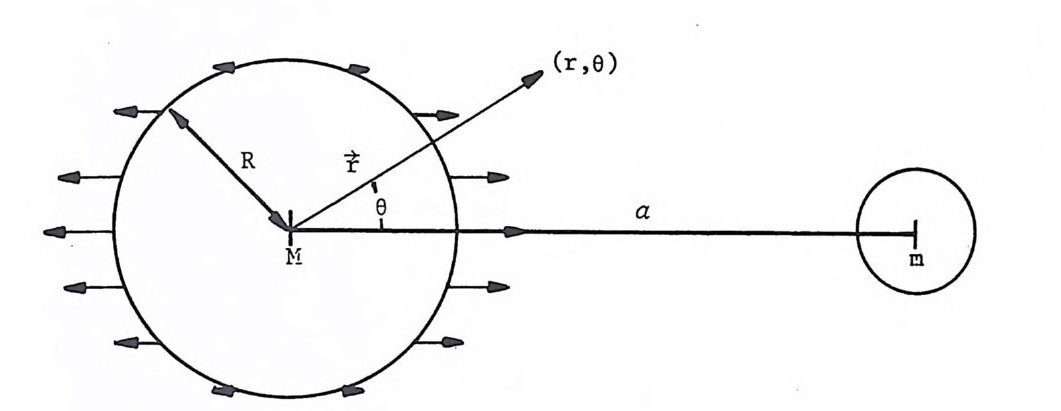 (r,e)
(r,e)
Fi g 2-6: Arrows in di c at e th e tida l accelerati on on th e surfa ce of body orbi ting around th e cent e r of masses M and m. The tw o eq u al tida l bulge s are rais ed by th e di ffere nt ial fo rce of th e tide -rai s i n g body 's gr avit y across (2R) th e tide- rai s ed body coup l ed wi th t h e cent r i fug a l accelerati on th at results fr om th e sy s t e m's orbi tal mot ion around its c ent e r of mass. When an elasti c b ody yield s to th e tidal for ce, energy is to be di s sip a t e d in th e fo rm of heat . For th e earth -moon sy s t e m most of th e di s sip a t ion occurs in shallow seas and shore-lin es where oceans and con ti n 탸t s are in cont a ct . In addi tion to th e sea wat e r th e earth crust expe rie nces tidal fo rce and yiel ds to rais e land-ti des , whi c h consume energy in th e
fo rm of heat, to o. Energy th us lost is to be sup pl i e d ul timat e ly fro m th e energy associ a t e d wi th e arth 's rot a t ion and moon's orbi tal mot ion. Due to th e elast icit y tl1 e wat e r and crust have, th e earth ta kes some time to respo nd to th e tidal fo rce rai s ed by th e moon. Durin g th e delay in respo nse th e earth rot a t e s around its a xi s more th an th e moon revolves around th e earth , th e tidal bulge s th us make some ph ase lag a( 러 。 ) wi th th e li n e connect ing cent e rs of th e moon and earth . Because of th i s mi s - ali gnm ent moon's di ffere nt ial gr avi tat i on act ing on th e tw o bulge s has un-balanced comp o nent , in di c ate d by th i n arrows in Fig 2-7, whi c h give s ri s e to a net to rqu e on th e earth . Thi s to rqu e decreases earth 's rot a t iona l ang u lar moment u m. At th e same time it in creases moon's orbi tal ang u lar moment u m, because fo r every act ion th ere is a react ion.
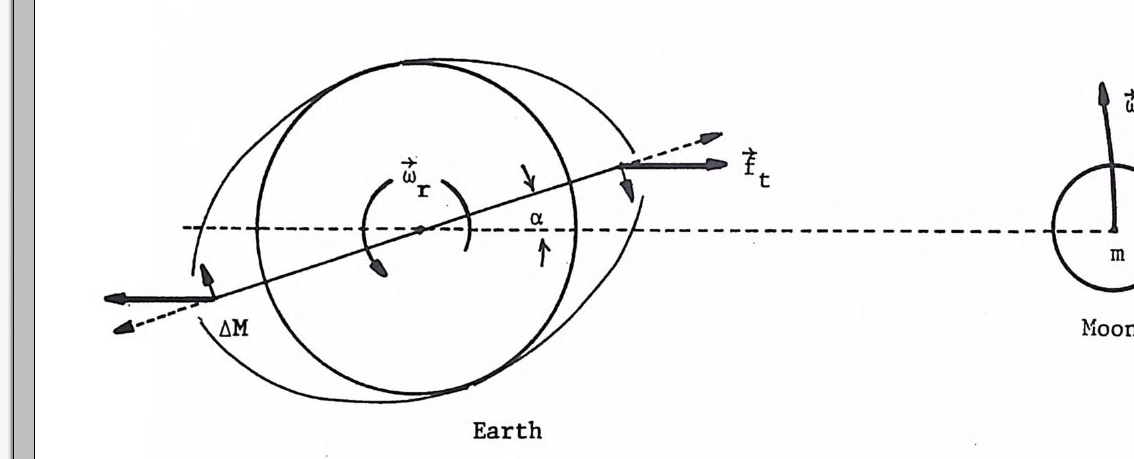 Moon
Moon
Fi g 2-7 : The e_a r th -moon sy s t e m is vi e wed fr om th e po le . Si n ce wr- > wo_ th e lag ging tides are carrie d slig h t l y ahead of th e moon or east w ard of th e li n e of cent e rs. The th i c k arrows rep r esen't tidal fo rces and th i n arrows give ri s e to a decelerat ing to rqu e on th e earth .
We now est imat e th e mag n i tude of tidal to rqu e N+ = 2+i x f ►t , where +f t is th e tidal for ce act ing on th e bulge of mass t:,M . It fol lows from Fig u re 2-7 th at N ' 2r . 뿌 r t::.M -. si n a . a3 By not ing th at th e tida lly di s t o rte d surfa c e should be an eq u ip o t e nt ial surfa ce in th e combi n ed field s of earth 's self -gra vit y and moon's tidal at trac t ion, one ge t s an order-of -m ag n i tude relati on 포M = 프M ('a학 . Subst itut ion of t:iM in t o N yiel ds N a, —Gm2 존 si n a. a6 The tidal to rqu e varie s in ge neral as th e in verse six th po wer of th e sepa rat ion a bet w een tw o bodi e s. The tidal in t e ract ion is th us fe l t more serio usly in pl anet- sate llit e s y s t e ms th an in th e sun-pl anet ones. Problem 2-23: Show th at an in comp r essib le body of densit y p at tai n s, under th e tidal in f l uence of a po i n t mass m at a di s t a nce a, a sp h eroi d al surfa ce of eccent r i c i ty e ' ( 45/161r ) . {GM/a3 ) . ( l/Gp ) . Ap pl y this result of an id eal case to th e real earth -moon sy s t e m to make an est imat e of the heig h t of earth tides . 2.3.2 Ti d al Evolut ion of _th e Earth -Moon Sy s t e m Obvi o usly, when a becomes zero, th e tida l to rqu e is no long e r to be fe lt . Thi s is exact ly what happ e ned to th e moon. The earth has tida lly in f l uenced th e moon much more st r ong l y th an th e moon has done, si n ce th e
tidal fo rce of th e earth on th e moon is alway s about tw ent y times as large as th at of th e moon on th e earth . The earth has th us slowed down moon's rot a t ion unt il t h e moon alway s shows only one fa ce to th e earth . The moon is fo rced in t o a sy n c h ron o u s rot a t ion wherei n si d ereal p 죠 io d of th e rot a t ion is exact l y same as th at of th e revolut ion. In ot h er words th e earth has in sta lled a pe rmanent handle on th e surfa ce of th e moon, th ereby , fo rces th e tidal bulge s to al ign wi th t h e cent e r of th e earth . We now di s cuss th e tidal coup l i n g bet w een earth 's rot a t ion and moon's orbi tal revolut j ·n. Due to th e tidal fr i c t ion th e earth loses its r ot a t ion al energy . The di s sip a t ion rate of th e rot a t iona l energy is relate d to th e decelerati on rate w of earth 's rot a t ion as E. r = I u r u. r < o, where I is th e moment of in erti a o f th e earth . Modern measurement s te ll us th at our earth is slowi n g - down current l y at th e rate of 1.6 x 10- 3~ sec cent u ry. As early as in th e sevent e ent h cent u ry ast r onomers, fo r examp l e Edmund Halley , not iced leng the ni n g of th e day by comp a rin g old hi s t o ric al records of solar eclip s es wi th t h ei r pr edi c t ions . Anot h er evi d ence comes fro m th e pa leont o log y. Corals add one gr owt h ri n g each day , and th e ri n g - wi d t h depe nds on wat e r te mp e ratu re, whi c h in tu rn varie s with th e season. From fo ssi l . c orals of Devoni a n era some hundred mi l lio n ye ars ag o Prof e ssor Jo hn Wells at th e Cornel Uni v ersit y fou nd in 1963 over 400 day- rin g s in one ye ar. Si n ce average . ext e rnal to rqu es exerte d on th e earth -moon sy s t e m are neg l ig ible , th e to t a l ang u lar moment u m J of th e sy s t e m should be conserved. Ig n orin g th e rot a t iona l ang u lar moment u m of th e moon, we have J = I wr + ma2w o = comst . It foll ows from J.= O th at • w. I 쇼 r + ma% o (2 으a + .u... 。£ ) = 0.
Subst itut ing Kep l er's th i r d law in th e form of w. 0_ !w_0 = -(3/2)(a./ a) in t o th e above eq u at ion, we obt a i n 으a• = -(m브-a--2) (%w.~ ) and w.。 (m브a- 2) 요 r As th e earth slows down its s p in (~r
Alth oug h th e tidal bulge s rais ed by th e earth in th e moon do not pr oduce a tidal to rqu e, th e moon st ill exp e rie nces th e tidal energy di s si- pa t ion th roug h th e frict i on as th e heig h t of th e tides in th e moon osci llate s in respo nse to vary ing earth 's tidal fo rce. The energy di s sip a t e d as heat is ul tim~t e ly_ de riv ed fr om th e moon's orbi tal energy , and si n ce fo r a fixed ang u lar moment um th e lowest - energy orbi t is a ci r cle, tides in th e moon te nd to decrease th e orbi tal eccent r i c it y. In th i s respe ct we may under- st a nd th at orbit s o f close bi n ary sy s t e ms, wherein sy n chroni z at ion is common, are close to ci r cles. 2.3.3 General Charact e ris t ics of Ti d al Evolut ion Taki n g our earth -moon sy s t e m as an examp le , we have seen how th e sp in- orbi t coup ling is ef fec t e d by th e tidal to rqu e and frict i on . And we have not iced th at a tida lly in t e ract ing sy s t e m of pl anet and sate llit e m ay have th ree choi c es for th ei r fina l fa t e of dy n ami c al evolut ion: (i) th e sate llit e orbi t may decay in ward· unt il b ein g dest r oy e d; (ii) th e orbi t may gr ow out w ard at an ever decreasin g rate ; (iii) th e sate llit es orbi tal mot ion may be sy nc hroni z ed with th e pl anet ' s sp in. In th i s secti on we wi ll fo ll ow Counselmann (19 73) to deriv e th e crit eri o n for th e fina l fa t e , and wi l l exami n e whet h er th e sy nc hroni s m is a st a ble confi gu rat ion fo r th e sy s t e m. Wi th K ep l er ' s th i r d law, G( ~l+m) = a3w~。 , th e to t a l ang u lar moment u m of th e sy s t e m is give n by J = aMR2U r + m -[G(·M +m·) -] 2/3 u o -1/3 , where aMR2 is th e moment of in erti a o f th e pl anet wi th r espe ct to its sp in- axi s , and a becomes 2/5 fo r a homog e neous sp h ere. An addi tion of th e rot a t iona l energy 1/2 MR2 w~r of th e pl anet to -GMm/a, whi c h is th e sum of th e po t e nt ial energy and ki n et ic e nergy of th e orbi tal mot ions , give s th e to t a l mechan ica l energy of th e sy s t e m as E = -21 aMR2 Ur2 -m .[ G(M +m)] 2/3 u o 2/3
To make our di s cussio n ap pl i c able to any combi n at ion of M, m, wr_ and wo it is desi r able to work wi th d i m ensi o nless varia bles. We ta ke th e Schuler fr equ ency CJ G 三 (GM/R3) 1/2 as th e nat u ral uni t of ang u lar velocit ies1 and in t r oduce a pa ramet e r k k 三 냐) 1/U (l + 룹 )1/4 to elim i n at e in di v i d ual masses fr om J and E. The di m ensi o nless ang u lar velocit ies of pl anet ' s sp in n,r. and sate llit es orbi tal mot ion nno are def ined by Q r 三 (·-Uo! - )• k-3 and no 三 (·cu으r ) 1/3 k-_11 , respe ct ivel y. These di m ensi o nless fr equ enci e s lead us to tr ansfo rm th e relati ons fo r th e anIg u J lJa =r m9or m+en 9t ;u1 m andan. de ner2g1y E i=n t 건o r re-m a·Q·ro2 k a• f >l y sim pl e form s : where JJ and IE repr esent J and E in di m ensi o nless fo rm, namely, 끄 三 J/ (aM R.2 k3 a) and IE 三 E/ (aMR .2 k6 a2) . Now, we can draw th e pa t h of tidal evoluti on in th e (firr ' 11o0 )-pl ane. nI_。n = F i0g ru erep r e2s-e8n, t thl oe cri e coft a ncog un slata r n ht yp ane gr bu olalar em woim tehn t ua ms ym (JpJ to= tc eo sn st ! .l r)- , = anJJd atnh de arencd ta nn_rg u =la -rf l ho_ y per erbpro elsaeen ct e ntht ee r elodc io n o ft h eco onsritga nint we niethr g ay s y(Im Ep =toc at en ss t n . r). . = 11 o
The sp in- orbi t sy n chroni z ati on (Slr = n 。) is describ ed in th e same (Slr ' n0)- pla ne by th e cubi c pa rabola, nr = no3 . As a pl anet- sate llit e s y s t em undergo es th e tidal evolut ion, th e po i n t (nrr , n,o. ) repr esent ing in st a nt a neous condi tions of pl anet ' s sp in and sate llit es orbi tal mot ion moves along th e const a nt- JI hy pe rbola correspo ndi n g to its in i tial value of th e sy s t em in th e di r ect ion of decreasin g IE.
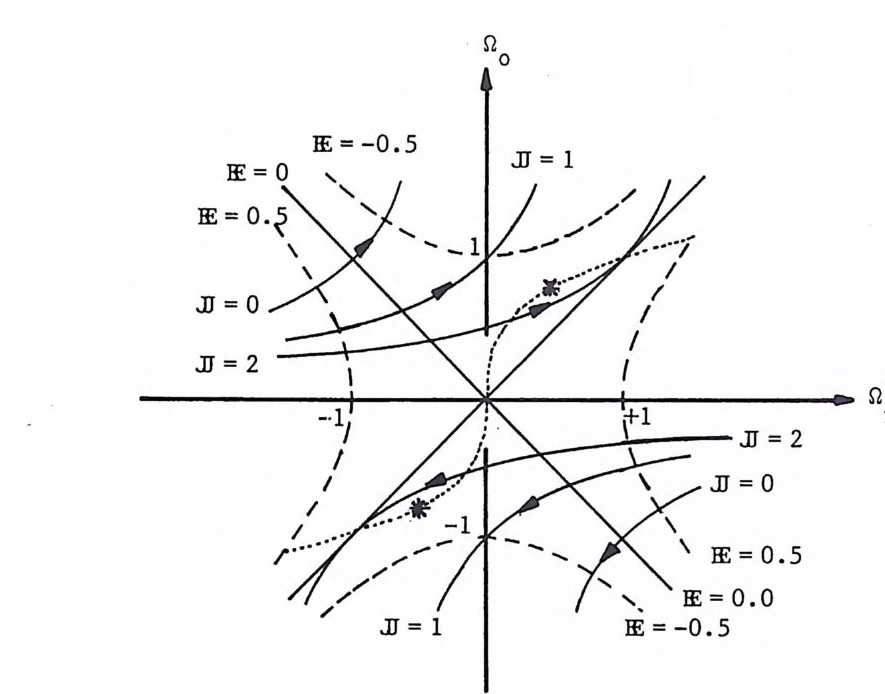 c
c
Fi g. 2-8: Cont o ur~· of const a nt JJ and IE in th e (nr, n 。)-p lane. The th i n solid li n es repr esent cont o urs of const a nt energy . The th i c k solid li n es in di c at e loci of const a nt ang u lar moment u m wi th a rrows po i n t ing th e di r ect ion of tidal evolut ion. Sy n chroni z at ion of pl anet ' s sp in rot a t ion wi th r esp e ct to sate llit e's orbi tal revolut ion is tr aced by th e dashed curve.
Only wi thi n th e po rt ion of th e cubi c hy pe rbola n~r = 硏o bounded by th e tw o ast e ris ks th e sy n chronous conf igu rat ion becomes st a ble. For a varie t y of ph y s i c al reasons, act u ally, not all pa rts of th e F(ni ;r_ s, t n ~o~ f) -pal l aln, e l waorJ e
id ent ica lly zero. Therefo r e th e sy nc hroni s m is an eq u i libri u m confi gu rat ion, On th e ot h er hand th e second deriv at ive of IE wi th r espe ct to n_。 becomes 面a2m -2 - 나。_-1 + - 3 。 on t「 e「 oc i *o f 9r = 9;. Hence, th e eq u i l i b riu m confi gu rat ion becomes st a b1e for ln J < n~ = 3:.l /1+ a~d unst a ble for l nJ > n: . The crit ical confi gu rati on s of (n*r_ _ °', n*o~ ) °a nd (-n_*r , -n~*o ) are marked by0 aste0 r isks in Fig u re 2-8. Problem 2-26: (a) Locat e th e pr esent st a t u s of th e earth -moon sy s t e m on the enr_,· no_ )-pl ane. (b) In the same pl ane mark limi t s i m p o sed by th e Schuler fr e qu ency , th e Roche lim it, th e rang e of earth gr avi tat i ona l in f l uence and the ag e of th e solar sy s t e m. (c) Follow th e tidal evolut ion of our earth - moon sy s t e m backward in time unt il i t reaches th e sp in- orbi t sy n chroni s m curve. I~ it a st a ble confi gu rat ion or unst a ble one? If it is unst a ble -on e, what causes th e eq uili b riu m to make unst a ble? Evaluat e numeric al values of n_r and n~o at tha t time and convert th em in t o di m ensi o nal qu ant ities to deriv e th e leng th of earth -day and th e si z e of the lunar orbit . (d) Do st e p s (a) to (c) for any pl anet- sate llit e s y s t e m of yo ur choi c e th at is in tre retr ogr ade mot ion . (e) Gi v e yo ur op ini o n on the po s~i b i lity th at many retr ogra de sate llit es have been lost fro m the solar sy s t e m. We may conclude th i s secti on by po i n t ing out th at th e di a g r am shown in Fig u re 2-8 dec ide s th e dest iny of a pl anet- sate llit e s y s t e m in th ei r tidal evolut ion. 2.3.4 Ti d al Di s rup tion s i) Roche Li mit Let us consid er a rig id sate llit e o f mass m and radi u s r whic h is orbi ting at an ang u lar velocit y w around a very massiv e pl anet of mass M(»m) and radi u s R at a di s t a nce a. In addi tion to th e tidal fo rce ~2Gmr/a3 rais ed by th e pl anet, out e r edg e of th e sate llit e e x pe rie nce an
ext r a cent r i fug a l accelerat ion (a + r)w2 - aw2 = rw2 ' r • —aGM3 over th e cent e r. The sat e llit e i s to fe el a to t a l di s rup tive fo rce of 3 GMr/a3. If th e sat e llit e i s not to be di s rup ted , th i s shearin g for ce must be balanced by th e sate llit e's self -gra vi tat i ona l accelerat ion Gm/r2, si n ce th e gr avit y domi n at e s all ot h er cohesi v e fo rce once th e body is large r th an a fe w hundred ki l omet e rs in si z e. So th at di s rup tion occurs at a = DR oche give n by DR oche = (3M/m) 1/3 r = 3J 3 (p M / p m) 1/3 R, where PH and Pmm are mean mat e ria l densit ies of th e pl anet and th e sate llit e, respe ct ivel y. More carefu l analys i s , in whic h non-rig idi t y of th e sate llit e mat e ria l has been ta ken in t o account , give s a slig h t l y di ffere nt result fr om our crude analys i s (see Je ans 1929): DR oche = 2.4554(p M / p m) 1 /3 R Thus a small sate llit e o rbi ting around a rig id pr i m ary of mass enormously gr eate r th an its o wn cannot be in eq u i l i b riu m in any confi gu rat ion what e ver, if its d i s t a nce from th e cent e r of its pl anet is less th an about 2(PM,,/ Pm_) 1/3 radi i of th e pl anet. Thi s crit ical di s t a nce is called as th e Roche limi t. Problem 2-27: As th e di s t a nce betw een a secondary and its p r i m ary in creases, di ffere nt ial pe rtu rbat ions fr om bodi e s ot h er th an th e pr i m ar y become more im p o rta nt . Bey o n a certa i n lim it, th e pr im ary thu s losesi ts g r avit at i ona l in f l uence up o n th e _se condary and th e secondary escape s. Deriv e such a limiting -inf l uence di s t a nce fo r comet s to · escape th e solar sy s t e m.
ii) Di s rup tion of Op e n Clust e rs by Di ffere nt ial Galact ic R ot a t ion The Roche li m i t can be used as a crit eri o n fo r th e st a bi l it y of op e n· cluste rs fo r whi c h gr avit y is in deed th e only cohesiv e fo rce. Taki n g Roche li m i t DRno-c-hLe- e q u al to th e di s t a nce of th e cluste r fro m th e Galact ic c ent e r, we may have th e fo llowi n g condi tion p cl >~ 3 p Gal as a crude st a bi l it y crit eri o n, where Pc_,l repr esent s mean mass densit y of th e cluste r and PG,.,_a,l im p l i e s th e mean densit y of th e to t a l Galact ic m ass bet w een th e cent e r and th e cluste r under consid erat ion. Problem 2-28: Accordi n g to th e old tidal th eory pl anets are sup po sed to have fo rmed fro m tida lly det a ched mat e ria l durin g a close encount e r betw een the sun and a pa ssin g st a r. Ap pl y our st a bi l it y crit eri o n to refu t e the tidal th eory of the pl anet fo rmat ion. Let us now exami n e how th e di ffere nt ial Galact ic r ot a t ion of th e Galax y tidal ly di s rup ts op e n cluste rs or in t e rste llar clouds. To· est imat e th e mag n i tude of tidal for ce or igina t ing from th e di ffere nt ial rot a t ion consid er a st a r in an op e n cluste r whi c h is orbi ting around th e Galact ic ca encot eo rrd wi ni atht e ans y as nt ge m· u l aror t. va ie nl o g c wit iyth wth_0 ea ct ludsi st et ar n cceen rt_ e0 r frto hm e rtah de i ca eln at ec rc .e leraInt ion fe l t by th e st a r is ; = - ~r2 + r w~o = F_r , where 1' is th e di s t a nce fro m th e Galact ic c ent e r to th e st a r and u is its rot a t iona l veloc ity. The di ffere nt ial accelerati on at th e edg e of th e cluste r relati ve to th e cluste r cent e r is
AF r = —ddFr r Ar = (u—r22 ·-2 ur_ -ddur + u02 )Ar. Taki n g t:.r eq u al to th e cluste r radi u s and evaluat ing te rms in th e pa rent h eses at th e cluste r cent e r, we have th e tidal accelerati on l!.F r = 2w 。 [ w 。 -( 皇 ] R • 。 Usi n g Oort ' s const a nt s A and B fo r th e Galact ic r ot a t ion of th e solar neig h borhood, we obt a i n Fr_ = 4A(A -B)R. The cluste r will be st a ble only if its self -gra vi tat i on al accelerati on is gr eat e r th an 6.F r_ . The st a bi l it y crit eri o n becomes fo r a sp h eric a l cluste r pc l ~ ~3 A(A - B) ' 8.3 x 10⁻² M 。/p c3. Any cluste r at th e solar neig h borhood whose densit y exceeds about 0.08 M。_ /pc 3 are st a ble as a whole; whi le fo r cluste rs less dense th an th i s crit ical value th e tidal di s rup tion pr oceeds very rap idl y. For examp l e, th e Galact ic d i ffere nt ial rot a t ion exerc ise s neg ligibl e tidal ef fec t on th e Pleia des cluste r whose densit y is about 2 M。_ /pc 3, whi le ex t e nded associ a t ions of densit y ~0 .1 M。_ /pc 3 are under severe tidal in f luen ces. (In th e fo llowi n g sect ion we shall give fu rth er consi d erat ion on th e st a bi l i ty of cluste rs.) Problem 2-29: Show it ap pr oxim a t e ly holds th at 4/3.A(A-B) = GMo j· R~o where M0 is th e Galact ic m ass wi thi n th e solar ci r cle at R0 fr an the Galact ic c ent e r, and convi n ce ourselves th at our crude deriv at ion based on th e. Roche lim it yiel ds essent iall y a correct result fo r the tidal di s rup tion crit eri o n.
2.4 ENCOUNTERS BETWEEN GRAVITATIONALLY INTERACTING BODIES The fo rces act ing up o n a st a r in st e llar sy s t e ms, li k e ga laxi e s and st a r cluste rs, can be sepa rate d in t o tw o cat e g o rie s. One resulte d fro m a smoot h ed-out gr avi tat i ona l po t e nt ial of th e sy s t e m as a whole det e rmi n es a sp e cif ic o rbi t of th e st a r around th e sy s t e m-cent e r; th e ot h er from a-fu nct ion li k e po t e nt ials of th e st a r's im medi a t e neig h bors to be met in th e mot ion modi fies th e energy and di r ect ion of th e orbi t cont inuo usly th roug h encount e rin g pr ocesses. Alth oug h th e chang e s occur in a random fa shi o n, th ey repr esent an ever-gr owi n g devi a t ion fro m th e st a r's orbi t th at would be det e rmi n ed by th e smoot h ed-out po t e nt iai alone. Event u ally af ter a certa i n pe rio d of time mot ions of st a rs in th e sy s t e m have chang e d so much th at th ey are no long e r id ent ifiabl e wi th t h ei r orig ina l orbi ts, and enoug h energy exchang e betw een member st a rs driv es th e sy s t e m to set tle in a rela:r: :e d dyn am i c al st a t e of st a t ist i cal eq u i libriu m. In th i s sect ion we wi l l est imat e time scales in volved in such relaxat ion pr ocesses, and dis cuss th ei r im p l i c at ions on the dy n ami c al evolut ion of st a r cluste rs. 2.4.1 Si n g l e Encount e r Encount e r> should be di s t ing u i s hed fro m collis i o n: In an_ encount e r tw o bodi e s pa ss each ot h er at some di s t a nce, whi l e in a collis i o n th ey come in t o ph y s i c al cont a ct wi th s ome drast ic c onseq u ences to th emselves. Collis i o ns are, however, very rare event s in most st e llar sy s t e ms, because ph y s i c al di m ensi o ns of st a rs are ext r emely small comp a red wi th t h ei r mean di s t a nces. For examp l e, in th e solar neig h borhood, st a rs occup y at most 10- 241• of th e avai l able sp a ce. , We may , th us, tr eat st a rs as po i n t masses, ign ore collis i o ns, and have to consi d er only tw o-body encount e rs in our di s cussio ns of th e relaxati on pr ocess. gr eat C doin ss it ad necr et ww io ths t aa rsre olaf tmi vaes s smp e, edan dr m=~2 I 저a p1 p-r o합a 2c hIi , n wg heearceh w니o ,t1 h aenr df 나wr·o ? 2m aa re in i tial veloc ities of th e tw o st a rs in a laborato ry fram e. Well befo r e th e
encount e r th e tr aje ct o rie s were nearly st r aig h t and fo llowed tw o pa rallel pa t h s sepa rate d at a di s t a nce p fr om one anot h er. If th ere were no in t e ract ing fo rce,t h e di s t a nce of closest ap pr oach would be exact l y p called th e impa ct pa ramet e r. The st a r rn1, is , however, at trac t e d durin g th e encount e r by m_ wi th t h ei r tr aje ct o rie s bei n g def l ecte d fr om ot h erw ise st r aig h t pa t h s2, and af ter th e encount e r th e tw o st a rs tr avel back out to a gr eat di s t a nce ag a i n . In a cent e r-of - mass fr ame th e tw o tr aje cto rie s are hsye peen r bino lasesc ot fi ogne o2m . 4e t rt ih ac t sit mh ie l arerilta yt i vine mtho et iorant o iof mm 11_ /r떠n.2_ t. h rHesopwe e~vte rt, o w me _2 h. acvane be reduced to th e mot ion of a fict i tious body of th e reduced mass around a fixed po i n t at m2~ .
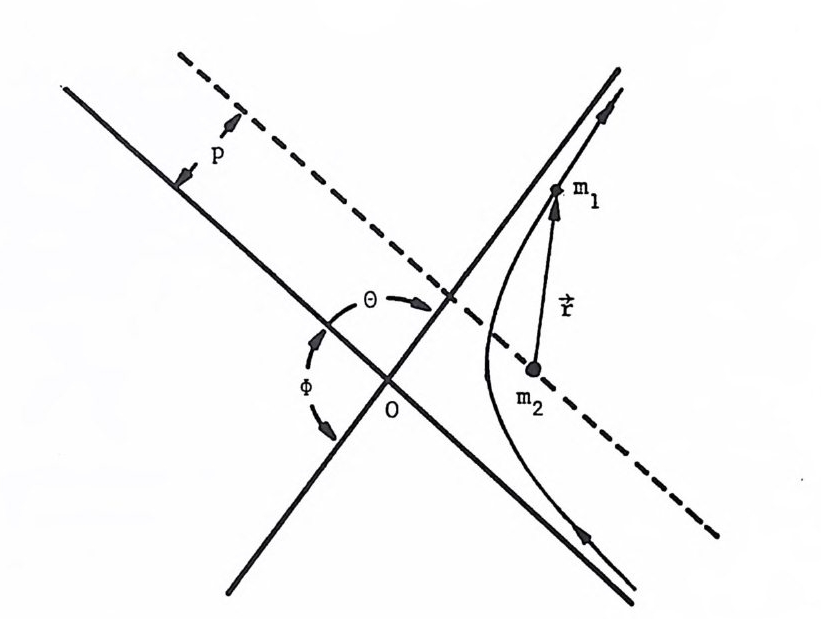 `` `/ ` ` `` ` ` ` ` `
Fi g 2-9: Schemat ic r ep r esent a t ion of th e relati ve tr aje ct o ry of th e encount e r·. The relati ve orbit , as shown in Fig u re 2-9, is a hy pe rbola, and it is give n by r = 1 +브 e c os \)
wIfh ewree noµ t =e Gth( ma t1 + mt h2 )e, anh=g pl ev a ndb ett wh ee ene cctew no t ar si yc m it pyto et e si s isl aergq ue ra l tht oa n thu nei ttyo t. a l chang e in th e tr ue anomaly u durin g th e whole encount e r, and th at th ~ values of u fo r th e orbi t are restr i c t e d to ang l es such th at cos u :,. - 1/e, we can easi l y evaluat e th e def le ct ion an gl e 0 of th e encount e r as cos -~2;;- = si. n -02;;- = 一e1 , or cot 2 ~2。 = e2 - 1. We know from Problem 2-7 th at e2-l = 2h2e/µ2; on th e ot h er hand th ~ to t a l energy e of th e sy s t e m pe r uni t mass is si m p l y give n by {1 v2. Hence, we have ta n -。2;; - = G(m1p v+ 2 m 긴 In most st e llar sy s t e ms th e ang l e of def lect i on. in volved in a si n g l e encount e r is ext r emely small. For examp l e in th e solar neig h borhood wherein m1_=m2=MQ , v= 10 Km/sec and p= 1 pc we have ta n 0/2= 10- h~ or 0 = 2 x 10 -ti• radi a ns . Even in gl obular cluste rs typica l values of 0 are of th e order of 10- 3- radi a ns. Theref o re, as a go od ap pr oxi m at ion we may rewrit e t h e relati on fo r 0 as th e fo llowi n g fo rm o = G(rn1 p+ rn 긴 '/ .2!. v2 .
Nulti pl y ing bot h denomi n at o r and numerat o r of th e above exp r essio n, by mr, we not ice th at th e def lect ion ang l e is give n by th e rat io o f th e po t e nt ial, energy of th e tw o st a rs at a di s t a nce p to th e ki n et ic energy of th e sy s t e m at th e in i tial moment . Int r oduci n g th e in t e ract ion di s t a nce p 。 as th e im p a ct pa ramet e r fo r whi c h th e def l ect ion ang l e becomes 이 2, p o 三 G(m 1 +m 2 )/v2, we may fu rth er si m p l if y th e exp r essio n fo r th e def l ecti on ang l e to ta n -02::- = —pp。 2.4.2 Vi r i a l Velocit y and Crossi n g Ti m e Si n ce th e def l ect ion ang l e dep e nds most sensit ivel y up o n th e velocit y, it is usef u l to know th e value of a typica l velocit y a st a r can at tai n in sid e a st a r cluste r. Furth ermore, as a messag e fro m one pa rt of th e cluste r is th oug h t to be tr ansfe rred to ot h er pa rt at th e typica l velocit y, it may repr esent a ki n d of dy n ami c al respo nse time. Let us consi d _e r a st a r cluste r in a st a t ist i ca lly st e ady st a t e fo r whi c h vi r i a l th eorem holds. E ml..v~ 2l:. -E Grmil.. mj J. = 0, where th e first te rm repr esent s tw o times th e ki n et ic e nergy of all th e st e llar mot ions wi th r espe ct to th e cluste r-cente r, and th e second te rm th e po t e nt ial energy of th e cluste r. For si m p licit y if we consid er th e case when all th e cluste r members have th e same mass m, we can th en writ e I: mi,v-+. ~i2 = mN
-iNEj ri2 j - - ~21 N(N-1) —GRm2 = - -2l —GMR2 ' where R is called as th e ef fec_ t i ve radi u s of th e cluste r . Subst itut ing th e ki n et ic e nergy and po t e nt ial energy th us obt a i n ed back in t o th e vi r i a l th eorem, we have th e exp r essio n for th e vi r i a 'l ve'l oc it y 뇽 --GM_-Z R-1 Y2 [
tx = [2石R3 r ], ½ = [검 志 ]남 ::: 7 x 10⁶ yr s [M~e pc -3] , ½ where p三 nm is th e mean densit y of th e cluste r.
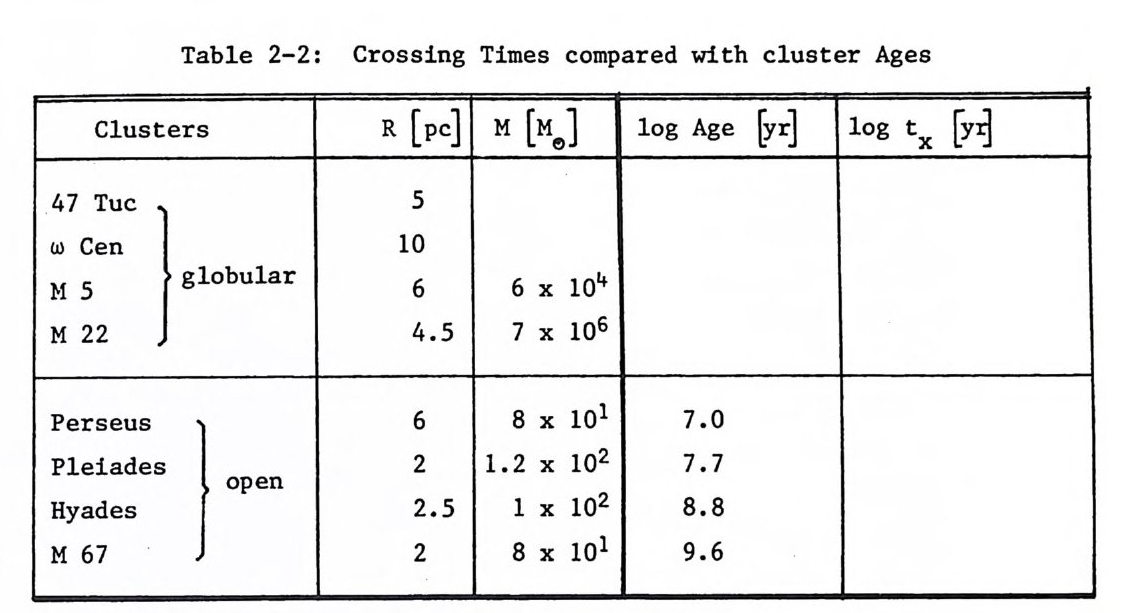 Table 2-2: Crossin g Ti m es comp a red with cluste r Ag e s
Problem 2- 3 0: Fi l l in the blancks of Table 2-2. Conf e r Alcai n o (1977), Lang (1974) and Allen (1973) for numeric al values of R, M and ag e . Let us consid er a small volume element in sid e a typica l st a r cluste r. If a st a r .le aves th e volume wi th s ome veloc ity, it will be repl aced, within in a ti m e in t e rval of t .X. , by anot h er st a r of th e correspo ndi n g velocit y. Crossin g times are evaluate d along wi th o t h er cluste r pr op e rti es in Table 2-2 fo r a fe w selecte d cases. The crossin g times are very short, pa rti cu larly fo r gl obular cluste rs, comp a red wi th a g e s. Thus it can be said th at repl acement s are done im medi a t e ly. Such an im medi a t e repl acement makes it di fficul t to not ice any fl uctu at ions in veloc ity di s t r i b ut ion of th e st a rs wi thi n th e volume unless one uses time resolut ions bet ter th an th e crossin g time. If a small di s t u rbance is give n to one pa rt of th e
sy s t e m, th e pa rt te nds to recover its m emory of th e pa st by di s t r i b ut ing th e shock it receiv ed fr om th e di s t u rbance qu i c kly to all th e ot h er members, Of course many encount e rs bet w een cluste r member st a rs exp e rie nced over a long pe rio d of time wi l l driv e th e sy s t e m very slowly in t o an eq u i l i b riu m st a t e of Maxwellia n velocit y di s t r i b ut ion; th e sy s t e m remai n s in a st e ady st a t e over th e time scale a li ttle long e r th an th e crossin g time, 2.4.3 Relaxat ion Ti m es i) The Relaxat ion Ti m e fo r Unbounded Sy s t e m We now consi d er an accumulat ion of many si n g l e encount e rs of small def l ecti on ang l e: As a crude est imat e of th e relaxat ion time, i.e. , th e time in t e rval requ i r ed fo r a sy s t e m to reach a st a t e of st a t ist i cal eq u i l i b riu m wherei n a comp l ete energy eq u ip a rti tion is achi e ved among its members, we first consi d er an unbounded sp a ce fille d wi th u ni form ly di s t r i b ut e d st a rs of eq u al mass m. If n denot e s th e number densit y of st a rs, as a typica l st a r moves th roug h th e sp a ce it wi l l suf fer , in a time in t e rval 1',.t , np 2 V 1',.t n times of encount e rs where p is a typica l :im p a ct pa ramet e r. Each encount e r wi l l def l ect th e st a r's ot h erwi s e smoot h pa t h at least by an amount 2Gm/pV 2 in randomly di s t r i b ut e d di r ect ion s. Here one should not e th at 2Gm/pV 2 is only hal f th e def l ecti on ang l e 0 deriv ed in sect ion 2.4.1. Because what we are in t e reste d in is th e -de f l ecti on ang l e measured in th e laborato ry fr ame cent e red at th e sy s t e m- cent e r not in th e cent e r-of - mass fr ame of th e tw o encount e rin g st a rs, it is ap pr o' pr i a t e to use 2Gm/pV 2 rath er th an 4Gm/pV 2 for th e comp u t a t ion of relaxat ion time. If we denot e by E02 th e accumulat e d sq u ares of each def l ect ions measured in th e sy s t e m laborato ry fr ame, we may have i::0 2 = 4n Gv23 급 n /:J.t.
i:;0 2 is a go od measure of th e to t a l chang e in th e ki n et ic e nergy of a st a r occurred over th e time in t e rval t::.t, si n ce -21m (0V)2 = t::.(-21m v 2) is th e energy chang e in a si n g l e encount e r. Recallin g th at relaxat ion results in energy eq u ip a rti tion, we may eq u at e th e relaxat ion time , t_r , to th e time in t e rval durin g whi c h l::0 2 becomes uni ty. We th en obt a i n th e relaxat ion time as fo llows: t r = 4 1T vc32 nm2 = 4 x 10⁹ yr s [函뇨] 3 [남 [탄?〕 Taki n g V = 10 Km/sec , and 1 pc as th e mean di s t a nce betw een st a rs in th e solar neig h borhood, one not ices th at at least a pe rio d of 1013 ye ars is requ i r ed fo r our_ sun to ap pr eci a t e any chang e in its o rbit . However, durin g th e tw ent y or so times revolut ion around th e Galact ic cent e r si n ce its b i r t h encount e rs with st a rs in th e Galact ic p l ane have modi fied th e orbi t of th e sun by only te n seconds of arc. In th e Galact ic pl ane encount e rs th us have li ttle ef fec t on th e dy n ami c s of in di v i d ual st a rs over th ei r li fe t ime s, and encount e rless dy na mi c s will adeq u at e ly describ e th e mot ion of field st a rs under th e smoot h ed out po t e nt ial field of th e Galaxy . In th i s respe ct a recent at temp t at locat ing bi r t h pl ace of ceph ei d varia bles by Wi e len (19 73) finds ju st ificat ions . However, si tuat ions are qu i te d i ffere nt fr om th i s fo r th e mot ion of st a rs in si d e st a r clust e rs.• ii) The Relaxat ion Ti m e fo r Bounded Sy s t e m The relaxat ion time deriv ed in th e above is li k ely to be an over- est imat e fo r cluste rs because th e fini t e s i z e of th e st e llar sy s t e ms has not been _ta ken in t o account . We assume ag ai n fo r sim pl i c it y th at all st a rs have th e same mass and are di s t r i b ut e d un ifor mly. For bet ter est imat e , we have to pe rfo rm th e fo llow ing in t e g r al E02 = f PPmm ia nx [p혹v ] 2 27rp d p n Vh .t
in order to ge t th e accumulat e d sq u ares of def l ect ion ang l e a st a r exp e rie nc in sid e a cluste r. In pr i n c ipl e th e relati ve veloc ity V should di ffer from st a r to st a r encount e red, but we repl ace V si m p l y by th e vi r i a l velocit y and pu t out s i d e th e in t e g r al sig n . Then, th e in t e g r al becomes E02 = 81TG2run2 • At • 1n( 노프) . <윤 >3/2 pmin It is nat u ra~ to assig n th e ef fec t ive radi u s of th e cluste r R to th e up pe r li m i t p_ m_a ,x. ,' whereas th e choi c e -fo r p_m 4i n~ is rath er subt l e . Clearly pm_ .i, _n= O yiel ds ph y s i c ally unreal ist i c r esult, si n ce we can hardly exp e ct a def l ect ion more th an ni n ety deg r ees. We may th en ta ke fo r th e lower limi t of th e in t e g r al th e in t e ract ion di s t a nce p。_ = 2Gm/V2. Put ting m = M/N and subst itut ing th e mean sq u are velocit y GM/2R in t o v2 and
by an encount e r. Our above deriv at ion of t~r is admi tted ly a crude one, because we have not serio usly consi d ered all th e varia bles in volved in th e encount e r pr ocess, li k e di s t r i b ut ions of velocit y, mass, and sp a t ial varia t ion of densit y in si d e a cluste r. We refe r th e reader to Chandrasekhar (1943) and Sp itze r (19 56) fo r a rig o rous tr eatm ent of th e pr oblem, and we si m p l y qu ot e Sp itze r's refe rence time t ref = 3/J 11/ 2G 2r
iii) Sel f-Co lli si o n Ti m e As anot h er measure of th e relaxat ion time, we in t r oduce th e self- collis i o n time t_ def ined as th e time requ i r ed fo r a st a r of th e mean C energy to undergo a def l ecti on of 90° in th e cent e r-of - mass fr ame of th e encount e r. For such a def l ect ion to occur, th ere must be at least one st a r wi thi n a cy lind ric a l volume of radi u s P0n and heig h t
t—r t 1 N x 12 ln N/4 It is clear fr om th e rati o t Tr ./tv X th at fo r sy s t e ms of ri c h membership relaxat ion times sig n i fican t l y exceed crossin g times conseq u ent l y a typica l st a r orbi ts t h e st e llar sy s t e m many times in respo nse to th e smoot h ed out po t e nt ial field of th e sy s t e m bef o re its e nergy and orbi t are chang e d ap pr eci a bly. Table 2-3: Ap pl i c abi l it y of th e Encount e r Theory Cluste r Ty pe s N t r ItX Encount e r Theory Poor Op e n Clust e rs $ 102 ~ 1 not ap plica ble Ri c h Op e n Clust e rs 103 15 st ill valid Globular Clust e rs 105~6 103 very well adap ted Cluste r of Galaxi e s <': 102 ,?; 1 doubt ful We have give n in Table 2-3 values of t_r/·t _X_ for vario u s type s of cluste rs along wi th t h ei r charact e ris t ic s i z es of th e membership . Concerni n g th e valid i ty of th e pr edi c t ion based on th e tw o-body encount e r, we may fo rmally conclude th at dep e ndable results are exp e ct e d fo r sy s t e ms of membership large r th an say 400, fo r whi c h a typica l st a r can make seven to eig h t crossin g s wi thi n one relaxat ion time scale. The qu ant ity t_r /t _X_ can be in t e rpr ete d as th e rat io o f mean free pa t h of a st a r to cluste r si z e: One may def ine th e mean fi>e e pa t h ;\(v) in such a way th at th e pr obabi l it y fo r a st a r movi n g with velocit y v to tr averse a leng th Z(=vb .t) witho ut suf fer in g th e expe ct e d sq u ares of def l ect ion, E02 , be exp r essed by ex p[-7,/). (v)] . It is th en clear from our def ini t ion of th e relaxati on time th at t;h e mean free pa t h can be eq u ate d sim p l y to th e pr oduct of th e veloc ity v and th e relaxat ion time tr- • Subst itut ing th e vi r i a l veloc ity
点=\TnN/4 .I It is remarkable th at not only th e rat ios of vario us time scales in volved in th e relaxat ion time but also th e qu ant ity 1./ R dep e nd solely on th e to t a l membership of th e give n sy s t e m. We are now in a po sit ion to make a comp a ris on of th e relaxat ion time wi th t h e ag e to gu ess th e dy n ami c al st a t e of a give n cluste r. Sy s t e m wi th ag e s much longe r th an th ei r relaxat ion times , i. e . , ag e >> tr , have exp e rie nced so many enr unt e rs bet w een th ei r member st a rs th at th ei r orig ina l velocit ies have been th oroug h ly randomi z ed to ward a Maxwellia n di s t r i b ut ion. Sy s t e ms whose ag e s are much shorte r th an th e relaxat ion time but st ill long e r th an th e crossin g time, i. e. , t~c < ag e << t,.r. , have not reached a st a t ist i ca l eq u i l i b riu m st a t e ; th ei r velocit y di s t r i b ut ions are in a st e ady st a t e whi c h has pr act ica lly unchang e d si n ce th ei r fo rmat ion. For sy s t e ms havi n g ag e s comp a rable to th ei r relaxat ion time s, it is , however, di fficul t to draw any conclusio ns concerni n g what dy n ami c al st a t e th ey are act u ally in . The di fficul t y aris es pa rtl y fr om th e fa ct th at densit y cont r asts are observed wi thi n a give n cluste r, hence di ffere nt relaxati on times should be ap pl i e d to di ffere nt pa rts of th e sy s t e m. Even if t_r
Usi n g th e exp r essio n give n by Ost r i k er and Davi d sen (19 68) we have evaluat e d th e relaxat ion times fo r vario us examp l es of cluste rs. The beg inn i n g fo ur columns of Table 2-4 cont a i n numeri c al values • repr esent ing ph y s i c al charact e ris t ics of each cluste rs and th ei r est imat e d ag e s, and th e last column is fo r th e relaxat ion time. To in f e r th e current dy n ami c al st a t e of a give n cluste r, we have no choi c e ot h er th an usi n g th e ph y s i c al pa ramet e rs at th e pr esent in . th e comp a ris on of t_r wi th th e ag e . However, th e current dy n ami c al st a t e has resulte d fr om th e cont inuo us evolut ion over th e pa st. Hence, one mi gh t wonder whet h er th e comp a ris on of th e current value of t r.. wi th t h e ag e could yiel d any meani n g ful results . If one consi d ers a cluste r undergo i n g a ge neral exp a nsi o n wi thou t losin g its m embers, fo r .su ch a cluste r one may relate th e relaxat ion time to th e si z e as tr 00
have t_r in th e order of 1013 ye ars. Thus, th e relaxat ion seems not to have been accomp l i s hed th roug h th e tw o-body encount e r, fo r th ese sy s t e ms as ye t . Thi s nai v e exp e ct a t ion makes a sharp cont r ast to th e remarkable success in repr oduci n g th e surfa ce brig h t n ees di s t r i b ut ion and th e ga laxy - count dat a by th e same type of di s t r i b ut ion fu nct ion as used for well relaxed sy s t e ms like th e gl obular cluste r (Zwi c ky 1957; Oort 1958; King 162; Peebles 1969; and Ki n g 1972). In th i s respe ct we should pa y a sp e ci a l at ten t ion to rath er st r ong dep e ndence of t_r up o n th e mass of in di v i d ual obj e ct s . If one reduces th e to t a l namber of in dep e ndent gr avi tat i ng obj e ct s whi l e keep ing th e to t a l mass M= mN fixed , th en th e relaxat ion time decreases in pr op o rti on to N unlesst h e c.h ang e in R is large . Conseq u ent l y , · ev en wi thi n th e th eoret ical fra me of si m p l e tw o-body encount e r we may not ice th at th e relaxat ion must have been ef fici e nt when pr ot o -ga laxi e s or pr ot o -cluste rs of ga laxi e s were made of more massi v e but smaller number of blobs th an th ey are now. Some collect ive relaxat ion pr ocess ot h er th an th e si m p l e tw o-body relaxati on must have been op e rat iona l in exp e di ting th e relaxat ion in early fo rmat ion st a g e s of ga laxi e s or pr ot o -cluste rs. A member of a cluste r in a qu asi- equ i l i b riu m st a t e wi l l exp e rie nce th e overall gr avit at i on al po t e nt ial whi c h is nearly time- i n dep e ndent ; relaxat ion is ef fec t e d only th roug h small scale pe rtu rbat ions c;lu e to di s t a nt encount e rs. On th e ot h er hand, a cluste r in its f o rmat ion st a g e will undergo osci l la- tions on a rap id time scale in th e order of th e crossin g time. In such a si tuat ion a st a r exp e rie nces rap idl y vary ing gr avit at i ona l field , th us pe rmi tt:ing th e cluste r as a whole to evolve rap idl y. Thi s rap id evoluti on due to a collecti ve ef fec t of th e sy s t e m has been called as th e vi o lent relaxati on , fo r det a i l s of whi c h th e reader is refe rred to Henon (1964) and Ly nd en-Bell (19 67 ) . We th us find ju st ificat i on s for ext e ndi n g King ' s (19 62) eq u i libri u m model of gl obular cluste rs to ellip tial ga laxi e s fro m th e vi o lent relaxati on pr ocess.
2.4.5 Dy n ami c al Fric t ion So fa r we have fo cused our at ten t ion to th e randomi z at ion of moment u m leadi n g to an energy eq u ip a rti tion bet w een cluste r members havi n g more or less eq u al masses. One of ten finds hi s in t e rests li e in th e averag e exchang e of moment u m bet w een a heavy te st pa rti cle and a gr oup of less massi v e field pa rti cle s. For examp l e, in in t e rste llar sp a ce we of ten needs to know th e drif t velocit y of ei ther massi v e at o mi c io ns or dust gr ain s wi th r espe ct to neut r al hy d rog e n ga s; or in a cluste r of ga laxi e s, we may need to know dy n ami c al behavi o ur of th e most massi v e comp o nent wi thi n th e cluste r. As a massi v e body moves th roug h a backg r ound of lig h t pa rti cle s, th e gr avit at i on al at tra ct ion of th e massi v e body te nds to pu ll th e backg r ound pa rti cle s in t o a gr avit at i ona l wake behi n d th e body , th en, th e gr avi tat i ona l at tra ct ion by th e small pa rti cle s collecte d in th e wake st a rts to exert a decelerat ing fo rce or dy n ami c al fri c t ion up o n th e massiv e body . In th i s sect ion we want to measure an ef fici e ncy of th e dy na mi c al fr i c t ion of th e field st a rs in slowi n g - down th e te st body . ~et us consid er massi v e te st pa rti cle of mass M movi n g th roug h a medi u m of uni form ly di s t r i b ut e d field pa rti cle s of mass m with a relati ve velocit y -V+ in a laborato ry fr ame . In a fr ame of refe rence movi n g with th e cent e r of mass fo r each encount e r bet w een th e te st pa rti cle and a field pa rti cle , th e te st body moves wi th a velocit y ±w = m+mM ±V , and th e field pa rti cle +w =-m~+MM V ±. Si n ce all th e field pa rti cle s are consid ered to be of th e same mass and in a uni form mot ion wi th r espe ct to th e te st body , th e movi n g fr ame of ref e rence is in dep e ndent of th e encount e rin g pa i r s under consid erat ion and moves with a velocit y -V누 •M/(m +M ) in th e laborato ry fram e.
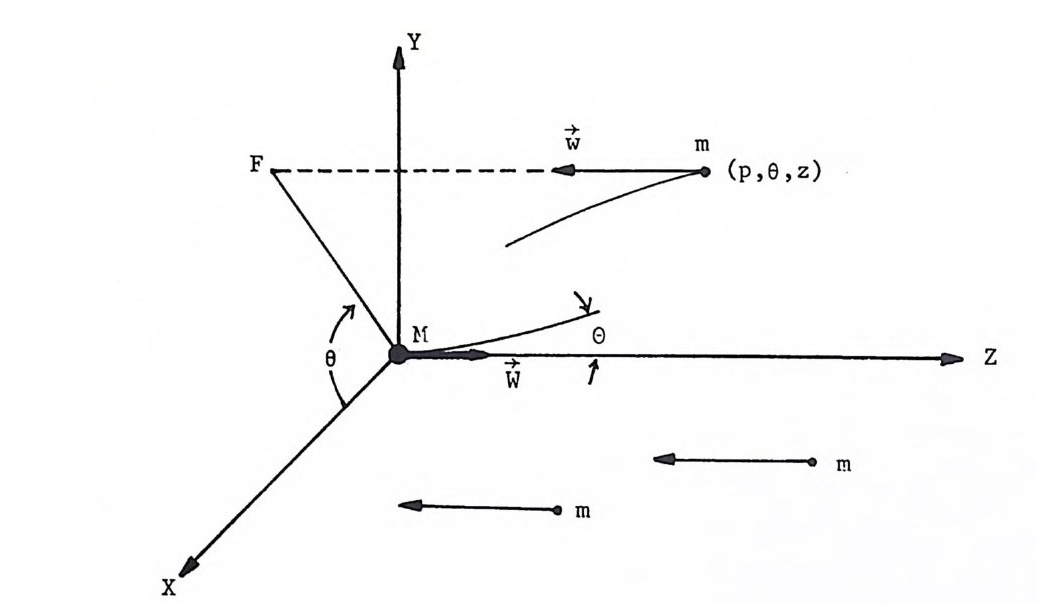 Y
Y
Fi g 2-10: Coordi n at e s describ i n g a te st body movi n g ag a i n st a st r eam of field ' p a rti cle s. For th e field pa rti cle s we in t r oduce cy l i n dric al coordi n at e s (p, 6,z) wi th Z -axi s bei n g ta ken pa rallel to 니V . Well-bef o re'a n encount e r th e veloc ity of th e te st body is give n by +W =(O,O,W) in th e XYZ-coordi n at e s; af ter th e encount e r th e te st body is def l ecte d by an ang l e 0 in th e ZOF- pla ne and th e velocit y now becomes 저' = W(si n 0 cos 8, si n 0 si n 8, cos 0) . The veloc ity chang e t:, 기W 三 니W '-니W is , th us give n by /:J.+W = W(sin 0 cos e, sin 0 si n e, cos0-1 ). Empl oy ing th e relati on ta n 0/2 = p。j p and exp r essin g si n 0 and cos 0 in te rms of im p a ct pa ramet e rs, we may rewrit e t h e velocit y chang e resulte d in a si n g l e encount e r as A:wl:: = P2 2W+ p2。 (PP 。 cos e, pp°0 si n e, 군)° .
It now remai n s to in t e g r ate ti처 over all th e encount e rs exp e rie nced by th e te st body in order to obt a i n th e to t a l velocit y chang e , I:/1니W , exp e ct e d in a time in t e rval t.t: E t.+W = f p·m· ·a- ·x· f 21T AW+ nVt .t pd p de . pm i n ° The X and Y comp o ne.n t s of th e in t e g r al become zero, and we obt a i n E A 처 = -: nm At { ln[1+(pm :/pm i n )2]} We subst itut e , as bef o re, th e ef fec t ive radi u s R and th e in t e ract ion di s t a nce P,.o.. in t o p·m-~a~x and P·m-~i ~n • respe ct ivel y and ap pr oxim at e th e cut - of f pa ramet e r as ln [l + (pm ax /p·m i. n )2] ::: ln [l + (N/4)2] ::: 2 ln(N/4) . Fi n ally we obt a i n th e to t a l ex pe ct e d chang e , E 6W(6t ) , in th e time in t e rval 6t as r t.W (t. t) ' - ~4,r G v2 2(m +M ) nm t.t ln(N/4) . The sym me t r y of our pr oblem about th e Z-axi s has broug h t no chang e s, in th e averag e ,_ to th e velocit y comp o nent s pe rpe ndi c ular to th e te st body mot ion; only th roug h th e chang e in th e Z-comp o nent th e te st body has been slowed down to a sp e ed give n by W + I: t:,,W (t: ,,t) . When th e te st body moves wi th t h e same velocit ies as th e field pa rti cle s in th e mov ing fram e, one may say th at th e dy n ami c al fr i c t ion caused by th e field pa rti cle s has comp l ete ly slowed down th e te st body . Therefo r e; we def ine th e slowi n g - down time t s such th at
w + E AW(At =ts) 三 w or E t:,W (t, .t=t5 ) 三 -v, fr om whi c h it fo llows t ::: v3 :::2_m v3 5 4nG2 (m+M ) run ln N/4 M 8nG2 run2 ln N/4 Problem 2-32: For th e in t e ract ion betw een an in t e rste llar dust gr ain and hy d rog e n molecules, th e gr avit y doesn't pl ay any role at all. How would yo u def ine th e slowi n g -d own time fo r such cases? Conf e r Sp itze r (1978) . Si n ce th e slowi n g -d own time is shorte r th an th e relaxat ion time by ap pr oxim at e ly a fa ct o r m/M, th e dy n ami c al fr i c t ion may have exerci s ed im p o rta nt roles in th e dy na mi c al evolut ion undergo ne by sy s t e ms havi n g membership of wi d ely vary ing masses'. For examp l e, massi v e gl obular cluste rs may have been caused to sp ira l in to ward th e ga lact ic n uclei th roug h th e dy nam i c al fr i c t ion withi n an in t e rest ing l y short time in t e rval. And , as sug ge st e d by Tremai n e et al . (19 75) and Tremai n e (19 76) , th e dy n ami c al fr i c t ion can be im p o rta nt in exp l ain i n g th e fo rmat ion of sharp nuclei in ga laxi e s, if pr ot o -ellip tica l ga laxi ~ s were fo rmed by coalescence of mass condensat ions or subsy s t e ms wi th m asses M ::i: 106 ~ 109 M_。 . Furth ermore , th e dy n ami c al fr i c t ion may have some relevance to th e ph enomenon associ a t e d wi th c D ga laxi e s havi n g ext r emely ext e nded envelop e s (Lecar 1975; Ri c hst o ne 1976). Problem 2-33: Read arti cle s by Tremai n e, Ost r i k er and Sp itze r (1975) and by Tremai n e (1976), whi c h sug ge st th e dy n ami c al fr i c t ion is respo nsib le fo r the nuclei. Then, th i n k over th e pa p e r by Van den Bergh (1976) , whi c h pr ovi d es observat iona l argu ment ag a i n st th e dy n ami c al fr i c t ion hy po t h esi s . Take yo ur own st a nd on th e di s p u t e : If yo u are on th e Tremai n e's sugg e st ion, think of any argu ment s to save th e id ea, if떡 ai nst it, exp l ain th eoret ica lly why th e dy n ami c al fr i c t ion has been in ef fec t ive.
We have concerned so fa r wi th t h e moment u m exchang e ; we now tu rn to th e qu est ion of energ y chang e . It is usef u l to have, fo r th e energ y Bcoy npsie dr feo r ramt ii on ng , sti mh ei l aser coinn td e~ go rr adte ir omnso muesnet ds , fo 1r: (6t.hW e1 ; 6f.Wi rJJ s t, - oofr dtehr e m voemleonct ist yr cf:J.Wh aJi n, g e s . we can easi l y obt a i n th e fo llowi n g results : E(AW x AW y ) = E(AW y AW z) = E(AW z AWx ) = o, 1: (t:,W x) 2 = 1: (t:,Wy ) 2 = 21rG2 Vm nm /1t [ln [1+(p max1Pm i n) 이 - [l+(pm a)Pmi n )2l-l] E(AW z )2 = ~4nG2 m nm t.i t r[ 1. +. (, pm ax/, pm i n . /2 ] 기• • _T he sy nnne t r y in herent in th e pr oblem makes all th e cross-moment s zero and brin g s about th e eq u i pa rti tion , E (t:.W x~ ) 2 = E (t:.W y. ) 2 , bet w een tw o comp o nent s pe rpe ndi c ular to th e te st body mot ion. We have seen th at th e first - order moment E t:.W z- is comp o sed of .tw o te rms ; one pr op o rti ona l to th e mass of te st body and th e ot h er to th e mass of field pa rti cle . The second- order moment , however, has only th e lat ter te rm. The fo rmer te rm may be in t e rpr et e d to orig ina t e th e excess densi ty of field pa rti cle s behi n d th e tes t body , si n ce th e excess is caused by th e pr esence of th e massi v e body . The lat ter te rm can be in t e rpr et e d as th e ef fec t of th e fl uct u at ions of th e gr avi tat i ona l field at th e locat ion of th e te st body . Such flu ct u at ions pr oduce a velocit y chang e whi c h is in dep e ndent of th e mass of th e te st body . Let us evaluat e th e exp e ct e d chang e in th e ki n et ic e nerg y of th e te st body : E A(½M QZ ) = .2.!. M E { (w+A W z ) 2 + (AWx ) 2 + (AWy ) 2 _ if } .
One finds th at th e above exp r essi9 n is zero, by subst itut ing our pr evi o us results on th e second-order moment s and l: t::,W z_ and th e relat ion bet w een W and V give n in th e beg inn i n g of th i s sect ion. The ef fec t of all th e encount e r·s is only to chang e th e di r ect ion of th e te st body mot ion keep ing th e mag n i tude of its v elocit y const a nt . The dy n ami c al fr i c t ion doesn't di m i n i s h th e ki n et ic e nergy of th e te st body . 2.5 STABILITY OF STAR CLUSTERS Even if densit y of a st a r cluste r is suf fici e nt l y hi gh to survi v e th e di s i n t e g r at ing te ndency of th e di ffere nt ial gr avi tat i on al field of th e Galaxy as a whole, th e cluste r fa ces fr om time to time tidal im p u lses whenever it encount e rs wi th m assi v e in t er ste llar clouds. Such an encount e r in creases to t a l energy of th e cluste r and leads to a gr adual exp a nsi o n of th e cluste r. In addi tion to th i s ext e rnal cause, th e cluste r loses its member cont inuo usly: As st a rs in th e cluste r in t e ract wi th e ach ot h er th roug h st e llar encount e rs, some ga i n enoug h energy to escap e fro m th e cluste r . Thi s pr ocess leads to evapo rat ion of cluste r st a rs and ·ev ent u ally results in a comp l ete di s i n t e g r at ion of th e cluste r. In th i s sect ion we wi l l est imat e time -scales in volved in th ese tw o pr ocesses of st a r cluste rs. 2.5.1 Di s rup tion by Encount e rs wi th I nt e rste llar Clouds Sp itze r (1958) carrie d th roug h a carefu l analys i s of th i s pr oblem of cluste r di s rup tion ; in th e fo llo 갑i n g we shall summari z e ess,en ce of hi s deriv at ion fo r th e· di s rup tion time scale by encount e rs wi th i n t e rste llar clouds. We def ine a coordi n at e sy s t e m locate d at th e cluste r cent e r with X-axi s po i n t ing to ward th e cloud when it is at its d i s t a nce, p, of closest ap pr oach to th e cluste r cent e r. The Y-axi s is ta ken pa rallel to th e relat ive velocit y, 니V , of th e cloud wi th r espe ct to th e cluste r, and th e z-axi s pe rpe ndi c ular to th e X- and Y-a. xe s. As an in t e rste llar cloud otfi dmala sas cMce plae srsaetis o nb y rethl ae tci vlue s tteo r,t h eea .cchl u sstt ae rr icen ntt he er . clusSpt e i tr zee xrp ee mrpi nl oeyc ee ds aa si m p l i fying assump tion th at th e cloud pa sses by th e cluste r suf ficien t l y
rap idl y th at th e st a rs do not move ap pr ec iab ly durin g th e pa ssag e . We th en eq u at e th e velocit y chang e , t:.니v , of each st a r si m p l y to th e pr oduct of tidal accelerat ion and tida l p_ ulse durat ion t:.t , over whi c h th e tida l im p u lse has been ef fec t ive. The time requ i r ed fo r th e cloud ·to move a di s t a nce comp a rable to th e closest ap pr oach di s t a nce can be ta ke, in th i s im p u lsiv e ap pr oxi m at ion, fo r th e pu lse durat ion, namely, 6t ' p/ V. Emp l oy ing th e tida l accelerati on deriv ed in sect ion 2.3, we can have Avx :::p브3 핀 요V x, Av y :::: 0 , Av z :::: - 뿌p 웅 z fo r th e chang e in velocit y of a st a r at (x,y , z) . Please not e th at net chang e in th e Y-comp o nent of th e velocit y is pu t zero, because th e cloud exerci s es its t idal accelerat ion up o n th e Y-comp o nent in op po sit e di r ect ions bef o re and af ter th e pa ssage of closest ap pr oach. By ta ki n g an averag e of th e ki n et ic e nergy in crease over all th e st a rs in th e cluste r, we can th en calculate , 6.U , th e' in crease in to t a l energy of th e cluste r: AU = ½m (p뿌2 V) 2 1 R2 , where m is th e cluste r mass and R th e ef fec t ive cluste r radi u s . The rate of chang e of U is give n by b.U multi plied by th e number of encount e r pe r uni t time fo r all th e clouds havi n g di ffere nt masses and impa ct pa ramet e rs: —ddUt ' Mf o=o o pf = Rn 한1: fp2.G ;Mv) 2 132 R 2 n (M) dM 2,rp d p V o, ~3V f(X。) n(M)M2 dM f(X%) 뽀p3
wanhde rne( MRn) d Mis its h et h rea dnui mu sb eor f oaf n cilon ut de srs tine lulanir t cvloouludm e( nweib tuhl am) awssh oisne mtha es s rains g Me M ~ M+dM. Encount e rs wi th i m p a ct pa ramet e r less th an R~n is neg l ecte d. To evaluat e th e in t e g r al ap pr oxi m at e ly Sp itze r assumed th at th e pr oduct RnPi n (=3M/411~) is in dep e ndent of th e cloud radi u s, whi c h is consi s t e nt wi th t h e observat ion th at column densit y of hy d rog e n or ext inct ion pe r cloud is more or less in dep e ndent of cloud si z e. Then, th e final fo rmula fo r dU/dt becomes ddUt = ( 3뚝2 mR2 PaVn Rn Pi n where p a__n is th e to t a l mass densit y of clouds averag e d over th e Galaxy . As U in creases, th e cluste r exp a nds wi th a n in creasin g rate , hence, we need a fu nct iona l relati on betw een U and R_ to fa ci l i tat e th e in t e g r al of dU. From th e vi r i a l th eorem we may eq u at e th e to t a l energy to half th e gr avi tat i ona l po t e nt ial energy : 2U = -yRG m 2 , where y is a numeric al consta nt ~0.5 whose exact value dep e nds on th e degr ee of cent r al mass concent r at ion of th e cluste r. We now elim i n at e R from dU/dt in fa vour of U and in t e g r ate to obt a i n u3 며 [1 - 무 pa n :np in 상 where u_。 is th e to t a l energy of th e cluste r at t= O at th at moment th e cluste r has mean mass densit y of pC_ . We def ine th e di s rup tion time , t d.i. s .' as th e time when U reaches zero: t di s = 그8'JT c p an V(R nP in ) P C
Sp itze r (19 58) in serte d P,a,nn = 1.6 8 x 10-24 gm /cm3 , Rnn p iinn = 2 x 10⁻³ gm /cm2 and y= l/2, th en th e di s rup tion time becomes td i s ' 2 x 10⁸ yr s [모p 詞 [ 10 ;/sec] 2.5.2 Evap o rat ion The relaxat ion time is essent iall y th e time requ i r ed fo r a cluste r to at tai n Maxwellia n di s t r i b ut ion of velocit ies. The very exi s t e nce of Maxwellia n di s t r i b ut ion im p l i e s th at th ere must be a small but fini t e fr act ion of st a rs in ta i l of th e di s t r i b ut ion th at have velocit ies suf ficen t enoug h to ove~come th e gr avi tat i ona l at trac t ion of th e sy s t e m. When th ese hig h velocit y st a rs escap e , th e st a t ist i cal eq u i l i b riu m will be di s t u rbed, but af ter anot h er relaxat ion time, some st a rs will ga i n energy th roug h encount e rs and repl ace th e escap e es, th en, th ey wi l l also escap e . Seq u ence of such event wi l l ~esult in a cont inuo us loss, event u ally leadi n g to a comp l ete di s solut ion of th e sy s t em whi c h is called th e ev 야 ? ora ti on. We wi l l fol low Chandrasekhar (19 43) to est imat e th e evap o rat ion time sale. Pot e nt ial energy ~i of st a r i wi th m 1i . in a cluste r is give n by 언 = mi <-r ~Gm). , ij and, th e ki n et ic e nergy K__ necessary fo r th i s st a r to escap e is -ct>~ • O l. Seni ne crgey th cef> , suim.e o. f, cf>l~. f focf >ri= 2aclt >l, twh ee scat na rsob it as i nj u asnt atwv ie cr eag te h ke i nt oe tt a i cl pe on te er gnyt i
or
Table 2-5: Evap o rat ion Ti m es fo r St a rs of Di ffere nt Masses m/m 0.1 0.2 0.3 o.s 1.0 1.1 1.2 1.3 1.5 t ev /t re f 6.07 7.66 9.80 16. 8 88 130 198 296 667 Act u ally evap o rat ion time is a st r ong fu nct ion of mass. For st a rs of lower mass, th e evap o rat ion pr oceeds much more rap idl y, because th e te ndency of encount e rs to give all st a rs th e same energy leads to hig h er veloci ties fo r less massi v e st a rs and allows th em to exceed escap e velocit y more readi l y . Conversely, more massiv e st a rs escap e more slowly. The mass-dep e ndenc.e of th e evap o rat ion pr ocess was in vesti ga t e d by Sp itze r and H~rm (1958), who. n i c ely summari z ed th e results some of whi c h are repr oduced here in Table 2-5. In th i s ta ble masses are give n in uni t of averag e cluste r-sta r mass, 굶, and th e evap o rat ion time is . in uni t of hi s refe rence time , t _r_e f,, ' , fo r th e cluste r . Problem 2-34: Def ine th e relaxati on time of molecules in th e atm o sph ere; esti ma t e th e evap o rati on time scale fo r He at o ms fro m th e Earth atm o sph ere. What ph y s i c al pa ramet e rs are im p o rta nt fo r set ting - up a crit eri o n wheth e r a give n pl anet can reta i n a sp e cif ic k i n d of at o ms or molecules wi thin its atm o sph ere si n ce th e fo rmat ion of our· s olar sy s t e m? Table 2-6: Di s rup tion and Evap o rat ion Ti m es CHlyu as dt ee sr s andl Ty pe p C [M0 pc -3) Ag e td i s t ev= 88 t ref M 13* Globular 43 101 o yr yr l.6x l011 yr * 0.8 6x10⁸ 2xl08 Pleia des* Op e n 3.5 Sx107 7x10⁸ 1 xl09 NGC 2264* 0.5 6x196 lx108 * Allen (19 73) :f= Pels , Oort and Pels-Kluy ve r (19 75)
In Table 2-6 we have li s t e d, fo r a fe w select e d cluste rs, th e di s rup tion times evaluate d fr om Sp itze r's fo rmula and th e evap o rat ion times of average -mass st a rs. Ap pa rent l y , only a very small fr act ion of average -mass st a rs can have evap o rat e d fr om th e gl obular cluste r. However, fo r st a rs havi n g one-te nt h th e averag e mass, th e evap o rat ion time becomes comp a rable to th e ag e of Ml3, th eref o re, substa nt ial fr act ion of th ese less massi v e st a rs have escap e d th e cluste r. The same can be said fo r th e Pleia des cluste r. The di s rup tion by encount e rs with in t e rste llar clouds is of no im p o rta nce fo r gl obular cluste rs, because th ey sp e nd most of th ei r lives in th e ga lact ic h alo where in t e r- st e llar clouds si m p l y do not exi s t . However, a li m i t to th e li fe t ime of op e n cluste rs wi l l be im p o sed by th e tidal di s rup tion not only due to th e di ffere nt ial gr avi tat i on field of th e Galaxy as a whole but also due to many cloud-encount e rs. Di s rup tive encount e rs wi l l have im p o rta nt consequ ences to th e st r uct u re of , fo r examp l e, th e Hy a des cluste r, bef o re th e evapo rat ion ta kes pl ace. The di s rup tive mechani s m by cloud-encount e rs may account fo r th e scarcit y of ga lact ic c lustu rs older th an 10 ye ars, as a recent survey (Ja nes and Adler 1982) in di c at e s.
REFERENCES As usual fr eq u ent uses are made to th e fo llowi n g comp e ndi a fo r an order- of - mag n i tude est imat e : Allen, C.W. 1973, Ast r op h y s i c al Quan t ities (Al thlo ne: London) . Lang , K.R. 1974, Ast r op h y s i c al Fo1'T 11Ul ae (Sp r i n g : Berli n). Essent ials of Classi c al celest ial mechani c s can be fo und fr om St e rne(,I nTt e. Er s. c1ie 9 n6c0e, : An NIenw trY oodrukc)t. ion to Celest ial Mechani c s Recent exci tmen t s over collaps ed obj e ct s reki n dle in t e rests in th e subj e ct of bi n ary st a rs, in pa rti cu lar, in t e ract ing close bi n arie s: Sahade, J. and Wood, F.B. 1978, In t erac ti껑 B i泣 r y St a rs (Perga mon : Oxf or d) . Plavec, M.J . , Pop pe r, P.M. and Ulric h, R.K. (edi tors ) 1980, 9,Z ose Bi n ary St a rs : Observat ions and Int e rpr eta t ions , Proc . /of IAU Sy mp. No. 88 (Rei d el: Dordrecht ). A go oMd i hi na tl ra osd, ucDt. iaonnd toR otuht el y ,s t Pe .lMla. r 1d9y6 n8 a,m Gi ca sl acist icg iAv es nt r obnyo my (Freeman: San Francis co). An excellent lect u re on Coll, isi o nal Dy n ami c s in Sp h eric al St e llar Sy s t e ms was gHiveen no nbe, yd M. . by1 9L7.3 , Mianr tD inyne at m ia cn da lM S. t rM uacy to u r re( Gaennde v助a oOlbus teir ovna to o fr yS: t eS wlli as rs )S, yps t. 1e m83s,. ClassiCc h atned xrta ss eoknh atr h, e S s. t e1 9ll4a3 r, Pdyi> n ianm cii p c lse sa roef: S t ell 따' Dyn ami c s (Dover : New Og o rodYnoir kk o)v. , K.F. 1957, Dyn ami c s of St e llar Sys t e ms tr anslate d by J . B . Sy k es in 1965 (Perga mon : Oxfo r d) . Alth oug h it deals wi th t h e tw o-body relaxat ion under th e Coulomb in t e ract ion, not gSr ap viit tzae tr i, oLn. a lJ, r d. et1 a9 i6 l2 e , dP hayn sa il cy ss i os f iFs uglliyv e Ino nbiy z ed Gases (Int e rscie nce : New York), chap ter 5. Ap pl i c at ions of basi c id eas develop e d in th e st e llar dy nam i c s to th e pr oblems of st r uctu re and fo rmat ion of ga laxi e s and of cluste r of ga laxi e s are fo und fr om fo llowi n g s : Freemsayn s, t Ke m.Cs .·V 1o9l 7I5X, , ine dGi taelad x biey s Aa. ndS atnhd ea gU e ,n i vM e. rsSea,n dasg et a arnsd aJnd. Kstr ei sl tl aiarn (Uni v . Chi c ag o : Chi c ag o ), p. 409. Freeman, K.C. 1976, in Galaxi e s, Si x t h Advanced Course of th e Swi s s Soci e t y of Ast r onomy and Ast r op h y s i c s, ed. by L. Mart inet and M. May o r (Geneva Observat o ry : Swi s s) , p .1. Larson, R.B. 1976, ib i d ., p. 69.
Current th eoret ica l to p ics rang ing fr om st a r cluste rs to cluste rs of ga laxi e s wi l l be fo und fro m a recent pr oceedi n g of IAU Sy m p o si u m on th e subj ecHta y: li, A. (edi tor) 1975 , Dyn ami 'os of St e llar Sys t e ms Proc . of IAU Sym p No. 69 (Rei d el: Dordrecht ). We now list key pa p e rs on a sp e ci fic s ubj e ct dealt in each sect ion of th e te xt : Tyc ho Brahe's gr eatn ess as an astr onomer is ni c ely pict u red in th e arti cle Tyc hoP eBdrearhsee na nod. t1h9 e8 0R, ebPih yr st hi c ao f SAcsritp r otnao,m 브y , by6 93. Ef fec St sc houfe rmtha en , raDd.Wi a. t 1io9n7 2 p, r eAssst ur orep h yw sa .s Sipn av cees tiS gcia. t e, d. !.2b_y, 351. Bi n aryB laoaruigw i, n A f. o 1r 9r6u1n, awBa.Ay .Nst. a, r_s !iw, a2s 6s5u. g ge st e d by Those who wonder what will hap pe n to a comp a ni o n st a r af ter an exp l osio n of its p r i m ary as a sup e rnova wi l l find in t e rests in read: ing a recent st u dy Fbryy x e ll, B.A. and Arnet t, W.D. 1981, Ap .J. , 스브., 994. Excellent ex pl anat ions on th e tidal evolut ion of th e Earth -Moon sy s t e m will be fou nd from a sci e nt ific A meri c an arti cle by Goldrei c h, P. 1972, Sci . Am. , 226, 43. Ang u lar moment u m, energy and th e Roche li m i t are beaut iful ly piec ed to g e t h er to overvi e w ge neral charact e ris t ics of th e tidal evolut ion in a beaut iful piec e of work by Counselman III, C.C. 1973, Ap .J., 180, 307. More carefu l deriv at ion of th e Roche li m i t th an ours wi l l be fo und fr om th e classic by my Je ans, J. 1929, Astr o no and Cosmog o ny (Dover: New York) , p. 231 . Old tidal th eorie s of pl anet fo rmat ion are th oroug h ly di s cussed in chap ter 2 of Wtih le lbiaono k, bI.y P _. 1975, The Origin of PZ~net s (Adam Hi lge r: London) . Classic Pap e rs on th e tw o-body relaxat ion, dy n ami c al fr i c t ion and st a bi l it y of st a r cluste rs are: Chandrasekhar , S . 1943 , Ap . J . , 으?_, 255 . Cohen, R.S., Sp itze r, L. Jr . and Rout l y , P. McR. 1950, Phy . Rev. , 쁘!, Sp itz2e 3r0, . L. Jr . 1958, .. AP.J . , ill, 17. Sp itze r, L. Jr . and Harm, R. 1958, Ap .J. , 上끄., 544. Gravi tat i ona l encount e rs betw een st a rs and in t e rste llar clouds were shown to be much more ef fici e nt in sp e edi n g - up low mass st a rs th an th e st a r-sta r enount e rs by Sp itze r, L. Jr . and Schwarzschi l e, M. 1951, Ap .J. , 上브, 385.
ecenPt erless, uGlt. s Ooonr t .t h Je . Hst. r uacndt u Pree lso-f K Hluy ya vdee sr , cHlu.Ast. e 1r 9a7r5e, Arespt o r ornte. d Absyt r op h y s ., 모. ., 423. leadi nVL gia mn tdbhee err v, foDoo lr.lNto ,.w Pi1 n 9. gO6 2 . , 19ST65ch ie, e nPTtl eihfie ia Acd ge Aes mo,e fr iSO cc air.n i o aAn rmNt. i, e cb브luue l_sa, w , i5 Sl8 lc. i .g ivAme . p, l ela 프s,u re90s .: ;:hloe bfuuLl nia gdrah m ct mle unastn at, el Arps.h P ya. sr eia nc dba el aSiuhdat pei faiurs ol u ,l yn Sd r.eeLrv .ly i e1i wn9ge7 d8 t, hb yeR edvyi ne awms i co fa lM boedhearvni oP huyr s oi fc s, rlhni st h reeovryi e w브o~ f . w is l4t el3 7lsl. aerrv ed y na asm ai nc se. xcellent in t r oduct ion to recent develop m ent s )the r pa p e rs qu ot e d in th i s chap ter are as fo llows: AHFJIralel wacnnnaieo innns n,e,, orMyJK, , ... BGB1a.. n9.Pad16n9 .4 dA7, a7dnAL, ldaneP nnrU..,d A olADr.liSts. c, t. P hr1 oA.,9 p,8. RUh2_ y..,? K s으 ,..1A p9, 417.]9 9:2]_1J7, _ 7.., P, 8S.AA3upp.. S.pJ.lP.. ,., ,꼬 쓰한~욕t.,, 456238536. .. KLLONOOPRSiypeisa eoe nn trcc mre ig idtrha tb la,e, iszre l · naPkr,(tere( I Rn WiJ-h o,es r. M,Bde.n i,r . .D RiH A .,,le e d.K .EP..e. , l 1 Je.Ly.vl 11J 9T,P1 lJ.o. : 99:7 rP1 h9. l. D.O67u95EJe5N. D 22,t.s7r8..e ,, w1iai5.o, i o sn19,1 r1 AA nn9ddi,Y79 91 pp A n 6r369 7 oDe .o.sCD7,967rJJy cf't,Pkaa,8, n .h. r v) lr a, oMToti,,t AAim , f ) n h cdpphP o.으 묘 i, . ?Neeesph.. . c소 reJeJ.y ..p,sAn S dUn R,.. s y isi.n i1., , n1o4 a Ai t sA c 8 7fL 6 g rv묘t 2 . a -.1o 11SseIeF호30 Sl m pn2...r. 41, t h3ossa, P ,. e yf.e tt1 r _ sl i i93o6 ilS.ctl694cla _uo,832e rP,tl,.. s ~ v ersS o1aAe(.yySp0opss e1ft . t3CJor.i eT0to.onm pn9i e , fess.ct ,브eshh: rn브e eoo ,enfBl Id ocnr Ceg6utb y7le sy ou.9r s ns.seA t tl. ets e h)rlH s e,l a ayoSpr tfl. r1iMu G6ec3adt .liu a ux mrie e s, St o ne, R.C.. 11997789,, AAp. J. J.,. ,흐 !조,g _,3 935 2. 0 . . 1981, A.J ., 쁘i, 544 . TSTurreegm mimaaaUoii n tnn l doeer i,,, I c nDShS. t ... DD e1( rRa9..p n8e, rdi21 e dO,9 Hte7sAa it6l y tr:., J aii o Aj.Dk nip,eo ,s. rr흐 J,d? .S.r. ,Je., c. PMh91~et09 )d8. ,,a0. n, bpd3iy 4. 1nS5 Mp3. C3.iJ.tl o.z se ePr ,lBa ivLn e.a crJ,y r D.S .Mt1 a.9 r7sP5:o, p pAOpe r.bJ sa.e nr, vd브 atR쁘 i.,Ko n. s van d4en0 7B. ergh , S. 1976, Ap .J. , 안브, 764.
3 Hy dr ost a ti cs in Ast ro p h y si c s 3.1 INTRODUCTION Self -gra vit at i ng ga seous sp h ere in hy d rosta t ic e q u i libriu m has served as an id eal model fo r a wi d e sp e ct ru m of celesti al obj e ct s rang ing fr om st a r to cluste r of ga laxi e s. Hy d rosta t ic e q u i libriu m is an unavoi d al condi tion fo r th e long lasti ng exi s t e nces of such obj e ct s in th e uni v erse. For th e descrip tion of in t e rnal st r uct u res and observable pr op e rti es, one needs in ge neral ·to solve a set of di ffere nt ial eq u at ions , for whi c h sim pl e, analyt ica l solut ions are hardly ex pe ct e d to exi s t ; one usually relie s up o n numeric al soug h t s . However, under certa i n si m p l if ying assump tion s on th e pr essure- densit y relati on, th e very condi tion of hy d rost a t ic e q u i libriu m pr ovi d es analy tica l soluti on s whi c h describ e th eir eq u i libr iu m po p e rti es fairl y well. Usef u lness of such sim pl i fied solut ions dep e nds, of course, on th e assump tion s used and th e ki n d of in f o rmat ions one want s to know. Neverth eless, handy analyt ica l ex pr essio ns are always fa r bet ter th an pile s of numeri c al dat a fo r th e gr asp of an overall underst a ndin g of ot h erwi s e a comp l i c ate d pr oblem. In th i s chap ter we will tr eat many di s crete obj e ct s consis t ing a gr avi tat i ona lly bound sy s te in as ga s pa rti cle s, and exami n e in t e rnal densit y st r uct u re of such ga seous sp h eres in hy d rosta t ic e q u i libri u m.
3.2 STAR AS A POLYTROPE Polyt ro p e s are ga seous sp h eres in hy d rosta t ic e q u i l i b riu m in whi c h th e pr essure P and densit y P are relate d by th e po lyt ro p ie relati on p = K p(,-n-+ -l,) ./ n-- ' where th e di m ensi o nless number n is called th e po lyt ro p ic in dex and th e const a nt K dep e nds up o n th e nat u re of po lyt ro ' pe s under consi d erat ion. St a rs are in hy d rosta t ic e q u i l i b riu m, i.e. , th e pr essure at each po i n t in sid e a st a r is suf fici e nt to ju st balance th e.w eig h t of th e overlyi ng laye rs of th e st a r. The pr essure itsel f should be det e rmi n ed by th e th ermody n ami c st a t e s of th e local st e llar mat e ria l, fo r whi c h one should, in pr i n cip le , give det a i l ed consid erat ions up o n th e pr oduct ion and tr anspo rt of th e nuclear energy . Lane and Emden showed th at th e in t e rnal st r uctu re of st a rs can be det e rmi n ed if th e po lyt ro p ic relati on is si m p l y assumed witho ut pa y ing at ten t ion to th e th ermody n ami c st a t e s. Of course any explici t relati on ship betw een th e pr essure and densit y would make po ssib le th e solut ion fo r th e st r uctu re of self- gr avi tat i ng sp h eres in hy d rosta t ic e q u i l i b riu m. However, in some id ealiz ed ph y s i c al si tuat ions th e po lyt ro p ic relati on ~ holds for st a rs . 3.2.1 Examp l es of th e Polyt ro p ic Relat ion ~: When th e radi a t ion pr essure is not neg l ig ible comp a red with th e ga s pr essure th e to t a l pr essure becomes P= 」µ 댜느 PT+ t3 aT 4 ' where µ is th e mean molecular weig h t of th e ga s, and th e radi a t ion const a nt a is 7.56 x 10 -1·~5 erg cm -3~ _K- 4~ . Def ini n g e as th e rati o o f ga s pr essure to to t a l pr essure, we may ex pr ess th e te mp e ratu re in te rms of e as T=[ 卞尸론] l /3 p1 /3 •
The th e to t a l pr essure becomes p = 昌; P T = .[六汀붕 ]1/3p h /3· Alth oug h th i s relati on must be tr ue everyw h ere in th e st a r, th e rat io e does in ge neral dep e nd up o n th e di s t a nce fro m th e cent e r of a st a r. Hence in rig o rous sense th e po lyt ro p ic relati on with n=3 can not be uni form aly ap pl i e d to _th e ent ire volume of th e st a r. However, it tu rns out th at th e te rm in volvi n g 6 is roug h ly consta nt th roug h out th e reg ion where energy is tr anspo rte d by radi a t ion rath er th an convect ion. Eddi n g ton st u di e d ext e nsiv ely such ga seous confi gu rat ions of n=3, and we of ten call th em st a ndard models. ~: For th e case of is ot h ermal id eal ga s, th e po lyt ro p ic relat ion wi th n + ' can be used fo r th e pr essure-densit y relati on even wi th t h e radi a t ion pr essure te rm in cluded. Isoth ermal ga s sp h ere is of ten a go od ap pr oxim at ion fo r a number of celesti al obj e cts , fo r examp l e, di ffuse in t e rste llar clouds, HII reg ion s and gl obular cluste rs. ~: In hi s classic al tr eat ise Gas 등 eZn Emden (19 07) called th e chang e of th ermody na m ic st a t e s along P = KPY as th e po lyt ro p ic chang e , af ter whi c h th e po lyt ro p ic relati on was named. . From th e first law of th ermody n ami c s , we have dQ = dU + P dV, where Q and U are, respe ct ivel y, heat and in t e rnal energy cont e nt s in uni t gr am of ga s, and V denot e s th e sp e cif ic volume def ined to be th e volume of one gr am of th e ga s . For an id eal non-deg e nerate ga s of molecules havi n g unf r ozen deg r ees of fr eedom f and mean molecular weig h t µ , we may writ e t h e uin =t e .2r; nfa l— µe nkeTrg.·y as 1' N 。
where N 。 denot e s th e Avog a dro's number. Hence, th e sp e ci fic h eat at const a nt volume, (dQ / dT).V, , becomes Cv = .2! .f 무µ Wi th an aid of th e eq u at ion of state PV = (N 。 k/µ)T, we can rep la ce th e P dV work te rm by (N。 k/µ)dT -V dP , and th e first law of th ermody n ami c s can be rewrit ten as dQ = (C .V. + ~Nµo) kd T - VdP. Thi s yield s th e sp e ci fic h eat at const a nt pre ssure, (dQ / dT)p , as Cp_ = (2{ + 1) 무µ . We can now rewrit e t h e first law in te rms of sp e ci fic h eat s : dQ = cv dT + (C p -Cv ) 1vd v. Durin g an adi a bat ic p ro cess (dQ = O), th e te mp e rat u re and sp e ci fic v olume sat isf y th e relat ion cV —dTT + (Cp_ -C_v _ )dv~V = 0 . Si n ce CV_ _ and Cp_ are const a nt s and d ln P = d ln T -d ln V fo r an id eal ga s, we have foll ow ing adi a bat ic r elat ions : TVY' -1- = const . ; PVY = const . ; pl- Y 권 = const . , where Y 三강C =1+ 춥.
We rewrit e t h e adi a bat ic r elat ion betw een P and V in te rms of P and P (=1/V) as p = Kp y • Thus, th e pr essure and densit y of an id eal ga s under adi a bat ic c hang e sat isf v th e po lyt ro p ic relat ion. And th e po lyt ro p ic in dex n, y and f can be relate d each ot h er if th e sy s t e m undergo es an adi a bat ic c hang e . De~: In ge neral bombardment s of pa rti cle s up o n a surfa ce in a ga s result in a tr ansfe r of moment u m, hence, exert a fo rce on th e surfa ce. The pr essure, fo rce pe r uni t area, can be obt a i n ed by th e evaluat ion of moment u m tr ansfe r rate . If we let n(p) dp denot e th e number densit y of pa rti cle s havin g moment um p in dp , th e averag e moment u m tr ansfe r rate give n by th ese pa rti cle s is si m p l y (1/3) p vp_ n(p) dp , where th e one-th i r d results from th e assumed is ot r op y in th e moment u m di s t r i b ut ion and v_p repr esent s th e velocit y correspo ndi n g to moment u m p . The pr essure, to t a l tr ansfe r rate , is th us give n by P = i3l l O。O p v_p n (p ) dp . In th e most common case fo r whi c h th e ga s densit y is low enoug h to be non-deg e nerate and velocit ies are non-relati vi s t ic, we can use Maxwellia n di s t r i b ut ion for n(p) and p/m for vp- · Subst itut ing n(p) dp = N 三 ex p[-p이 2mkT], (21rmkT) where N is th e to t a l number densit y of th e pa rti cle s , and v_p= p /m in t o th e pr essure -in t e g r al, we easil y obt a i n th e fam i liar id eal ga s law P=Nk.T .
Problem 3-1: Perfo rm th e pr essure in t e g r al to deriv e th e id eal ga s law. As densit y becomes such hig h as th e pa rti cle s ge t sq u eezed up to th e di s t a nce comp a rable to th e de Brog lie w avelen gth ADn = h/p , th e qu ant u m nat u re of pa rti cle s st a rts to show up . In th i s st a g e th e electr ons become deg e nerate . The deg e neracy is due to th e exclusio n pr i n cip l e whi c h st a t e s th at no tw o id ent ical pa rti cle s of half in t e g r al sp in c an be in th e same uni t of volume and in th e same qu ant u m mechani c al st a t e . The di s t r i b ut ion of deg e nerate electr ons wi th m oment u m fo llow th e Fermi -D i r ac st a t ist i cs n(p) dp = 2 노 1 h3 e xp [a+ 균 /2mkT] +1 where a dep e nds up o n N and T th roug h th e normal izat ion condi tion / n(p) dp = N. For det a i l ed fo rmulat ions fo r pa rti al deg e neracy pr essure we refe r to -an excellent. te xt by Clay ton (1968) , and we shall consid er th e case of comp l ete deg e neracy wherei n all qu ant u m st a t e s are comp l ete ly fille d up to a certa i n level. Thi s correspo nds to a + -a, , and th e di s t r i b ut ion fu nct ion becomes 무h3 dp• •; •p 5-.p• o n(p) dp = 。 p > p 。 where th e maxi m um moment u m P。n is relate d to th e to t a l number densit y of electr o ns by Ne_ = / 。P 。 n(p) dp = —381Th 3p03 The energy associa t e d with th e moment u m po_ = (3h3/8TT•Ne _1) ·/,3- is called th e Fermi energy .
Problem 3-2: Det e rmi n e the crit ical number densit y at whi c h th e mean di s t a nce betw een pa rti cle s becomes th e de Brog l i e waveleng th, and show tha t electr ons become deg e nerate at much lower densit ies th an do th e heavie r io ns. If th e Fermi energy is much less th an th e rest mass energy of ienl et ce gt rr oanl. mc2 Hoorw e0v.e5r1 foMre Vs, ucohne h icg anh dsuenbssitt itieust e thp a/m t tfho er vF_ePr mini etnh ee rgpry e bssecuorme es comp a rable to th e electr on rest mass energ y, one should rath er use relati vi s t ic e xp r essio n fo r th e velocit y and moment um relati on: V P = [1 +입 (p / mc)2]1/2 Here we should po i n t out th at m is th e rest mass of electr on. Subst itut i on of th e relati on fo r v_P in t o th e pre ssure in t e g r al yield s p e = 3m81hT 3 r P。 o[1 +드 (p/ mc)2] 1 /2 Intr oducin g a new pa ramete r 8 def ined by si n h 8 三 p/m c, we evaluat e th e in t e g r al to obt a i n th e electr on deg e neracy pre ssure as Pe = 탕 [ 2 s i nh3e 。 coshe 。 -방 s i n h 28 。 + 380] , or in te rms of th e Fermi moment um % = 럽 [x(2x2-3)(x2+ 1) 112 + 3 si n h-l x] _ 'll13l14h 3c 5 f( x)
where x = po jmc = (h/mc)(3Ne- /81r)1·/,3~ . The foll owi n g tw o asym pto t ic relat ions hold fo r th e fun ct ion f( x): XlRim o f (x) =으 5 XS _ 소7 균 + ... non-relat ivi s t ic. lXi T m ° f (x) ::: 2x4 -2x2 + relati vi s t ic. Thus, th e non-relat ivi s t ic e lect r ons of comp l ete deg e neracy pr oduce pr essure pe ,nr ' ~紹 (구3) 2/3 Ne 5/3 ’ whi l e th e hig h ly relati vi s t ic e lectr ons yiel d p e,rel = —h8c ('13~r) ' 1/3 N··_e h,/ 3 . If we let µ_e denot e th e mean molecular weig h t pe r electr on of th e mat e ria l comp r i s i n g th e to t a l mass dens_it y P , Ne = p /% ~ = N 。 p/µ e ' hence th e deg e neracy pr essures can be give n in te rms of mass densit y: p e,nr =一2h02(m ~)13T .2/ 3 N0 5/3 (%요) 5/3 a:p 5/3 and Pe,rel ' 'hae (,'3i), 1/•3 N.. 。 1 + /3 (, p감 ,1 +/ 3 a: p 1+ /3
In a comp l ete deg e neracy th e pr essure is in dep e ndent of th e tem p e ratu re and dep e nds only up o n th e densit y. The pr essure-densit y relati on of non-relat ivi s t ic e lectr ons of comp l ete deg e neracy correspo nds to th e po lyt ro p ic relati on wi th i n dex n=3/2; whi le th at of hig h ly relati vi s t ic elect r ons correspo nds to th e po lyt ro p ic relati on with n=3. Problem 3-3: Deriv e th e pr essure-densit y relati on fo r th e non-relat ivi s t ic case by subst itut i ng p/ m fo r vp~ in th e pr essure in t e g r al. Do th e same fo r th e relati vi s t ic c ase by pu t ting vp_ =c. Problem 3-4: From th e uncerta i n t y pr i n cip le the charact e ris t ic· v a lue fo r th e moment a of deg e nerate electr on wi l l be of th e order of p ~ h Ne 1 /3 , si n ce each elect r on is wi thi n a volume wi th a li n ear di m ensi o n of roug h ly N_e -1-,/ 3- . And th e moment u m tr ansf e r rate pe r uni t area, i. e. , pr essure is obt a i n ed by multi ply ing p, vp- a nd Ne_ . Put ting ap pr op r i a t e qu ant ities in t o vp_ , convi n ce yo urself th e dep e ndences of th e deg e neracy pr essures up o n th e densit y. Problem 3-5: Mark, on- th e log P versus lo g T pl ane, th e boundarie s wi thi n whi c h th e pr essure is domi n at e d by radi a t ion, non-deg e nerate pa rti cle , and deg e nerate electr ons, respe ct ivel y. Gi v e examp l es of celest ial obj e cts fo r each domai n s. 3 . 2 . 2 Lane-Emden Eq u at ion We ·ha ve seen examp l es of po lyt ro p ic relati on s, wh~ch· pr ovi d e ph y s i c al reasons why th e po lyt ro p ic type of th e pr essure-densit y relati on has some relevances to th e st r uctu re of ga seous sp h eres in hy d rosta t ic e q u i l i b riu m, Usin g th e po lyt ro p ic relati on we now deriv e th e basic eq u at ion for th e densit y st r uctu re of a st a r held to g e t h er by self -gra vit y. Pressure at each po i n t in a st e llar in t e rio r is suf ficien t to ju st balance th e weig h t of th e over-lyi ng laye rs of th e st a r. Thi s condit ion of hy d rosta t ic equ i libri u m is repr esent e d by ¥dr= -pr쁘 2 묘
wi th t h e mass conservat ion condi tion 뿡다군p. From th ese eq u at ions it fo llows th at 슬훑룬쁩) = - 4nGP. We now emp l oy th e po lyt ro p ic relat ion fo r th e pr essure and pu t P (r) 三 Pc 0n(r) , th en th e HSE condi tion becomes [~ pl /n-1] 습志 (r2 器) = -on. C Thi s eq u at ion sug ge sts . a chang e of th e var iab le T to ~ in such a way th at T 三 as where a is def ined by CL2 = 뇨브4'IT G뇨 p 1./ n--- l • C We th en have a ni c e looki n g eq u ati on in te rms of th e di m ensio n less varia ble ~: 습志 [E 멸 ] = -en(~).
Thi s eq u at ion is th e Lane-Emden eq u at ion for th e Lane-Emden fun ct ion 0(;) of in dex n. The fun ct ion 0 dep e nds on th e po lyt ro p ic in dex n, whi c h is of ten in di c at e d by pu t ting a subscrip t n to 0 like 0n(;) . For a give n value of th e cent r al densit y p_C th e soluti on 0(0 to th e equ at ion comp l ete ly det e rmi n es th e whole in t e rnal st r uct u re of a po lyt ro p e . By not ing a very close si m i larit y betw een th e equ ati on fo r th e HSE condi tion and th e Poi s son eq u ati on , we may underst a nd why th e densit y was relate d to th e nt h po wer of th e Lane-Emden fun ct ion; th e eq u ip o t e nt ial surfa ce coi n ci d es wi th t h e is obaric surfa ce. For th e case of sp h eric al sym me t r y th e Poi s son eq u at ion is d—d2r24> +•. —2r —dd4r > = ~4TIGP , where ~ is th e gr avi tat i ona l po t e nt ial . On th e ot h er hand th e hy d rosta t ic equ i libri u m im p lies dP = -gP dr = pd 4> , where g repr esent s th e gr avi tat i on al accelerat ion. Now, with th e po lyt ro p ic relati on we find (1 + 点) K p1l n-1 dp = d~ , or ( 1 + n) K p 1•/ n•• = 4> • Here we have assumed ~=O at P=O. Thus, p ~ en was a natu ral choi c e; p = [~] n
We recover th e same Lane-Emden eq u at ion in te rms of th e gr avi tat i on al po t e nt ial 点옮[멸]=-c!> n but with a di ffere nt leng th scale def ined by n/2 r - {(n+1)K ] n . 虛 Si n ce th e po lyt ro p ic relati on can be give n in te rms of cf> as p = K p p1-'/ n-- = K p ~~ , th e fu nct ions 0 and cl> are te mp e ratu re-lik e varia bles fo r non-deg e nerate id eal ga ses and 0(~) di r ectl y det e rmi n es th e di s t r i b ut ion of te mp e ratu re wi th t h e radia l di s t a nce. Problem 3-5: Verif y th at a and r/n have in deed di m ensi o ns of th e leng th. S~lut ion s to th e Lane-Emden eq u ati on whi c h are.p h y s i c ally meani n g ful should sat isfy th e foll owi n g boundary condi tions at th e cent e r_: 0(1;= 0} = 1 and [뿔] = o. l;=o
These solut ions are called E-solut ions wi th E fro m Emden. Analy tica l solut ions exi s t fo r th ree cases of th e po lyt ro p ic in dex n=O, 1 and 5: 0 。 (~ ) = 1 - 강 군 , O1 (E) = 브E르 and 05 (E;) = [ 1 + }군 ] -1/2 · For f, >> 1 a po wer serie s solut ion exi s t s : 0n(0 = 1 - :군 + 옮단 + ……• Recent l y Servi c e (19 75) pr esent e d conc ise ap pr oxi m at ion s for th e Emden solut ions in a sui tabl e fo rm fo r small calculato rs. Problem 3-6: Show th at d0/dE; must be zero at th e cent e r in order to have a non-sin g u lar densit y th ere. Show fro m th e Lane-Emden eq ua t ion th at d0/dE; < 0 for 0 > O. 3~2.3 Macroscop ic St e llar Qu ant ities fr om Emden Solut ions Si n ce th e Lane-Fmden fun ct ion is a monot ica lly decreasin g fu nct ion of E; for 0 > O, th e first zero E;n_ of 0n_·, i.e. ,• 0n_ (•E• ; = E·n;_ ) = O, will def ine th e boundary of th e give n po lyt ro p e with in dex n. For n less th an five fini t e E ;n_ exi s t s , but it becomes in f ini t e f o r n > 5 . In te rms of E;n_ one may repr esent vario us macroscop ic q u ant ities of st a rs as modelled by po lyt ro p e s. Radi u s: Rn = at n = [뿔 K p1c /n-1 ] I/2 %
Mass: M(r) = / r 411 균 P (r)dr = 411a3p _ fl; 군 0n(l; )d !; 0 C 0 = -4,ra 2p C f! 옳 [ 韓 0(0] d~. The to t a l mass becomes fo r n > 5 Mn_ = -41ra3.p C [ f,2 옮 0(0] g=gn For th e case n=S, we have fr om th e analyt ica l solut ion fo r 0~5 (1; ) :2 [접~ 05(~)] = - 13. whi l e th e radi u s R is in f ini t e, th e to t a l mass has st ill a fini t e v alue give n by M5 = 4/3 ,r a3 Pc. For n > 5 bot h radi u s and mass are in f ini t e . Elim ina t ion of th e cent r al densit y fr om th e to t a l mass and radi u s give s th e mass-radi u s relati on fo r po lyt ro p ic ga s sp h eres of in dex n < 5 : Mn = 4'IT [ 뿔 K] 」n-1 겁프 -1 --―do年 - -r n Rn 등31 Problem 3-7:, Plot on th e log mass vep s us log radi u s di a g r am th e observed mass-radi u s relati on fo r mai n -sequ ence st a rs and comp a re wi th o ur crude result fo r th e po lyt rop e s. What impl i c at ions could yo u draw fr om the comp a ris on on the in t e rnal str uc t u re of mai n -sequ e nce st a rs ?
Si n ce a3 is in versely pro p o rti ona l to th e cent r al densit y fo r n=3, th e po lyt ro p e s of in dex 3 have th e same mass rega rdless of th ei r cent r al densit ies. The Eddi n g ton 's st a ndard model has mass whose si z e is give n numeric ally by MS =1—µ8 .0 —1182-B M0 • For a give n comp o sit ion, th e mass th us det e rmi n es a or th e im p o rta nce of radi a t ion in th e to t a l pr essure. Anot h er in t e rest ing examp le comes fr om whi te d warfs , whi c h are supp o rte d by th e elect r on deg e neracy pr essure. As th e mass of whi te d warf in creases, th e relat ivi s t ic deg e neracy develop e d at th e very cent e r ext e nds all over th e st a r and th e deg e neracy becomes hig h ly relati vi s t ic e veryw h ere. . At th i s st a g e , we can use (hc/8)(1r/3)1. /,3 (Noj µ •_ e) h·'/V3 for th e const a nt K in th e po lyt ro p ic relat ion, th en th e mass becomes M~=5.78e M0 e.• whi c h is called th e Charu k>a sekhar Zim it. Chandraskhar showed th at MC is th e maxim um mass th at could be supp o rte d by electr on deg e neracy when ot h er ef fec t s such as rot a t ion and i nve~ 호 e beta decay have been ign ored. Problem 3-8: Verif y th e numeric al values fo r MS_ and MC_ . Relevant const a nt s of the Lane-Emden fu nct ions are repr oduced in Table 3-1 fr an the classic by Chandrasekhar (1939).
Table 3-1 : Const a nt s of th e Lane-Emden Funct ions n En 꺾 [ d0/ds]s n pC /p 。 2.4494 4.8988 1.0000 0.5 2.7528 3.7871 1. 8361 1.0 3.14159 3.14159 3.28987 1.5 3.65375 2.71406 5.99071 2.0 4.35287 2.41105 11.40254 2.5 5.35528 2.18720 23.40646 3.0 6.89685 2.01824 54 .1825 3.25 8.01894 1.94980 88.153 3.5 9.53581 1.89056 152.884 4.0 14.97155 1. 79723 622.408 4.5 31.83646 1. 73780 6189.47 4.9 169.47 1. 7355 934800 5.0 O3 1. 73205 O3 Followi n g consid erat ions on th e pr essure-gr avit y balance will exp l ain qu ali tat i vel y why th ere exi s t s a mass limi t to th e body .su p po rte d by th e electr on deg e neracy pr essure: Dim e nsi o nally sp e aki n g , th e gr avit at i on al for ce G M(r)p /r2 var ies as M2R-s . And th e pr essure gr adi e nt fo rce dP/dr in creases as MS'/ 3 -R---6u fo r th e non-relat ivi s t ic deg e neracy pr essure, whi l e it var ies as i.f13 R-s fo r th e relat ivi s t ic case. As long as th e deg e nerat e electr ons remai n to be non-relat ivi s t ic, a whi te d warf can wi thst a nd th e gr avit y by . a dj u st ing its r adi u s to smaller value. Once th e electr ons become relati vi s t ic, th e R-dep e nden~e of th e pr essure._g ra di e nt fo rce is th e same as th e gra vit y, whi l e th e M-dep e ndence of th e pr essure in crease is weaker th an th at of th e gr avit y. Thus, fo r mass large r th an a certa i n crit ical value th e gra vit y is alway s to . w i n th e pr essure and th e whi te d warf can no long e r withs t a nd th e gr avi tat i ona l pu ll by adj u st ing its s i z e. The qu est ion of what hap pe ns if th e mass exceeDdse nMsiC_ tiys _Cao ndcie fnft ri actui l ct n o pn~e,. /pan : d wDeilf li n ni no -gt bthe ec moneasin d deerends i-th y-e rbe• y-. pr = 3--M-n_·/ 4.1..r -R-n;. , we can easil y obt a i n th e rati o o f th e mean densit y to th e cent r al densit y
%p = - ~ [志 。 n(E)] g The po lyt ro p ic in dex repr esent s th e ext e nt to whi ch th e mat ter is concent r ate d to wards th e cent e r. As can be seen fro m th e fo urth column of Table 3-1, th e mat ter in th e po lyt ro p e wi th n =O is di s t r i b ut e d uni - for mly whi l e th at wi th n =S is in f ini t ely concent r ate d to ward th e cent e r .. ~: Si n ce th e Lane-Emden fu nct ion is normal ized to uni ty at f;,= 0, th e cent r al pr essure is si m p l y give n by p C = K p·c( n+ l ) /n . Elim i n at ion of p_c and K in fa vour of Mn_ and Rn_ relate s th e cent r al pr essure to th ese macroscop ic st e llar qu ant ities as Pc =~) [農 ]E- 2 :G M2 n n By use of an ap pr op r i a t e eq u ati on of st a t e , we can comp u t e th e cent r al tem p e ratu re fro m cent r al pr essure and densit y. For examp l e, fo r th e mi x t u re of non-deg e nerate ga s and ph ot o n we have TC = µ~k acp pc c where P_C is th e sum of ga s and radi a t ion pr essure at th e cent e r. Problem 3-9: Show tha t fo r th e st a ndard model the centr al pr essure and tem p e ratu re are give n numeric ally by R 4 Pc_ = 1.24 X 10¹⁷ (M브。 . )2 (R으) dy n es/cm2
and Tc = 4.6 JC 106 µf3 (M—M。 ) 2/3 p c1 /3 deg r ees, respe ct ivel y. For a fixed value of µ det e rmi n e a fo r mai n -seq u ence st a rs fr om the relati on fo r mass of st a ndard model, and also det e rmi n e th e radi u s and cent r al te mp e ratu re- fo r the mai n -sequ e nc~ st a rs. Comp a re th ese results fro m po lyt ro p e models wi th t h e correspo ndi n g values of observat ion. ~: For a deriv at ion of th e· gr avi tat i on al po t e nt ial energy ·of a po lyt ro p e for n< 5, we shall foll ow Chandrasekhar's (19 39) elega nt pr esent a t ion whi c h was pr ais ed as Cat ' s Cradle by Temesvary (1973) Orig ina l deriv at ion was due to Ritter (18 80) . Denot ing th e gr avi tat i ona l po t e nt ial by ~, we can have ,1- 야dr― = r 宇 -I p 쁩(n+l ) K 'tdr ' p 1/n from th e HSE condi tion and th e po lyt ro p ic relati on for th e pr essure. Int e g r ati on of th i s relati on give s 4> = (n+ l)K p 1/n or P = (41/(n+ l)K 广 -갑 , where we have pu t 4>= 0 and P=O . at th e boundary :tt=R . The po t e nt ial energy n is give n by 8 = - 선o 택~) dM(r) = - Jo~ 습 (-r2 쁩) 4 군p dr = 붉} IRo 균 d~n +1 . Inte g r at ion by pa rts give s 9 = --n+3 1 f. Ro ¢. 4. 'If r 2., d. r = - —n+31 f.rRo.. ~ d.M (r) .
Once more in t e g r ati ng by pa rts we fina lly obt a i n n = —n3+ l r.R 。 M (r)d4 '. On th e ot h er hand we may have S1= - f 。R —GMr (r) dM(r) = -¾ 2l J-rG : : -dM2(r) = -¾ .2l GM~R2 + 21 J M (r)d~ , whi c h can be rewrit ten as n = -½ 平 + ½ ½
Problem 3-10: Perfo nn th e necessary in t e g r at ion fo r !15~ . 3.3 POLYTROPES IN THE uv-PLANE In addi tion to th e Emden solut ion, th ere are o~her fa mi l i e s of solut ions , i.e. , F-, M- and D-solut ions . It is in t e rest ing and wi l l give to uchi n g fe elin g s to know how th e F-a nd M- s olut ions came in t o bei n g . The st o ry to ld by Prof e ssor Temesvary (1973) is as fol lows: In th e op e ni n g pa g e of a remarkable is sue of th e Mont h ly Not ices (vol . 91) , E.A. Miln e (19 30) pr oclaim ed th at th e soluti on s with a hole at th e cent e r may be th e reason fo r th e exi s t e nce of collaps ed sy s t e ms, i.e. , deg e nerat e dwarfs , and he named th em in honor of R.H. Fowler; th us th e Fowler-solut ion s, called F-soluti on s late r (Hop f 1931), was born. R.H. Fowler (1931) im medi a t e ly retu rned th e comp lime nt . He fou nd anot h er fam i ly of solut ions whi c h will end up wi th s ome left -o ver mass at th e cent e r; he bap tize d th e solut ion by th e name of Miln e- solut ions . Much late r D-solut ions were in t r oduced by Chandrasekhar (19 39), who ext e nsiv ely di s cussed analyt ica l behavi o ur of th ese fa mi lies of solut ions in hi s classic . In th i s sect ion we will di s cuss only some basic pr op e rti es of E-, F-a nd M-solut ions in te rms of homolog y in varia nt varia bles u ·an d v whose meani n g s wi l l shortl y be give n. 3.3.1 Homolog y Theorem and Homolog y Invaria nt Varia bles Homolog y th eorem is as foll ows: If 0(~) is a soluti on of th e Lane- Emden eq u at ion of in dex n, th en A5~ 0(A0 is also a solut ion of th e equ ati on , where iii = 2/(n~1) and A is an arbi trar y real number. The consta nt A is si m p l y a scale fa ct o r and.: ;-is called th e homolog y consta nt . We essent iall y ga ve a pr oof of th e th eorem when we rewrot e th e eq u at ion in te rms of po t e nt ial 4>; we may not ice th at th ~ tw o fun cti on s 0(0 and Hn) are relate d to each ot h er by th e homolog y tr ansfo rm (cf. Problem 3-11) . From one solut ion of th e Lane-Emden eq u ati on a whole cont inuo us fa mi l y of soluti on s can th us be deriv ed. There are th ree dep e ndent varia bles (P, p, M) and one in dep e ndent varia ble (r) in th ree relati ons whi c h are consi s t e d of th e hy d rosta t ic
eq u i l i b riu m eq u ati on , mass conservat ion eq u at ion and th e po lyt ro p ic relat ion; one qu ant ity what e ver it may be must be left fr ee. Thi s is th e ph y s i c al reason why th e homolog y tr ansfo rm ati on is admi tted fo r th e solut ion of Lane-Emden eq u at ion. Problem 3-11: Det e rmi n e th e homolog y consta nt , in te rms of pC_ , K and in dex n relevant to the tr ansfo rmat ion fro m 0(~) to i( n) . The Lane-Emden eq u at ion is a di ffere nt ial eq u ati on of th e second order; consequ ent l y th e ge neral solut ion must be charact e riz ed by tw o in t e g r ati on const a nt s . One of th e consta nt s merely def ines th e scale fa ct o r, hence th e homolog y const a nt . For examp l e, th e condi tion fo r 0(0 to be fini t e a t ~=O def ines th e fam i ly of solut ions , whi c h wi l l be refe rred of to E-solut ions . In ot h er words , th e give n value of th e centr al densit y fixes one solut ion fro m th e fam i l y of E-soluti on s. It is th en very sug ge st ive th at we should be able to reduce th e second order eq u at ion to a first order eq u at ion in volvi n g varia bles whi c h are in varia nt under th e homolog y tr ansf o rmat ion. Let us in t r oduce u and v def ined as u=-~0。 n' V = -(n+ l)~ —。0 '- , where 01 denot e s d0/d~. These varia bles are def ined in such way th at th ey become homolog y in varia n t . From th e def inition of u we have 겅d ln= u t1 +. n0e1 - 00' . Up o n th e subst itut i on of Lane-Emden eq u at ion 011 = -0 n - 201/1; th e second deriv at ive of 0 wi th r espe ct to I; is elim i n at e d: 당 내 [3 -r¾ f v - u]
By th e same to ken we obt a i n from th e def ini t ion of v 방노 -¼ [ 1 -검 r v - u] • From th ese tw o relati ons we have dd llnn vu = - uu ++ nvv// ((nn++ ll )) -- 13 whi c h sho~ld be homolog y in varia nt because u and v are so. We have th us const r uct e d a first order di ffere nt ial eq u at ion. havi n g th e pr op e rty of homolog y in varia ncy . Problem 3-12: As anot h er examp l e of homolog y. i n varia nt first order di ffere nt ial eq u at ion, yo u may deriv e th e fo llowi n g relati on of z and y whi c h are def ined as z = E;6~ 0 and y = -E ; dz/dE; wi th
conseq u ence of th ei r homolog y in varia nt pr op e rti es. And it should be po i n t e d out th at only po si tive values are ph y s i c ally meani n g ful fo r u and v, because th e mass in creases and th e pr essure decreases wi th r . We may rewrit e t h e relat ion for u si m p l y as u = 3p ( r)/p( r ) where p(r) = 3M(r)/4nr3; th e homolog y in varia nt u is eq u al to th ree times th e rat io o f th e local densit y to th e mean in t e rio r densit y. On th e ot h er -h and th e homolog y in varia nt varia ble v can be recast in ' th e fo rm V = -dd llnn Pr _= _dd_Pr _Pr =_ —GM—r (r—) p /P , where we have made use of th e hy d rosta t ic e q u i l i b riu m condi tion. For pe rfe ct ga s of non-in t e ract: ! ,ng pa rti cle s th e pr essure is a sim pl e multi pl e of th e in t e rnal energy densit y U, i.e. , P = eu with 13 = 2/3 for non- relati vi s t ic g a s and e = 1/3 for relati vi s t ic case. And th e qu ant ity in th e numerat o r on th e rig h t hand si d e of th e above exp r essio n repr esent s th e mag n i tude of th e gr avi tat i on al po t e nt ial energy of a uni t volume of mat e ria l at th e po i n t under consi d erat ion. Theref o re th e homolog y in varia nt varia ble v is a measure of relati ve im p o rta nce th e gr avit y will exerci s e wi th r espe ct to th e in t e rnal energy . 3.3.3 uv-Curves Due to th e homolog y in varia ncy , all th e members ·of one homolog o us fam i l y wi th a give n in dex n are to be repr esent e d by only a ~ curve in th e uv-pl ane. Thus, th e charact e ris t ics of vario us fam i lies of th e po lyt ro p ic solut ions are most clearly repr esent e d by th ei r uv-curves. The behavi o urs of th e Emden curves are di ffere nt fo r 0 < n i 5 and n > 5 , whi l e th ose_ o f ot h er fam i lies are di ffere nt for l < n i 3 , 3 < n s. 5 and n > S . Emden _so lut ions are th e only solut ions th at are ph y s i ~ ally meanin gful at th e cent e r; Fowler-a nd Miln e-soluti on s are not . Soluti on s of th e Emden fa mi l y all have fini t e c ent r al densit ies, wherei n th e mass oug h t to in crease as th e th i r d po wer of th e· radi u s, hence th e log a rit hmi c mass gr adi e nt u should be 3 at th e orig in E.;= O. And th e condi tion th at th e pr essure gr adi e nt should be zero at th e orig in r equ i r es th e loga rith mic
pr essure gr adi e nt V fo r th e Emden fa mi l y be zero at ~=O. On th e ot h er hand, th e vani s hi n g densit y and pr essure, neverth eless, a fini t e p o t e nt ial energy densit y at ~ = ~n- for n < 5 should mark th e boundary of po lyt ro p e s by u+O and v+a>. Thus, th e Emden fam i lies of di ffere nt n should all st a rt fr om th e same po i n t (u=3, v=O) and move to wards u+O and v+a> in th e uv-pl ane wi th n ega t ive slop e s whose si z es are dep e ndent on th e po lyt ro p ic in dex. To exami n e th e slop e at (3 , O) we pu t x 三 u-3 and y 三 v and rewrit e t h e uv-equ at ion in th e fo rm 조 쓰 = - (n+ 1) (x+ 2) + y y dx (n + l ) x + ny By not icing xl,iym+ 0 (, d~x ) 三 y~o is th e slop e of uv-curve at (3 , O) , we make use of th e L'Hosp ital 's rule to obt a i n yo' =- - 정2 (n (+n 1+ ) l+) y~n y 。, , from whi c h it foll ows th at ll;-i+r on 쁘du = - 5(n3n+ 1) we have drawn, in Fig u re 3-1, a fe w uv-curves of th e Emden fa mi l y with arrow in di c at ing th e in creasin g di r ect ion of th ·e po lyt ro p ic in dex. The is ot h ermal case (n=o ,) wi l l be di s cussed in th e next sect ion. Problem 3-13: From th e analy tica l exp r essio ns fo r th e Emden Solut ions 0 。, 01 and 0 5 show th at u=3 fo r all values of v, v = 2 (1 - Ii:굼/2 cot /uvj2) and v = -2u + 6 fo r n=O , 1 and 5 , respe ct ivel y .
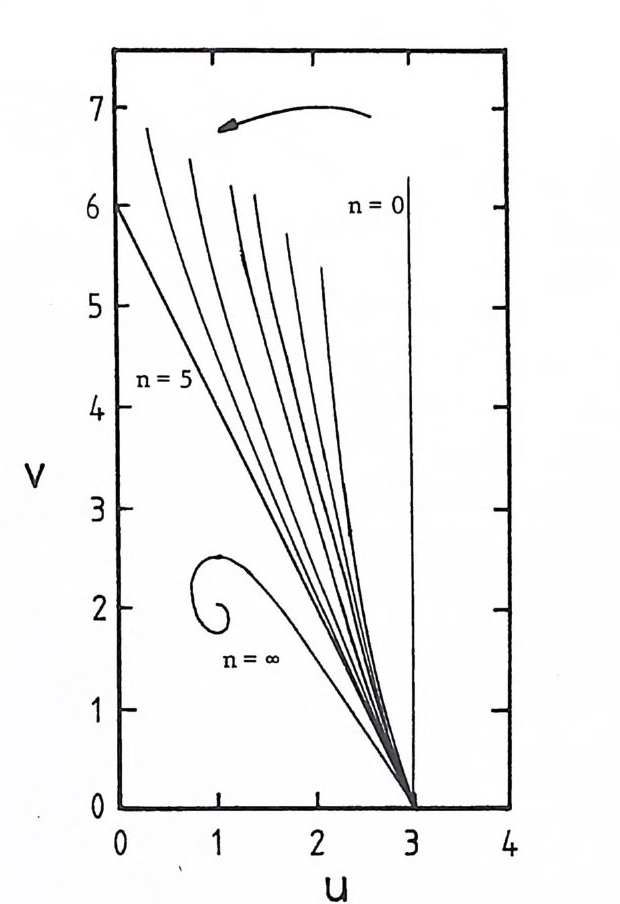 7
7
Fi g 3-1: Emden fa mi l i e s of uv-curves fo r vary ing po lyt ro p ic in dex. For di s cussi o ns on th e is ot h ermal case, n=', see th e next sect ion. To st u dy th e behavio u rs of Fowler-a nd Mi l ne-soluti on s near th e orig in a nd th ei r relati ons to th e Emden-solut ion, we may ap pr oxim at e th e orig ina l eq u at ion for x and y in th e form 으y 효dx = - (n+2 l()nx+ +1 ) ny whi c h must be hold in th e limi t where x+O and y-+ -0.
We now in t r oduce a new varia ble z def ined by z 三 y/ x, we th en use th e log a rit luni c di ffere nti al dz/z = dy /y - dx/x or iy d立x =iz 브dx+ •i x ' to elim ina t e y from th e ap pr oxi m at e eq u at ion: 으z 브dx +• 2x = - 으x (n +( n1 )+ +1 ) nz After some fu rth er manip u lat ions we fina lly sepa rate va: r i a bles and obt a i n 3 d—zz + 2 d{ 55 ++ 33nn// ((nn ++ 11 )) •. zz } + 5—d Xx = 0 , in t e g r ati on of whic h yield s (i; + 붉T z) 2 군 x5 const a nt . Ret u rnin g back to th e orig ina l homolog y in varia nt s we have [5(u-3) + 폼i v] v3/ 2 = c, where C is th e in t e g r al consta nt whose sig n det e rmi n es th e homolog o us family . For C=O we have v = -프 뭉:...!2. cu - 3) , whi c h correspo nds to th e Emden-solut ion in ag r eement with our pr evi o us di s cussio n. For C> 0 it should hold th at V > - 프뭉:..!2.. (u - 3) .
And th e Fowler-Solut ion was or igina lly obt a i n ed from such a boundary condi tion th at -dd~0 F > ddE0 E ' where we have desig n at e d ·th e Emden-and Fowler-solut ion exp licitly by 0E- (0 and 0F· (0 . Consi d erin g th e relati on betw een v and 0' , we may conclude th at th e case of po sit ive in t e g r al consta nt correspo nds to th e.F o wler-solut ion whose uv-curve li e s on th e rig h t hand si d e of th e Emden curve . Si m i l ar reasonin gs show th at th e case of neg a t ive in t e g r al const a nt repr esent s th e }1iln e-solut ion because it was obt aine d -f' rom th e boundary condit ion dd0; M < -dd~0 E • The Miln e.,-solut ion should lie o n th e left hand si d e of th e Emden-solut ion in th e uv-pl ane. We may at tai n fu rth er in sig h t in t o th e natu re of vario us solut ions from th e exact form of th e homolog y in varia nt dif fere nt ial eq u at ion for th e uv-varia bles. The. s t r aiUg +h t — nl+inl eV g-iv e1 n= b y0 , 1 whic h makes dv/du eq u al zero, should tr ace th e ta ng e nt po i n t s horiz ont a l to th e uv-,curve; th e st r aig h ut +li —nne+ m 1 aVk i n- g 3 d=u /d0v, zero n sh?uld tr ace th e verti ca l ta ng e nt po i n t s . For n 츠 3 th e tw o loc i in t e rsec at a po i n t give n by u = nn--13 and V = 2 nn+-1 1 •
Si n ce th i s in t e rsect ion po i n t li e s on th e left si d e of th e Emden curve, th e uv-curve of th e Mi lne -solut ion should ap pr oach th e po i n t in a sp ira li ng fa shi o n as dep ict e d in Fig u res 3-2 and 3-3. The exi s t e nce of such a sp ira l cent e r sug ge st s th e exi s t e nce of si n g u lar solut ions . Furth er di s cussio n on th e si n g u lar solut ion wi ll b e fo llowed in th e next sect ion. For 1 < n ~ 3 th e solut ions of cent r ally condensed type , M-solut ion, converge to a po i n t (u=O , v = n+l ) as ~-+O . For n < 5 th e ta ng e nt of th e curves in bot h fa mi lies near th e surfa c e (u+O , v+«>) is give n by 緖=-点 [1+~+ …] , and ap pr oaches th e Emden-curve. As examp l es of Fowler-a nd Miln e-curves and th eir relati on to Emden-curve we have repr oduced in Fig u re 3-2 th e case of n = 3/2 and in Fig u re 3-3 th at of n=4 give n by Hay a shi , Hoshi and Sug imo t o (1962) . Problem 3-14 : Deriv e th e asym ptot ic r elati on fo r d ln v/d ln u in th e lim it u+O and v-+-o>.
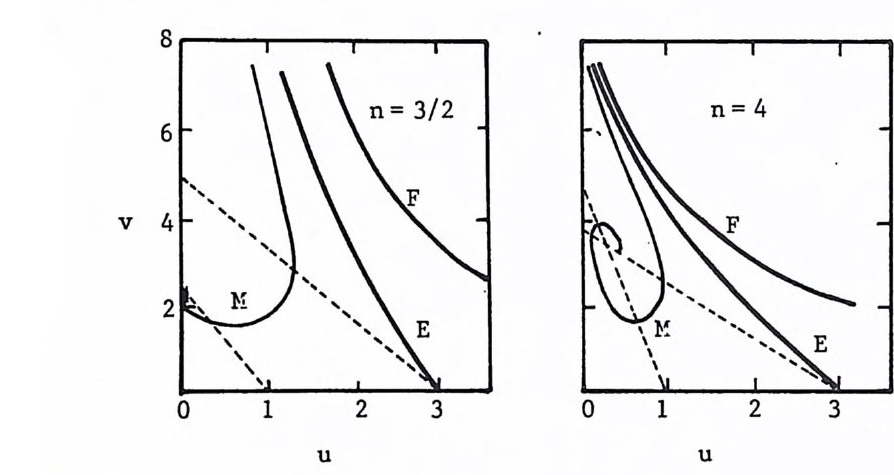 8
8
Fi g 3-2 and 3-3 : uv-curves fo r n = 3/2 and n = 4 . Dashed li n es rep r esent th e verti cal and horiz ont a l ta ng e nt po i n t s to th e J111 lne-curve.
3.3.4 Comment s on th e Fowler-a nd Mi l ne-Solut ions If one in t e g r at e s th e Lane-Emden eq u at ion from ; = ;n wi th s uch a boundary condit ion th at th e ta ng e nt [-d0/d;]C is large r th an th e value th e Emden-solut ion would need at th e boundary pn oi n t , as he pr oceeds to wards th e cent e r, 0 hence th e densit y in creases more rap idl y th an th e Emden-solut ion 0E~ (0 . He wi l l be th erefo r e in short of mat e ria l bef o re th e cent e r is reached; th e densit y di s t r i b ut ions pr escrib ed by th e Fowler-solut ion th us have a hole at th e cent e r whi c h makes th e solut ion ph y s i c ally ~ - On th e ot h er hand, fo r a solut ion whi c h st a rts wi th a ta ng e nt [-d0/d;]L smaller th an its c orrespo ndi n g value of th e Emden-solut ion , 균 d0/d; onr M(r) remain s fini t e i n th e cent r al reg ion . The Miln e- solut ion 0M(;) becomes in f ini. t :e as ;+O; if one bui lds a po lyt ro p e foll owi n g the pr escrip tion set by th e Miln e-soluti on he wi l l end up with some left -o ver mass at th e cent e r. These solut ions of cent r ally condensed. type are ph y s i c ally meani n g l ess ag a i n at th e cent e r, neverth eless th ey pl ay an im p o rta nt role in modelin g th e out e r envelop e of st a rs with a shell source. Chandrasekhar (1939) ga ve th e asym pto t ic b ehavi o ur of th e Mi l ne-solut ions for E;,- +-0: 0:(E;) ~ A + 『 n< 3 같 (E ) ~ ½[ 2 ln (C/0 ] -1/2 n= 3 o:(E) ~ [~_겔 ] 1/(n-l) ~2/(1 - n) 3< n< 5 where A, B and C are const a nt s .
Problem 3-15: Show th ese asym ptot ic s olut ion? of 0(;} correspo nd to th e sp ira l cent e r in the uv-pl ane at th e po i n t {u= (n-3)/(n-l) , v= 2(n+l)/(n-l)}. 3.3.5 Comp o sit e P olyt ro p e As an ap plica ti on of th e homolog y in var iant s we shall consi d er a comp o sit e c onfi gu rat ion whi c h consi s t s of tw o di ffere nt zones each charact e r ized by a di ffere nt value of th e po lyt ro p ic in dex. Let us sup po se th at a core of in dex n. is surrounded by an envelop e of anot h er in dex m and th at th e core-radi u s is q time s th e to t a l radiu s . The pr oblem is to const r uct an eq u i l i b riu m conf igu rat ion of such comp o sit e st r uctu re from th e give n mass M and radi u s R by ap pr op r i a t e ly di s t r i b ut ing th e mat ter .
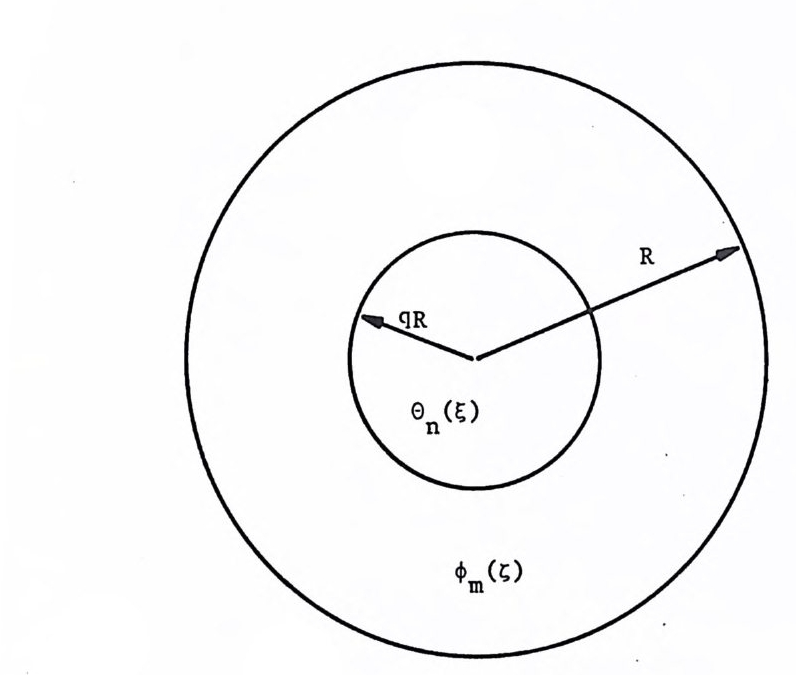
Fig . 3-4: A comp o si te p o lyt ro p e of th e core-envelop e confl igu rat ion.
We shall desig n at e th e solut ion of th e Lane-Emden eq u at ion in th e core by 0n(0 and th at in th e envelop e by 4>n (i;; ) • We fur t h er let th e varia b les at th e core-envelop e inter fa ce be si m p l y 0 , ~ • 4> and i;; • At th e in t e rfa ce th e values of ph y s i c al qu ant ities p, P, r and M(r) give n by th e tw o sets of solut ion 0 and 4> should be id ent ica l . We th us have th e fo llowi ng cont inui ty condi tion s fo r th e densit y, pr essure radi u s and th e mass, respe ct ivel y: K C 0 n =_ K e ¢.m , K c Alc + l /n 0~ l+ n = K e Ae 1 +1 /rn ¢. 1-½ -rn [털 Kc]l/2 {l-n)/2n f, = [밑 Ke]l/2 A1l-m)/2m i;, [밑 KC] 3/2 A 尸 3-n)/2n 단 운 [맡길 3/2 ).~3-m)/2m 겁명 · It should be clear th at th e core-solut ion 0 n should be one of th e Emden fam i l y whi l e th e envelop - soluti on ctm,_ is not necessaril y of th e same fam i ly. The pa ramet e r -C m ay be id ent ified wi th t h e cent r al densit y of th e core; whi le t h at may not be po ssi b le for AeP si n ce th e soluti on whi c h does not ext e nd to th e cent e r can have a si n g u larit y at th e orig in. For th e pr esent e- is left to be an arbi trar y const a nt whi c h will event u ally be fixed by sele~t ing a pa rti cu lar solut ion out of a homolog o us fam i l y whi c hever th at may be . At any rate if one not e s th at Xc_ ', Xe_ , Kc and K~e have di r ect bearin g s on th e scale pa ramet e r a's hence th e homolog y consta nt , he wi l l realiz e 1:h at elim i n at ion of th ese pa ramet e rs should reduce th e sy s t e m of cont inui t y condi tions to one in volvi n g only th e homolog y in var iant s .
Pay ing a pa rti cul ar at ten t ion to th e po wers of >.'s we rai s e th e radi u s-cont inui t y relat ion to th e th i r d po wer, multi pl y by th e densit y- cont inui t y, and fina lly di v i d e by th e mass-cont inui t y relat ion. Thi s pr ovi d es us wi th th e desir ed relat ion betw een in t e rfa ce-pa ramet e rs: n .m E 후d0/_d~ =-尸 ., 그dcj> /―dr; ' whi c h becomes si m p l y Iu (n;O u(m; r,;) ]. From th e densit y-a nd pr essure-cont inui ty relati on s, we now fo rm K c Ac1 /n 0 = K e Ae 1 /m ¢, and we di v i d e th i s by th e pr oduct of th e radi u s-a nd mass-cont inui t y relati ons to fina lly obt a i n (n+ l)f;. 쁘뿌O - = (m+ l)r; ~뵤¢ 또 ’ whi c h becomes si m p l y Iv(n;E) = v(m;c) |. Because th e po lyt ro p e wi th i n dex n ext e nds to th e very cent e r we should choose th e Emden-curve for [u(n;~) , v(n;~)] in th e uv-pl a ne. We should th en det e rmi n e whic h fam i ly, Fowler or Mi l ne, of solut ions is relevant for th e envel~p e with th e give n in dex m. Thi s is done by findi n g th e uv-curve whi c h in t e rsect s th e Emden-curve of in dex n.
The fo llowi n g th eorem is of in t e rest in th i s connect ion: If [ u(n;t; ), v(n;r; J] correspo nds to th e Emden-(!U r ve, th en th e eq u at ions of cont inui t y condit ions have a solut ion if, a 函 only if, th e envelop e of i函 e :r: m is describ ed by a Fowler-o r a Mi l ne-solut ion accordin g as n is less th an or gr eate r th an m . Furth er it is assumed th at m < 5, n < 5, a 函 n ~ m (Chandrasekhar 1939). Thi s th eorem is an obvi o us consequ ence of th e characte ris t ics th e tw o fa mi l i e s of uv-curve have with respe ct to th e Emden- fa mi l y in th e uv-pl ane. From th e in t e rsect ing po i n t we can also det e rmi n e th e rati o r ;/r; m where r;m_ is th e first z ero of th e envelop e solut ion, si n ce each po i n t of th e uv-curve correspo nds to a def ini t e v alue of r;/r;m_. We should fcuhre ct hk ewr hfeitx h etrh er; /rv;_ma l uies oef q u daql, m _ t/ do r; tha et pr; r= e sr;mc_,r ibe veden r aift i o r;q/ r.; _m = Wq,e bsheocuaulds e all th e members of a homolog o us fa mi l y have th e same r,/r;m_. Only af ter assig n i n g a pa rti cu lar value to [dq,m /dr, ].,_r, m ,· o• ne can ef fec t th e necessary di s t r i b ut ion of th e avai l able mass; such an assig n ment is easil y done by ap pl y ing th e mass-radi u s relat ion deriv ed in sect ion 3.2.3 to th e give n mass M and radi u s R. We th us have selecte d a pa rti cul ar member of th e h~molog o us fa mi ly for th e envelop e . Emp l oy ing si m i lar p r ocedures fur t h er on to th e core, one det e rmi n es_ th e whole conf igu rat ion of th e comp o sit e po lyt ro p e . Problem 3-16: Const r uct a comp o sit e p o lyt ro p ic st a rs of th e to t a l mass M=M 。 The is ot h ermal core at te mp e ratu re 5 x 10⁷ K ext e nds up to M( r) ~ 0 .1 M and it is comp o sed of th e mat e ria l wi th m ean molecular weig h t 1. 5 whi l e th e envelop e in convect ive eq u i l i b riu m (n = 3/2) is comp os ed of mat e ria l wi th t h e mean molecular weig h t 0.6. For conveni e nce yo u may assume th at th e envelop e solut ion is th e Emden solut ion of n = 3/2 . Obt a i n th e radi u s of the comp o si te s t a r. Not e th at this exercis e is ai m ed at knowi n g an ap pr oxi m at e st r uct u re of a red gian t (Chi u 1968) .
3.4 THE ISOTHERMAL POLYTROPE Isot h ermal po lyt ro p e s deserve our sp e ci a l in t e rest s , si n ce many ki n ds of celest ial bodi e s can be id eal ized si m p l y as is ot h ermal ga seous sp h eres: To ta ke a fe w, cores of hy d rog e n exhaust e d mai n -seq u ence st a rs in th e mass rang e one to tw o solar masses, di ffuse in t e rste llar clouds of moderat e ly low densit ies, and dy n ami c ally well-relaxed sy s t e ms li k e gl obular cluste rs or cluste rs of ga laxi e s could all be go od examp l es of is ot h ermal sp h eres. In th i s secti on we wi l l first consi d er ge neral charact e ris t ics of is ot h ermal solut ions , th en ap pl y th em to in t e rste llar clouds and gl obular cluste rs to at tai n in sig h t s in t o th ei r eq u i libri u m pr op e rti es and dy n ami c al st a bi l i ties as well. 3.4.1 Eq u at ion and Solut ions fo r th e Isot h ermal Poly tro p e If tem p e ratu re is const a nt over th e whole sp h ere, th e eq u at ion of st a t e , in cludi n g th e rapd =i a —µt ki떄 o np _Tc o m+. p ~ao3 T ne4n t , can be wri tten in a st a ndard fo rm of th e po lyt ro p ic relat ion P = Kp + D. The eq u ati on of hy d rosta t ic e q u i libriu m th en ta kes th e form 上r2 브dr ('-r2 브르dr) = -4nGP , whi c h sug ge sts us chang e of varia bles as P = pc exp [ -1/l (r)] r = [습]C 1/2. E;. 三 aE
and yiel ds g今 옮 (E2 뿔) = exp [ 재 (0) . Thi s is nn is ot h ermal eq u i v alent fo r th e Lane-Emden eq u at ion, and we shall si m p l y call th e is ot h ermal eq u ati on . Problem 3-17: Exp r ess th e chang e of gr avi tat i ona l po t e nt ial fro m th e cent e r [,=O to th e di s t a nce [, in te rms of th e is ot h ermal fu nct ion lj,([,) • Problem 3-18: Prove th at th e is ot h ermal eq u at ion also ad mitts th e homolog y th eorem. If lj,(;) is a solut ion of th e is oth ermal equ at ion, th en lj, (A;)-2 ln A is _al so a solut ion of th e eq u at ion, where A is an arbi tary const a nt . The solut ions whi c h sat isfy th e boundary condi tions give n by tlJ= O and d$/d~ = 0 at ~=O shall ·be called as th e Emden fa mi ly ~f solut ions fo r th e is ot h ermal po lyt ro p e . It does not seem to be po ssib le to obt a i n an ex plici t in t e g r al of th e is ot h ermal eq u at ion; th e fo llo 떠.ng po wer serie s exp a nsio n u = 강군 가듦컵 + 습한 + … ; E<
u and v in th e ta ble. Once th e is ot h ermal fun ct ion 1/1 (0 is kno~, one can det e rmi n e th e st r uct u re of a comp l ete is ot h ermal ga s sp h ere; th e mass M(O and th e mean densit y P(0 of th e mat e ria l in t e rio r to E; are give n by M(l; ) = 4 군% 근 뿜 and 값 0 = Pc %問 respe ct ivel y: The densit y di s t r i b ut ion of an is ot h ermal sp h ere fo llows p( S) ' pC ( 1 - 강군,+ ... ) (s«l) in th e centr al reg ion , whi l e in th e out s ki r t it varie s as p (0 p C 곱 ex p [*cos{ 운 ln~- ti}] ; (E:,»1) . Si n ce th e exp o nent of th e above eq u at ion te nds to zero as ~--, we can fu rth er exp a nd th e ex po nent ial and obt a i n P (E;) = pc 습 [ 1 + 令 cos { 운 lnE; - o }] E+0 . The mass of is ot h ermal sp h ere th us in creases as th e radi u s witho ut bound, si n ce th e mass dM(O cont a i n ed in a sp h eric al shell of th i ck ness dt ' is pr op o rti on al to PC- d t and t ext e nds to in f ini t y fo r th e is ot h ermal po lyt ro p e .
-158 -
We have, in figu re 3-5, pl ott ed exp [ 재 (0) ag a i n st ~ to il lustr ate th e normaliz ed densit y di s t r i b ut ion of ios t h ermal ga s sp h ere. The numeric al dat a used in th i s drawi n g are ta ken fro m th e ta bulat ion by Chandrasekhar and Wares (1949). For conveni e nce we have marked th e e-fo l di n g and e2-fo l din g scales for th e in f ini t ely ext e ndi n g densit y st r uctu re of th e is ot h ermal ga s sp h ere. The charact e ris t ics of th e is ot h ermal di s t ribu t ion wi l l be most clearly di s p l aye d in th e {log p( r), log r} pl ane·b y tw o almost st r aig h t lines of slop e zero and -2 meet ing each ot h er at r = a (see Problem 3-24) . 3.4.2 Isot h ermal Solut ion in th e uv-Plane Emp l oy ing th e homolog y in varia nt varia bles defi ned as u 三 ~ exp [-lj, ] /lj, ' and v 三 ~lj,1 wi th lj ,1 bei n g · d lj, /d ~, we may reduce th e second order eq ~ at ion of is ot h ermal di s t r i b ut ion to th e first order eq u at ion as ddllnnuv = - uu+-v1- 3 Thi s homolog y in varia nt eq u at ion can also be obt a i n ed by ta ki n g th e correspo ndi n g di ffere nt ial eq u ati on of. po lyt ro p ic in dex n to th e lim it give n by n-+라 th e homolog y in varia nt s u and v repr esent , as bef o re, th e loga rit hmi c gr adi e nt of th e in creases in log a rit hms of mass and pr essure, respe ct ivel y. , Therefo re th e uv-curve of all th e solut ions in th e Emden- family , whi c h are ph y s i c aUy meani n g ful at th e orig in E;삭 0, also st a rts from th e po i n t (u=3, v=O ) with th e slope of -5/3. The uv-curve sp ira ls, as shown in Fig u re 3-6, to ward th e po i n t (u=l, v=2 ), whi ch is th e in t e rsect ing po i n t of tw o st r aig h t li n es give n by u=l and u + v-3 = 0, si n ce the fo rmer tr aces th e horiz ont a l ta ng e nt po i n t s to th e uv:--curve whi le th e latt er does th e verti ca l ta ng e nt po i n t s . By ta kin g ap pr op r ia te boundary condi tions for Fowler-a nd Mi lne- solut ions , we have numeric a lly in t e g r ate d th e first order di ffere nt ial eq u at ion. The results _ a re pl ot ted in Fig u re 3-6, where Fowler-a nd Miln e.:.curves are comp a red with th e Emden-curve. The curves of th e th ree families all sp ira l-in a,ro und th e same po i n t (u=l, v=2 ) as f;-+o>, whi ch in di c ate s an exi s t e nce of th e asym pto t ic s oluti on for 1/l(E;) at E;-. (Conf e r th e foll owi ng pr oblem.)
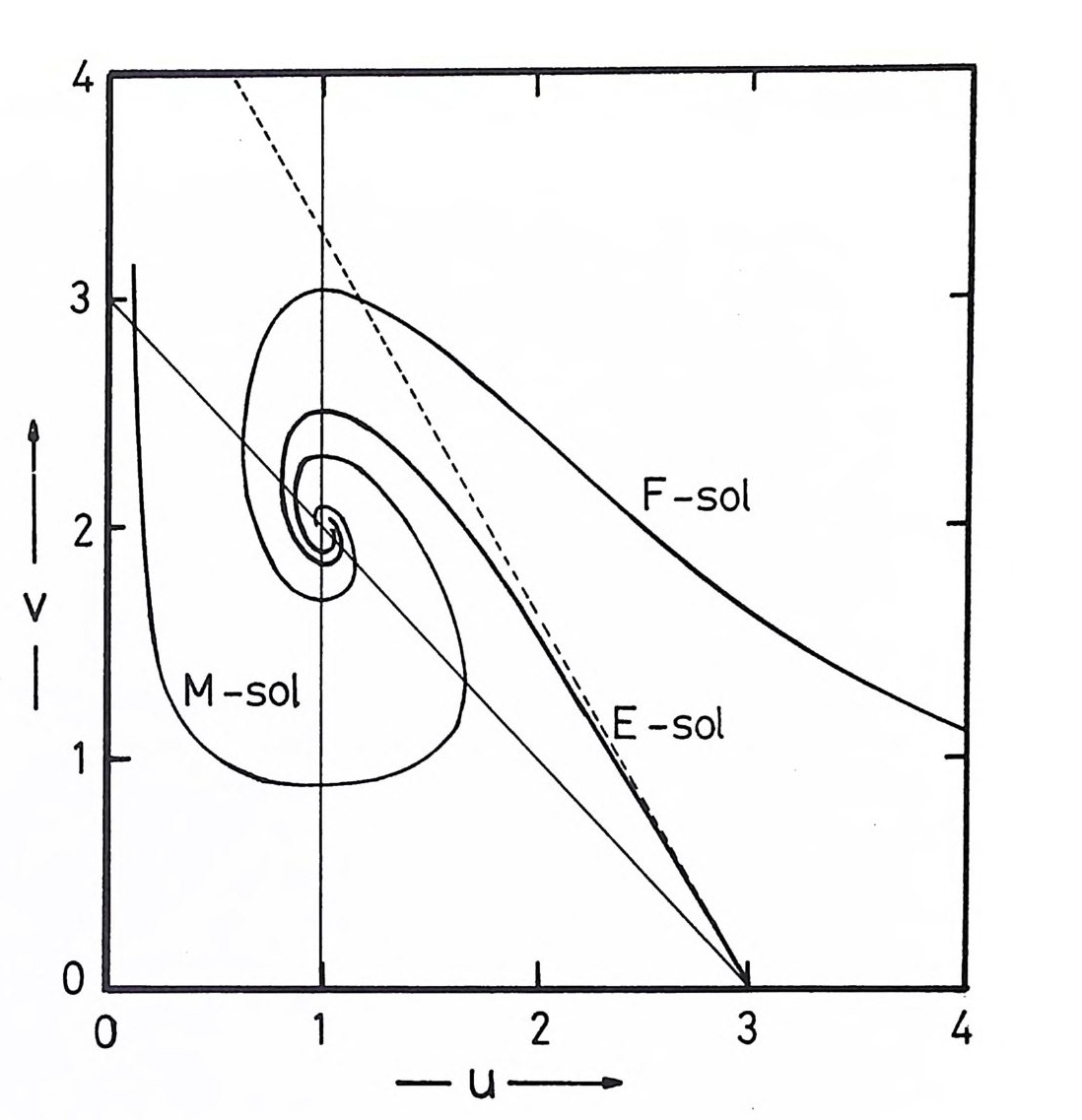 4 `` \ \` \` ` \``,\\
Fi g 3-6: The uv-curves of Fowler-a nd Mi lne- fa mi lies are comp a red to th at of Emden fa mi l y . All fa mi lies ap pr oach th e same po i n t (u=l, v=2) as ~ in creases. The tw o th i n st r aig h t sol id l i_ne s tr ace th e horiz ont a l and verti ca l ta ng e nt po i n t s to th e uv-curve; th e dashed st r aig h t line does th e ta ng e nt to th e Emden- curve at (u=O, v=3).
Problem 3-19: Show th at th e sp ira l cent e r (u=l, v=2) correspo nds to th e asym p tot ic s olut ion give n by W(£) = ln T균 一A cos [ T✓ 7 l n f, - o ] E ➔ 00. 仕 Problem 3-20: By ta ki n g th e first - order di ffere nt ial eq u at ion fo r th e is ot h ermal uv-varia bles to th e li m i t u-+3 and v ➔ O, yo u may verif y th at th e di ffere nt ial eq u at ion has th e fo llowi n g closed fo rm of in t e g r al (S(u-3) +v] v312 = const a nt , whi c h holds fo r th e give n li m i t. You may id ent ify th e Mi l ne-curve in Fig u re 3-6 wi th a neg a t ive const a nt of in t e g r al and th e Fowler-curve wi th a po si tive const a nt . 3.4.3 Int e rste llar Clouds It is fo und th at wi th t h e heat ing done by low energy cosmi c ray s th e tem p e ratu re in dif fuse in t e rste llar clouds is rath er in sensit ive to th e densit y in th e rang e from a fe w to hundred hy d rog e ns pe r cubi c cent imet e r (Fi e ld, Goldsmi th a nd Habi n g 1969). Then th e is ot h ermal po lyt ro p e seems to be a go od first order ap pr oxi m at ion fo r in t e rste llar clouds in st a ble ph ases. However, di ffuse clouds of moderat e densi ties and low tem p e ratu re are usually in pr essure balance wi th t h ei r surround- in g medi u m of hot rarefi ed ga s , th ereby bein g conf in ed wi thi n fini t e di m ensi o ns; whi l e th e is ot h ermal ga s sp h ere ext e nds to in f ini t e di s t a nce. Conseq u ent ly, th e is ot h ermal po lyt ro p e in its u sual fo rm may not be adequ at e fo r describ i n g st r uct u res of is olat e d in t e rste llar clouds; an ext e rnal-pr essure bound is ot h ermal ga s sp h ere mig h t be a bet ter repr esent a t ion fo r such in t e rste llar clouds. We shall exami n e how an in t e rste llar cloud of fixed to t a l mass M adj u st s its o wn in t e rnal st r uct u re and si z e to th e vary ing pr essure P 。 of its a mbi e nt medi u m. The hy d rosta t ic eq u i libriu m condi tion 뻑r2 = -브 ll~ [L 브dr ln p (r)]
should also hold at th e cloud boundary r=R under an ext e rnal pr essure. Af ter exp r essin g th e balance eq u at ion in te rms of th e is ot h ermal fun ct ion lj,(E;), we re-arrang e th e result fo r th e cent r al densit y as % 갑(均 3 *• ' [ 낌 ljJ I(£;0)] 2 where [,_o denot e s th e value of [, at th e boundary . Subst itut ion of p c in t o th e is ot h ermal po lyt ro p ic relat ion and in t o th e scale pa ramet e r a yiel ds th e st r eng th of th e ext e rnal pr essure Po = 志 푹 4 *, ' [_ ~~ qi1 (~0_) r2 exp [-qi(~ 0)] ' and th e cloud ext e nt R = ?. GM [E;0 '.ji1 (E;0 )] -1 respe ct ivel y. We may add, fo r comp l ete ness, th e deg r ee of densit y concent r at ion r-c /p = r,o_ /31/ J' (e,o_ ) to Pc- , P_o and R as qu ant ities charac- te riz i n g th e cloud st r uct u re. These pa ramet r i c repr esent a t ions of pc_ , Po_ , R and pc_ /p comp r i s e th e sequ ence of models in whi c h th e to t a l mass is fixed at a const a nt value M but t,_。 is varie s. In Fig u res 3-7a, b and c, we have il lustr ate d how th e radi u s, centr al densit y and pr essure chang e wi th t h e pa ramet e r r,。_ . (The is ot h ermal fu nct ion give n by Chandrasekhar and Wares (1949) has been used in th ese di a g r ams . ) Si n ce 1/J ' (t,。 ) is about eq u al to e,/。 3 for fsmo ra lclo vnastlu a nest mofa srs, o_ t, h eth ec loculodu dc onrafd igi uu sr avt aiorines sw ii tn hv es rmseallyl vasa lu군eo s.\ of Trh, 。u s are very ext e nded ones wi th l ow pr essure, low densit y and very li ttle densit y concent r at ion. Wi th i n creasin g t,_。 th e cloud cont r act s , pr essure and densit y in crease , and th e clo~d becom.e s more cent r ally condensed.
The in creasin g tr end of th e pr essure wi th f, , however, slows down 。 its t em p o as f, o_ ap pr oaches a cri' tica l value f, m__a x.. ' 6 . 47 , af ter th e pr essure at tai n i n g th e maxi m um value it decreases wi th f,。_ ; whi l e th e cent r al densit y cont inue s to in crease wi thou t a bound. Mat h emat ica lly, th e reversal in th e pr essure varia t ion is broug h t by th e exp o nent ial fac t o r exp [-lj,(f,on )] in th e exp r essio n for Pon ; ph y s i c ally, such an accelerat e d in crease in th e gr avi tat i ona l po t e nt ial lj,(f,0 ) as to undermi n e th e pr essure in crease is orig ina t e d fr om th e in crease in densit y concen- tr at ion. As can be seen fro m th e dep e ndence of gr avi tat i on al po t e nt ial energy up o n th e po lyt ro p ic in dex hence up o n th e deg r ee of cent r al concen- tr at ion (see sect ion 3.2.3), an in i tial densit y concent r at ion whi c h may have resulte d almost exclusiv ely fro m an in crease in th e ext e rnal pr essure wi l l pr ovi d e th e self -gra vit y wi th m ore fa vourable condi tion fo r con- tr act ing th e cloud th an wi thou t th e concent r ati on , whi ch in tu rn brin g s a fu rth er concent r at ion to th e densit y st r uct u re. The acti on pl aye d by th e gr avi_ t y ap pe ars as a slowi n g - down of th e pr essure in crease wi th ~。- , and th e mut u al coop e rat ion betw een th e self- gr avit y and th e densit y concent r at ion makes th e self -gra vit y at tai n more im p o rta nce th an th e ext e rnal pr essure in shap ing th e cloud. Event u ally at th e crit ical moment f, = ~m--a·x· ' an in f in_ites im al in crease in pr essure causes , as shown in Fig u re 3-8, a fi!9-~ in crease in cent r al densit y. At th i s st a g e p C amount s to 5 . 74 times th e mean densit y p . Conf igu rat ion of p C_ ~~ 6p are so cent r ally condensed th at less th an th e maxi m um pr essure Po_ (·7~m--a~x ) is requ i r ed to conf ine th em; th e self -gra vit y_ t h us domi n at e s cloud st r uctu res over th e pr essure. Si n ce th ere is no need fo r in crease in pr essure fo r ge t ting hig h er pCn , th e bi n di n g pr essure of th e ambi e nt medi u m no long e r mat ter s fo r confi gu rat ions with ~o- > ~m---a-x - · Thi s is what has actu ally happ e ned to th e ga s under is ot h ermal condi tion ; th e result is an eq u at ion of St a t e il lustr ate d in Fig u re 3-8. We may , th en, ap tly te rm th e P 。 versus pc relat ion as ~ 무, foll owi n g Bonnor's (19 56) po i n t of vi e w ex pr essed in a hi s t o ric ally im p o rta nt st u dy Boy l e's I.ca,) and Gravi tat i ona l, Insta bil ity. We may not ice fro m Fig u re 3-8 th at th ere are tw o confi gu rat ions are po ssib le fo r a give n value of Po_ : one of small •p _c bound by ext e rnal
pr essure and th e oth er of large p_ bound by sel f-gra vi ty. Our for eg oing C consi d erat ion on th e charact e ris t ic b ehavi o ur of th e pre ssure-densi ty relat ion, in pa rt icu lar, an in crease in densi ty bei ng accomp a ni ed by a decrease in pr essure, clearly sug ge st s th at th e denser conf igu rat ion is likel y to be unst a ble. Ebert (19 57 ) pro ved by pe rt u rbat ion analys is th at this is in deed th e case; all conf igu rat ions wi th t; ,_o large r th an t;, max are gr avi tat i on ally unst a ble. This in st a bi lity of an is ot h ermal sp h ere is an examp le of th e well-known in st a bi li ty whi c h occurrs to syste ms wherei n pr essure vari e s as pY and y < 4/3. Problem 3-21: Prove th at an is ot h ermal ga s sp h ere of fixed mass sat isf i es th e fo llowi ng relat ion bet ween fr act ion al varia t ions , oPc_· /p• _C and oR/R, in th e cent r al densi ty and radi u s: o—pc % = 3 OR_R 2 P/P_。 - 3 where p_。 denot e s th e densi ty at cloud boundary . yo u may conf e r Bonnor (1956) fo r th e deriv at ion. Put ting I; m__a__x into I·;_o wpem~ o-a-bx- t =a in1 . t4h0 (e· 一 µm)떄a x im —Gum3M 2p re ,ss ure kT , h' 1 and th e minim um radi u s µ~ Rmi n = 0.41(k. T) GM , at whi c h an is ot h ermal cloud of mass M and te mp e rat u re T can exi st. i n pre ssure eq u i libriu m wi th t h e surroundi ng medium. At this crit ical conf igu rat ion, th e cent r al densi ty of th e cloud becomes
p c1 c rt. = 19 . 8 (·µ—km 'lH ' ) · `’ G—3 l M 2 , and th e mean densit y becomes p- c rt = 3 . 47 ( —µkmTH ) 3 -C3l M 2 · Conseq u ent l y , th e rat io o f cent r al to mean densit y becomes [P/ii ] . = 5.73 , crt for th e crit ical conf igu rati on . Taki n g anot h er po i n t of vi e w on th e crit ical confi gu rat ion, we may consi d er th e mass give n by Mcrt = 1.1 8 ( :? /글=;- , 。 as a crit ical mass bey o nd whi c h th e cloud of a give n te mp e ratu re can not exi s t in gr avi tat i on al eq u i libriu m wi th t h e give n ext e rnal pre ssure P。- ; clouds havi n g masses gr eate r th an th i s crit ical value wi l l undergo gr avi tat i ona l collaps e. Elim i n at ing P 。 in fa vour of Pc 야 ;; at th e crit ical confi gu rat ion, we may rewrit e t h e crit ical mass in th e fo rm 3./2 Mcrt = 4.45[ 걸曰 같 ’ or Mcrt = 1.86 [틀] 3/2 六
On th e ot h er hand, Je ans' classic al analys i s , as give n in th e next chap ter , on th e gr avi tat iona l in st a bi l it y of a cloud wi th u ni form densit y p yiel ds th e crit ical mass as MJ = 5 • 57 [ 특 ·걸 ] 3/2 亡 · If we ta ke th e mean densit y p of is ot h ermal· c loud eq u al to th e densit y p of th e cloud assumed to be homog e neous, th e cent r al densit y concen- tr ati on th eref o re reduces th e mi n i m um st a ble mass ag a i n st th e gr avi tat i ona pu ll by a fa ct o r about th ree. Problem 3-22: Read an arti cle by Ju :r:; a (1976) on th e collaps e of cloud subj e ct to ext e rnal pr essures, and make a tw o-p a g e repo rt on th e varia t ion of slop e , in log - log pl ot, of th e curve fo r th e crit ical mass and ext e rnal pr essure. 3.4.4 Isot h ermal Model of Globular Clust e rs In th i s sect ion we shall exami n e, fol lowi n g Miha las and Rout l y (19 68) how go od th e is ot h ermal sp h ere is fo r charact e riz i n g th e in t e rnal densit y st r uct u re of gl obular cluste rs. Ei ther by di r ect l y count ing st a rs in successiv e concent r i c ri n g s on th e ph ot o g r aph i c im ag e of a gl obular cluste r, or by converti ng th e di s t r i b ut ion of surfa ce brig h t n ess in t o th at of st a rs under an assump tion of eq u al mass m and lumi n osit y fo r all th e members, one det e rmi n es surfa c e-densit y di ~tri b ut ion N(s), not di r ect l y volume-densit y n(r). The observable N(s) is th en relate d to n(r) by th e fo llow ing in t e g r al: N(s) = 1' n(r) dz wi th r 2 = s2 + 균, where r, s and z are radi a l di s t a nce, pr oj e ct e d radi a l di s t a nce and line-o f - sig h t di s t a nce, respe ct ivel y. By solvi n g th i s Abel type in t e g r al eq u at ion, we obt a i n
n(r) = - —T1lr —dd r J ,0 r0 NJs(2 s )-s r d2s for th e radi a l di s t r i b ut ion of st a rs in th e cluste .r . Wi th t h us emp iri c ally det e rmi n ed n(r) on our hands, we may now fo rm th e mass di s t r i b ut ion d M(r) = 411 군 mn(r) dr , and fu rth er evaluat e th e po t e nt ial energy ~(r) pe r uni t mass at radia l di s t a nce r fr om th e cluste r as
Wi th t h i s rat io, we now relate th e velocit y di s t r i b ut iJn fr.nc t ion s as n(r)
because th e tr ansverse-velocit y vect o r can po i n t in any di r ect ion in th e pl ane pe rpe ndi c ular to u。_ . Si n ce th e relaxat ion time s of gl obular cluste rs are ge nerally much shorte r th an th ei r ag e s, as demonst r at e d in sect ion 2.4.3, th e Gaussi a n di s t r i b ut ion may be very near th e realit y pa rti cu larly in cent r al reg ion s where relaxat ion is exp e ct e d to be comp l ete . Subst itut ing our Gaussi a n in t o th e above relat.i o n in a box and af ter some fu rth er alge brai c manip u lat ions wi th t h e condi tions fo r energy and ang u lar moment u m conservat ions , we fina lly relate th e di s t r i b ut ion of st a rs at 1' in te rms of th at at r>。_ : h k2 n( 마 (u,w) = n(r0) exp [ -2h~(
Unf o rtu nat e ly we have no di r ect observat ion al in f o rmat ion on th e asym met r y in velocit y di s t r i b ut ion bet w een radi a l and tr ansverse comp o nent s , namely, th e rat io k 0~ /h~0 . As was pr evi o usly di s cussed, however, th e relaxat ion is exp e ct e d to be st r ong enoug h to set- up a comp l ete eq u ip a rti tion among all th e velocit y comp o nent s at least at th e cluste r cent e r. If so, th e velocit y di s t r i b ut ion becomes sp h eric al wi th t h e same si z e of di s p e rsio n k2 = k~0 = h~0 th roug h out th e whole cluste r. In th i s case we can rewrit e t h e sp a ce de 먀 s ity di s t r i b ut ion in th e fo rm n(r) = n(r0) exp [-2h~ (~-~0)] , or n(r) = n(r0) exp [ -(
-176 -
wi th v elocit ies gr eat e r th an th e escap e velocit y is give n by Q- = —J4T - f <0 v 2> l1 exp [--23 _
J h。 o V oo exp [-x2 1 dx -h o v a, exp [ -ho2 균o ] Q = f h。 O v00_' exp [ -x2 ] dx -h 0 v.!, exp [-h20 균00 ] where v Cl) rep• r esents th e escap• e velocit y- fr om r and vC'l) fr om r~0 . As a final co• 1ent we whould po i n t out th at th e reduct ion fa ct o r Q alone is st ill not suf fici e nt fo r fu ll correct ion because it is based exp l i c i tly up o n th e assump tion of Gaussi a n di s t r i b ut ion. We should in c-1. u de more serio usly th e ef fec t s of gr avi tat i on al encount e rs in th e analys i s ; Ki n g ' s (1965, 1966) tr eatm ent s on th e basi s of Fokker-Planck fo rmulat ion have resul ted in a remarkable success in th eoret ica lly repr _o d uci n g observed surfa ce brig h t n ess di s t r i b ut ions not only fo r gl obular cluste rs but also fo r some ga lact ic s y s t e ms. 3 . 5 FURTHER APPLICATIONS OF POLYTROPES In recent ye ars th e classic al Emden's po lyt ro p e has been ap pl i e d, with slig h t modi ficat ions , to many in t e rest ing pr oblems, some of whi c h will be di s cussed in th i s last pa rt of th e chap ter . We shall see th at relaxin g th e is ot h ermal condi tion leads th e is ot h ermal sp h ere to po lyt ro p e s of neg a t ive in dex; we wi l l modif y th e Lane-Emden eq u at ion fo r si n g l e comp o nent is ot h ermal sp h ere to deal wi th m ult icom p o nent sy s t e m; we shall th en ext e nd th e classic al fo rmulat ion of Lane-Emden eq u at ion to ge omet r i e s ot h er th an sp h ere. 3.5.1 Polyt ro p e s of Neg a t ive Index As di s cussed by Shu et al (1972), a self -gra vi tat i ng in t e rste llar cloud heat e d by ext e rnal heat ing sources wi l l not be is ot h ermal in st r i c t sense: Even if th e heat ing fl ux is uni form th roug h out th e cloud,
th e denser reg ion s near th e cent e r should be cooler in th ermal eq u i l i b riu m th an more raref ied reg ion s near surfa ce si n ce coolin g rate varie s as sq u are of th e number densit y whi l e heat ing rate varie s li n early wi th t h e number densit y. Furth ermore, th e heat ing fl ux, ei ther low energy cosmi c rays or di ffuse in t e rste llar UV ph ot o ns, may be at ten uat e d to ward th e cent e r so th at th e denser cent r al reg ion may be even cooler th an est imat e d under th e assump tion of uni form fl ux. The pr essure of ga s in in t e rste llar clouds th en sat isf i es an ap pr oxi m at e po lyt ro p ic relat ion . P=[ ―kT으 ] p -c1 k p ln+ n n < -1 JJ叫 where we have pu t (T/Tc ) = (p /p c) 1• ,/ n.. wi th s ubscrip t c im p l y ing th e cent e r. As fo r th e cases of po si tive n, wi th a n in t r oduct ion of di m ensi o nless varia ble r, def ined by kT % r=[: 국 · 걸 ·E: we combi n e th e eq u at ions of hy d rost a t ic e q u i l i b riu m and mass conservat ion in t o th e same Lane-Emden eq u at ion E: 읊 (때 2 經) = 0n excep t th e sig n in fr ont of 0n·· . 0 is now th e Lane-Emden fu nct ion of neg a t ive in dex n < -1. We may emp l oy exact l y same fo rmulat ions develop e d fo r an ext e rnal- pr essure bound is ot h ermal sp h ere to clouds wherei n te mp e ratu re decreases in ward. Radi u s R and mean densit y p and cent r al densit y p_C of a neg a t ive in dex po lyt ro p e • w i th a fixed mass M under an ext e rnal-pr essure P_。 are give n by
(n-1)/(:1- n) R = R* E:,o [E:.o ~,(E:,。) ] 5 = ;* 3 E;3 [ E: 0 ’ (? ] -3(n-1)/(3-n) , -2n/(3-n) pC = pC * [ E:,~ 0I (E:,。) ] and = -2(n+1)/(3-n) P 。 p* 0n+l (~。) [~~ 0' (~。) ] Here, R*' p*, pc * and P* are li k e st a ndard scales fo r each qu ant ities, and can be give n in te rms of const a nt s M, Tc, µ~, G and th e in dex n. Tish oe t ch eenrmt ra al l ccaosnec, ean t rc aritit oinc al p vC_ aIplu ei s ~ ms(,._nia. m,x)_ p l yf o r ~e0_ a/3c0h ' n(~ ,°e.Jx i. s ts Awsh efroe r tht he e surfa ce pr essure P_。 reaches a maxi m um, bey o nd whi c h no st a ble conf igu ra- tions are po ssib le. Problem 3-24: Gi v e th e st a ndard scales fo r radi u s, mean densit y, cent r al densit y and pr essure exp lici tly,. in te rms M, Tc' µ~, G and th e po lyt ro p ic in dex n .
Table 3-2: Lane-Emden Funct ion fo r a Neg a t ive Index n = -3 . E C (g ) 균 d0/df, Radi u s Pressure pc /p 0.00 1.0 0 0.000 O3 0.000 1.00 0.20 1.01 0.003 10.52 0.019 1.02 0.40 1.0 3 0.020 5.36 0.071 1.0 5 0.60 1.0 6 0.065 3.70 0.145 1.11 0.80 1.1 0 0.144 2.91 0.228 1.19 1.00 1.1 5 0.259 2.46 0.310 1.29 1. 20 1. 20 0.409 2.18 0.383 1.41 1.40 1.26 0.591 1.99 0.445 1.55 1.60 1.3 2 0.801 1.8 5 0.495 1.70 1.80 1.3 8 1.04 1.76 0.535 1.88 2.00 1.45 1. 29 1.69 0.565 2.07 2.20 1. 51 1.5 6 1.6 3 0.589 2.27 2.40 1.58 1.8 5 1.59 0.606 2.49 2.60 1.64 2.15 1.56 0.619 2.73 2.80 1.7 0 2.46 1.5 4 0.628 2.97 3.00 1.77 2.18 1.5 2 0.634 3.23 3.20 1.83 3.11 1.50 0.639 3.51 3.40 1.89 3.45 1.4 9 0.641 3.79 3.60 1.9 5 3.80 1.4 8 0.643 4.09 3.80 2.00 4.16 1.47 0.643 4.40 4.00 2.06 4.52 1.46 0.643 4.72 4.20 2.12 4.89 1.46 0.642 5.05 4.40 2.17 5.26 1.45 o:641 5.40 4.60 2.23 5.64 1.45 0.639 5.75 4.80 2.28 6.03 1.45 0.637 6.12 5.00 2.33 6.42 1.4 5 0.636 6.49 In Table 3-2 we have repr o duced, from Shu et al, (19 72)., th e Lane- Emden fu nct ion 0n(t) for n= -3 along wi th R /R*, P 。 /P* and P/P• It can be seen fro m th e ta ble th at th e po ly~ rop e of n = -3 at tai n s th e crit ical confi gu rati on at L。 = 3 . 80 . Shu et a l, also calculate d values of t, 0n_ (t) and 0n~ (0 at th e crit ical si tuat ion for in di c es ot h er th an -3. Thei r results are repr oduced in Table 3-3 along with pCj p and pCj p_0 ·w· i th p _O bei n g th e boundary densit y. An ext e nsiv e numeric al comp u t a t ion was done by Vi a la and Horedt (19 74).
Table 3-3; Crit ical Conf i gu rat ions of Neg a t ive Index Polyt ro p e s n £m ax on (g max.) 군m a:x d0 n /dE, pC/ p p C /p 0 -1.00 1.0 0 1.0 0 -1.50 5.70 3.35 16.0 3.86 6.13 -2.00 4.78 2.63 8.91 4.08 6.90 -2.50 4.22 2.25 5.85 4.28 7.58 -3.00 3.80 2.00 4.16 4.40 8.06 -3.50 3.50 1.8 4 3.16 4.52 8.52 -4.00 3.26 1.7 3 2.50 4.62 8.86 -
3.5.2 Two-Comp o nent Isot h ermal Sp h ere Eq u i libri a of is ot h ermal ga s sp h eres comp o sed of pa rt~ cles wi th di ffere nt mass have recent l y at tra ct e d gr owi n g in t e rests fr om several branches of astr op h y s i c s . . A fe w examp l es may be as fo llows: The di s covery of a very hot ga s respo nsi b le fo r th ermal X-ray emi s sio n i뼈난i es an exi s t e nce of in vi s i b le comp o nent in cluste rs of ga laxi e s (Forman et al 1972) . Radi o observat ions of CO line pr of iles from dense molecular clouds demand a large number of small dense ag gr ega t e s in si d e such clouds. Thus, th e cluste r of ga laxi e s and dense molecular cloud bot h can be pict u red as bei n g comp o sed of subcondensat ions of hig h densit y embedded in di ffuse less dense medi u m. On th e ot h er hand, in gl obularcluste rs are fo und tw o po p u lat ions of st a rs, namely, red gian t s and whi te d warfs . Let us st a rt wi th t h e Poi s son eq ua t ion whi c h should be sati sf i ed by th e gr avit at i on al po t e nt ial —rl2 —ddr ( rL2 Tdd¢r) = -4nGP (r) . The to t a l mass densit y is give n by p (r) = E mi ni ( 0) exp [ - 百mi {Hr) - HO))] , where m_t . and n_t. repr esent mass and number densit y of sp e ci e s i, respe ct ivel y. In cont r ast to th e si n g l e comp o nent case, th ere is no natu ral choi c e of di m ensi o nless vari~ bles fo r a mult icom p o nent is ot h ermal sp h ere. We si m p l y choose less massi v e comp o nent ·, say m1, , and def ine th e di m ensi o nless varia bles U(r) 三 莊ml {4>( r) - 4>(0 )} ; ~ 三 [ 47TkGTm/ml nl l (O) ] -:난 三 r/a.
For a tw o-comp o nent is ot h ermal i;;ph ere, we th en rewrit e t h e Poi s son eq u at ion as 눕尙 (때홍) = e-1/1 + AlJ e 국, where µ = m2 /m1 and X = n2 (0) /n1 (O) . Problem 3-25: Exami n e whet h er th e Lane-Emden eq u at ion fo r tw o-comp o nent is ot h ermal sp h eres admi tts t h e homolog y tr ansfo rm 1/J (Af ;) = B1 j,(f;) + c. Taf f, Horn, Hansen and Ross (1975) ga ve an ext e nsiv e di s cussio n on th e tw o-comp o nent is ot h ermal sp h ere. In th e fo llowi n g we wi l l in t r oduce some of th ei r results . Asy mpto t ic s olut ions are fo r E;,+ o ' = (l+).µ) t-- (1+ ).µ) (1-파) 릅 + (1+).µ) • { (1+記 )2 + 1(1+Aµ) (1+ 샤 )2 릅 + .....• and for ~-+a> 1/1 = ln 요2 -소J E cos( 운 ln;-o ) + ~(2µ(2 .-. .5µ. 2+ 4.). .단. )µ- l. The lack of homolog y in varia n cy in th e t.; ,,o-comp o nent case (cf. Problem 3-25) pr event s us fro m reduci n g th e eq u at ion to a first order eq u at ion. Taf f et al pr esent e d th eir resul ts o f numeri c al in t e g r ati on in ta bles for th e casesµ = 2(3)8 and log ). = -0.5(0.5)1 .5 . General fe atu res in densit y st r uctu res of tw o-comp o nent is ot h ermal sp h ere, as il lustr ate d in Fig u res 3-9a and 3-9b, ta ken fr om Taf f et al (19 75) can be understo od as refl ect ing th e concent r at ion. o f more massi v e sp e c ies to wards th e cent e r due to th ei r smaller scale-he igh t .
Obvi o uslr fo r large E;. _th e di s t r i b ut ion of less-mass sp e ci e s ap pr oaches th at ol; th e one-comp o nent case7 si n ce ml, was chosen fo r def ini t ion of f,.
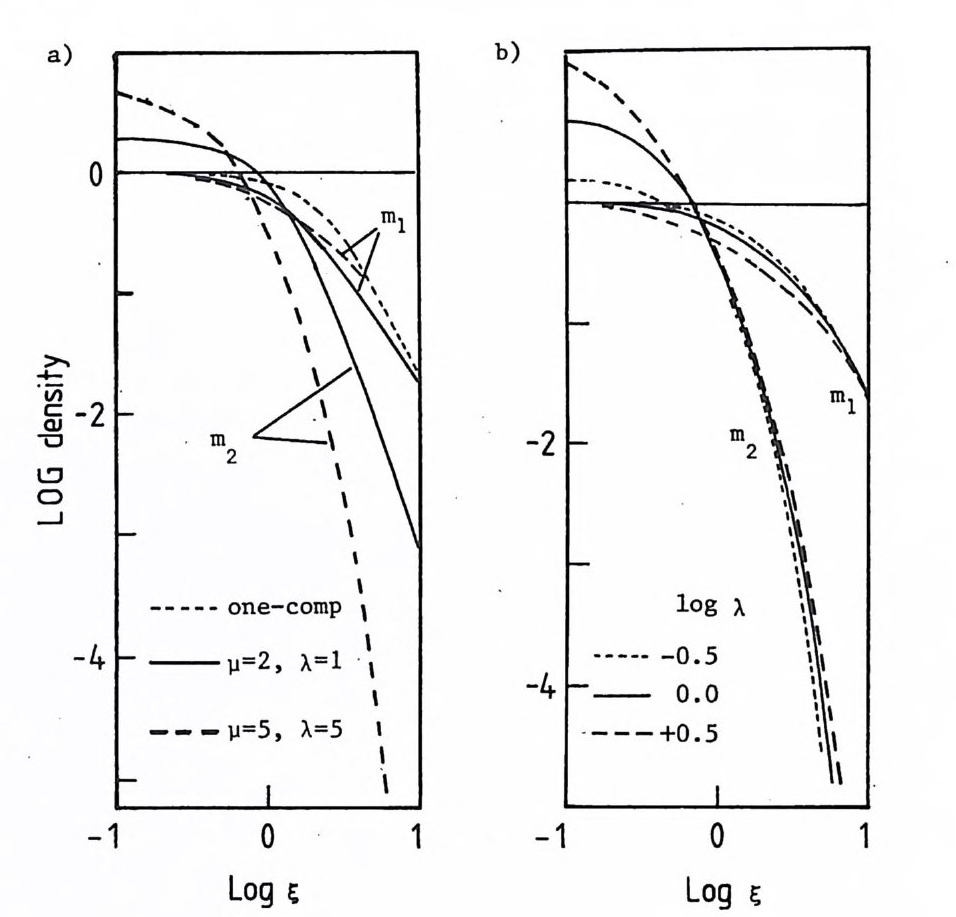 a) b)
a) b)
Fi g 3-9: Densi ty st r uct u res of tw o:--cornp o nent is ot h ermal sp h eres ta ken fr om Taf f et aZ (1975) . (a) Di s t r i b ut ions of each comp o nent s ,. massi v e m2 a_n d less massi v e m1 , are comp a red wi th t h e si n g l e comp o nent case. The mass rat io i s varie d fr om µ=2 to 5, whi l e th e cen~ral densi ty rat io i s fixed at log >. = 0 . ( b ) The same as in a but wi th µ fixed at 5 and >- Vl; J.r i e d.
Most in t e resti ng resul t is th e comp a ris on th ey made bet w een. th e densit y di s t r i b ut ion dep ict e d by a t~ o-comp o nent is ot h ermal sp h ere in hy d rost a t ic ~ and th at resul ted from dy n ami c al calculati on s by Sp itze r and Hart (19 71) . They il lustr ate d th ei r comp a ris on in a di a g r am whi c ~ is repr oduced in Fig u re 3-10. Si n ce th e dy n ami c al resul ts d ep ict th e si tuat i on at t = 0.81 t_r where t r__ is th e mean relaxat ion time of th e sy s t e m, th e is ot h ermal results devi a t e fro m th e dy n ami c al ones fo r large r. However, th e ag r eement is excellent in si d e th e reg ion where th e local relaxat ion time eq u als th e evolut ion ary time 0.81 t_r .
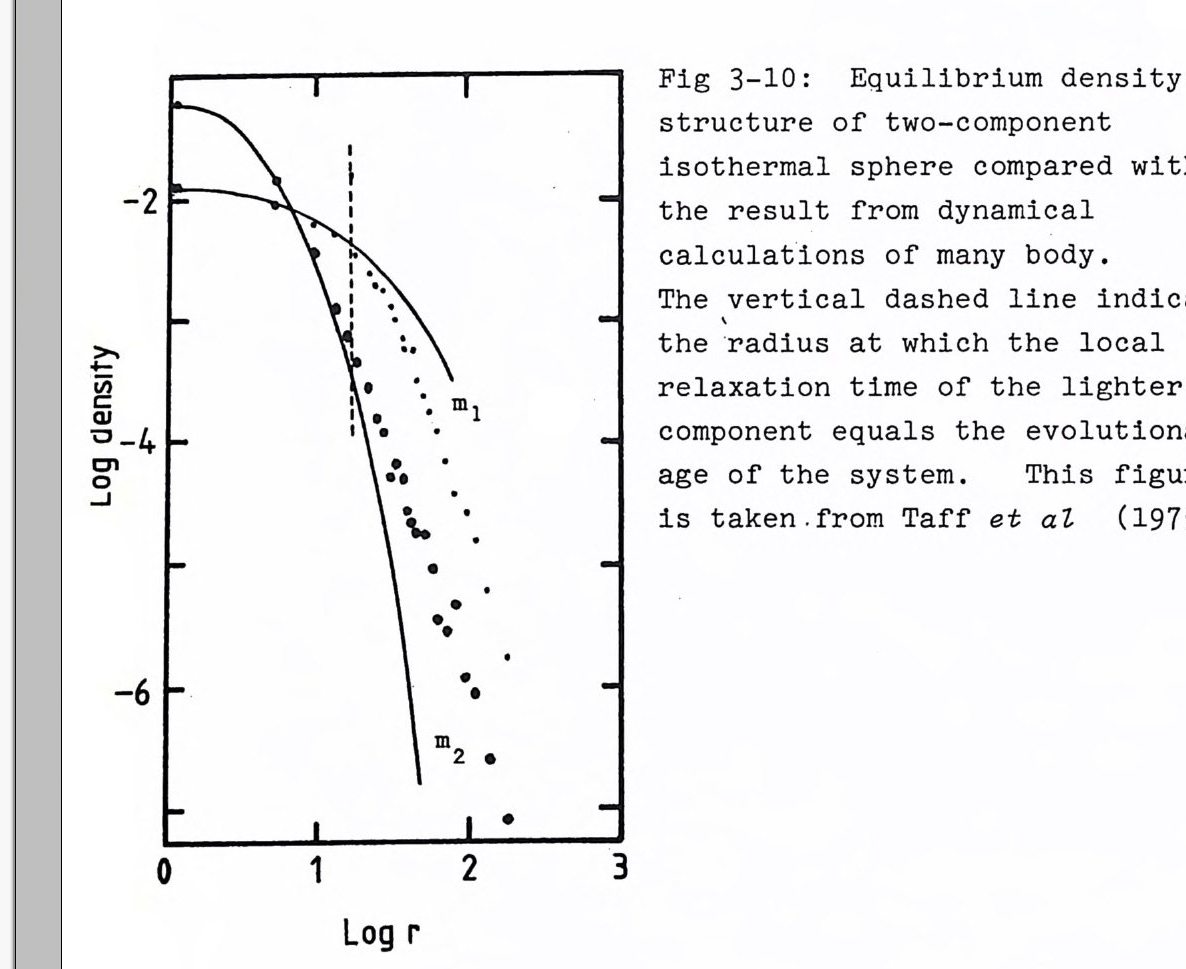 Fi g 3-10: Eq u i libri u m densit y
Cap e lato et al (19 79) pe rfo rmed an ext e nsiv e numeri c a l in t e g r at ion of th e Lane-Emden eq u at ion fo r tw o-comp o nent is ot h ermal sp h ere, and pr esent e d th ei r results in ta bular and gr aph i c fo rms wi th e mp h ases bei n g give n to maki n g di r ect comp a ris ons of th e is ot h ermal di s t r i b ut ion wi th o bservat ions of pr oj e ct densit y and free -fr ee lumi n osit y di s t r i b u- tion fro m cluste rs of ga laxi e s. Thei r pr i n cip a l ai m s were at det e ct ing hi d den mass and account ing fo r mass-seg r ega t ions wi thi n cluste rs of g al 쵸i es (Cap e lato et al 1980, 1981). An ap plica ti on to in t e rste llar clouds was recent l y made by Yoo (1982), who successf u lly repr oduced densit y st r uct u res, as delin eat e d by CO-cont o urs, of a fe w selecte d gia,1 t molecular cloud comp l exes by models of tw o-comp o nent is ot h ermal cloud wherei n many small dense clump s were assumed bei n g embedded in an ext e nded medi u m of te nuous ga s. 3 . 5 . .1 Ext e nsi o n to Ot h er Geor. .e t r i e s Eq u i l i b riu m confi gu rat ions based on -th e Lane-Emden eq u at ion have been ext e nded to ge omet r i c al shap e s ot h er th an sp h eres (Ost r i k er 1964; Harris on and Lake 1972; Vi a la and Horedt 1974a). As Vi a la and Horedt (1974a) summari z ed, th e fo llowi n g form of Lane-Emden eq u at ion _E1m_ 一ddg (~ md—d0g ) = 土 On holds fo r po lyt ro p ic sheet s , cy l i n ders and sp h eres with bot h sig n s of th e po lyt ro p ic in dex. The po sit ive sig n , as was shown in sect ion 3.5.1, on th e rig h t hand si d e of th e ge neral form go es wi th p o lyt ro p e s of neg a t ive in di c es -«n<-1; whi le th e up pe r neg a t ive sig n go es with po lyt ro p e s havi n g in di c es in th e rang e -l
th e ge neral fo rm by ap pr op r i a t e ly ta ki n g Lap l aci a n op e rat o r fo r a give n ge omet r y . Vi a la and Horedt (19 74b) integ r at e d th e ge neral eq u at ion numeric ally, and ta bulat e d fo rvalues of m= 0, 1, 2, and n= -0.2(0.3) -1.5 , -2(-1) - 5, -10. In po lyt ro p e s ,nth -1
(n+ l)K 昌 f; (r 店 p1 /n) = 411GP + 납\(타 ) . Int ro duct ion of dimensio nless varia bles w and f: by U2 三 2n군GP C r = [ 앞c l)K p: /n -l ] 七. g wi th p 三 pC_ 0·n· simp lifies th e above eq u at ion into 같 옮(내 뿜) = 0n + 志 옮 (w2 군 ) . Solut ion for 0 subj ect to th e boundary condi tions 0 (E;= O) = 1 and 9 ' (E;= O) = 0 wi th t h e give n rot at ion law w wil l describ e how densi ty varie s wi th d ista nce from sym me try axi s of th e rot at ing cylin der in eq u i libri u m. Robe (19 79) examin ed th e in st abi:Ti ties of ga seous cylin ders of fini t e r adi u s in di ffere nt ial rot at ion, and fo und an unst a ble mode whose densi ty pat ter n has a sp ira l shap e . Furth er dis cussi o ns on th e rot at ion are not bey o nd th e scop e of this monogr ap h , fo r readers inte rest ed in pr oblems of rot at ion we ref e r to an excellent tre at ise by Je an-Loui s Tassoul Theory of Rot at ing Sta rs.
REFERENCES Followi n g s are im p o rta nt classic s on th e po lyt ro p e : ECmhdaennd, raRs.e k1h9a0r7, , S. G1a9sk3u9g, e Alnn , In(Ttr e oudbun ce tr :i onL etiop zt ih g e )S. t u d y of St e llar St r uctu r e, (Dover: New York). The bi b lio g r aph i c al not e s at th e end of Chandrasekhar's Chap . IV are worth readi n g . Polyt ro p ic • understa ndi n g s of st e llar st r uct u re are ellega nt l y summar ized by Clay toNn u,e lDeo. sy1 n9 t6 h8 e, siPs ,r in cip (Mle csG roawf -HSi t le ll)l 따p• . E_1v5o 5lu-1t 6i o5 n . and For fu rth e_r det a i l s of th e pr essure-densit y relati on , consult chap ter s 1 and 2 of th i s book. Usef u lness of homolog y th eorem and th e st a ndard model is demonst r ate d th rougC hh i ut h, e HS.Yt r. o m1g9 r6 e8n, tSh et oe rlelma rb Py hy s i c s, Vol I, (Blai s dell: London) p. 422-447. Furth er ap pl i c at ions of po lyt ro p e s to pr oblems relate d to st e llar st r uctu re and evolut ion can be fo und fr om fo llowi n g s : Cox, J. P. and Gi u l i, R.T. 1968, Prin cip le s of St e llar St r uctu re, (Gordon and Breach: New York). Hay a shSui, p pCl .. ,, BHo,s hi1 ,- 1R83. . and Sug imo t o , D. 1962, Prog . Theor. Phy s . For qui c k evaluat ion of Lane-Emden fu nct ions consult th e fo llowi n g tw o arti cle s: Pascual, P. 1977, A. Ap ., _§_Q, 161. Servi c e, F.T. 1977, Ap .j . , 요브., 908. Isot h ermal fu nct ion and its r elate d qu ant ities are ta bulat e d by Chandrasekhar, S. and Wares, G.W. 1949, Ap .J., 109, 551. Lane-ESmhud,e nF f.Hu n. c, tiM oi ln i oo fn en, =V -. 3, iGs e bgeilv, e Wn . b, y Yuan, C. , Goldsmi th, D.W. , and Robert s , W.W. 1972, Ap .J., ..!_꼬, 557. Lane-Emden fu nct ions of neg a t ive in di c es fo r po lyt ro p ic sheet, cy l i n der and sp h ere are di s cussed by Vi a la, Y. and Horedt , Gp . 1974, A. Ap . , 혹!, 195. They Vail sa ola ,t a Ybu. laantde d Hnourmedetr ,ic Gap l . v1al9u7e4s, Afo. rA Lp a. neS-uEpm pdl.e n, 1f..u§ n.’, c1t 7io3n. s .
Overall charact e ris t ics of tw o-comp o nent is ot h ermal po lyt ro p e are th oroug h ly di s cussed, and relevant numeric al dat a are give n by Taf f, L.G. , van Horn, H.H. , Hansen, C.J . and Ross, R.R. 1975, Ap .J. , 프끄, 651 . Numeri c al values fo r tw o-comp o nent is ot h ermal po lyt ro p e s are also ta bulat e d by Cap e lato , H.V. , Gerbal, D. , Sole, E.S. , Mat h ez, G. , Mazure, A. and Roland, J. 1979, A. Ap . Sup pl . , 프혼, 295. Insta bi l i ty of is ot h ermal ga s sp h ere is di s cussed in th e fo llowi n g arti cle s in vario us cont e xt s : Bonnor, W.B. 1956, M.N. , ~. 351 . . 1957, M.N. , 브.J..., 104. Ebert, R. 1957, Z.f. Ap ., 42, 263. McCrea, w.H. 1957, M.N. , 旦 z, 562 .• Fi e ld, G.B. 1974, in At o mi c and Molecul@ 잡iy s ic s and th e Int e rste llar Medi um ed. by R. Bal ian, P. Enrenaze and J. Leq u ex (Nort h -Holland: Amst e rdam), p. 467-532. Sp itze r, L. Jr . 1968, in Nebulae and Int e rste llar Mat ter ed by B. Mi d dlehurst and L.H. Aller (Chi c ag o Uni v . Pr.; Chi c ag o ), p. 1-63. For roTta as ts ionugl , pJo -lLy.t ro1 p9 e7 s8 , coTnhseuollt' y aonf Reoxtc ae tl ilnegn t S mtC oUn'o, g r( aPprih n bcye to n Uni v . Pr.: Pric et o n). Ot h er pa p e rs qu ot e d in th i s chap ter are as fo llows: Fi e ld, G.B. , Goldsmi th, D.W. and Habi n g , H.J . 1969, Ap .J. , lE_, Ll49. JHFuoo prw afl,,e rME, .. R11.H997.3 611,, 9HA3 n JN .. M,, .__N9?1 ..! .,,, 96157138, .. 63. Ki n g , I.R. 1965, A.J . , 끄~. 376. 1966, A.J . ; 끄노, 64. Mi h alas, D. and lout l y , P. Mc. 1968, Galact ic A st r onom y (Freeman: San Franc isc o). p. 240-248. Miln e, E.A. 1930, M.N. , 으!., 4. Oort, J. H. and van Herk, G. 1959, B.A.N. 브 L, 299. Ri tter, A. 1830, M.N. , 11, 332. Sp itze r, L. and Hart, M頂 . 1971, Ap .J 브~. 483. Temsevary , S.C. 1973, Unp u bl ished lectu re not e s. Yoo, C.W. 1982, Mast e r's Thesi s , Seoul Nat ion al Uni v ersit y.
4 Boltz m ann Transp o rt and Hy d rody n ami cs 4.1 INTRODUCTION In th e last chap ter we develop e d a th eoret ical pr obe, whi c h enables us to pe er in t o ga seous sy s t e ms in hy d rosta t ic e q u i l i b riu m; we now tu rn our at ten t ion to dy nam i c al aspe ct s of cosmi c fl ows. We beg in th i s chap ter wi th t h e Boltz mann's th eory of tr anspo rt, whi c h wi ll su bsequ entl y be used in deriv i n g basic eq u at ions of hy d rody n ami c s. After in t r oducin g th e concep t of sound wave, we brie f l y consi d er th e comp r essib i lity of cosmi c fl uid . As a sim pl e examp l e of astr op h y s i - cal ap pl i c at ions of th e hy d rody na mi c s, we ta ke th e ph enomenon of solar wi n d and model it as a st e ady fl ow. We shall,t h en stu dy tw o examp l es of in sta bi lities: th e Je ans gr avi tat i on al in sta bi li ty and th e Ray l eig h -Tay l or in sta bi lity. Prin cip a l pu rpo se of th e chap ter is only to pr ovi d e basi c th eoret ical fr ameworks fo r descrip tion s of tr anspo rt ph enomena and hy d rody n ami c al pr oblems, not to di s cuss th em sp e ci fical ly. By ta ki n g somewhat awkward ap pr oach based on Boltz mann tr anspo rt eq u at ion in deriv i n g hy d rody n ami c eq u at ions we tr y to make ourselves fa mi l i a r with basic mat h emat ical fo rmulat ions used in th e ki n et ic t h eory of ga ses. Thi s chap ter wi l l.al so serve as a st a rti ng base fo r th e next
chap ter whi c h is concerned wi th m ot ions of io ni z ed mat ter under th e in f luen ce of mag n et ic f ield . 4 . 2 BOLTZMANN 'l'RA NSPORT THEORY It is pr act ical ly im p o ssib le and not necessary to sp e cif y every tr aje ct o rie s of in di v i d ual pa rti cle s for th e descrip tion of dy n ami c st a t e of fl ui d in mot ion. Inste ad, one ta kes a st a t ist i cal ap pr oach as fo llows: 4.2.1 Di s t r i b ut ion Funct ion We def ine di s t r i b ut ion fun cti on f( 기r,니w ,t) such th at th e number of pa rti cle s in a volume element (기r , 기r + d니i- ) movi n g wi th v elocit ies in th e rang e (~, ; + d'ti ) at time t is eq u al to f (t ,t, t) a31 d3; , Thi s does not mean th at th e give n element d3r act u ally cont a i n s th i s number of pa rti cle s havi n g veloc ities in th e rang e (~기, . 기w + dw기 ) at th e time t; th i s is th e averag e · nu mber of such pa rti cle s when th e fl uctu - at ion s occurrin g in a short time in t e rval dt are smoot h ~d out . The def ini t ion is necessaril y of st a t ist i ca l natu re. The time -dep e ndence of th e di s t r i b ut ion fun ct ion results fr om tw o causes: One is th e pa rti cle mot ion in ge omet r: (.c sp a ce 니r and th e ot h er is th e chang e in pa rti cle velocit y due to for ces act ing on in di v i d ual pa rti cle s comp r i s i n g th e flui d . The time- dep e ndent behavi o ur of th e di s t r i b ut ion fun ct ion in si x -di m ensio n al, th ree from th e ge omet r ic sp a ce +r and- th- ree t_h- e vel-o ci-t y sp a ce +w , ph ase- sp a ce are th us to ful ly d escrib e th e dy n ami c develop m ent of th e fl uid . For such a descrip tion based on th e di s t r i b ut ion fun ct ion of st a t ist i cal natu re to be meani n g ful , however, th ere should be a large number of pa rti cle s in an element of sp a ce th at is suf ficien tl y small in com- pa ris on to th e scales over whi c h substa nt ial varia t ions occur to macroscop ic pa ramet e rs characte riz i n g th e fl uid mot ion under consi d era- tion.
The di s t r i b ut ion fu nct ion f is never neg a t ive. It must te nd to zero as 조t.y becomes in f ini t e. It is ~ssur!l e d to be fini t e a nd cont inuo us fo r all values of t. 4. . 2 . 2 l~easurable Prorerti es of Flui d In pr i n cip le th e di s t r i b ut ion fu nct ion cont a i n s all th e in f o rma- tions necessary fo r describ i n g fl ui d mot ion; th e fu nct ion itsel f is , however, not a di r ect l y measurable qu ant ity. Only moment s of th e di s t r iT bh ue t imona s fs u dncent siiot ny inp ( -rt,h et) voefl o cthi t ey f-sl upia dc ei sa reg imvee na sbuyr atbhl ee pzae rraomt he t e rs characte riz i n g th e flui d . order mol! le nt of th e di s t r i b ut ion fu nct ion: p (t, t) = J rn f(t,t;, t). d3t , where m is th e pa rti cle mass. We restr i c t our di s cussio ns to th e case of si n g l e-comp o nent fl ui d . No concep tua l di fficul ty aris es in ext e ndi n g to multi -co mp o nent cases, but pr act ical di fficul ty alway s conf ron t s us·. Obvio u sly , th e number densit y n (니r , t ) is give n by n(tt ) = J f(°t,tt,t )d 휴. The mean _ve locit y 니v is give n by th e first order moment of th e di s t r i b ut ion fu nct ion : -; = <~ = .n! f ;- f( t,°t,t) d3~. 야 e can th en sepa rate th e velocit y of a fl ui d pa rti cle at t in t o th e comp o nent along th i s average velocit y and its p e cuUar comp o nent ii, i.e. +u = +w· - <나W· > = 구w -수 v· .
The fo rmer, macroscop ic flow velocit y v1 describ es bulk mot ion of th e fl ui d as seen in a fixed laborat o ry fr ame, whi l e th e latt er , mi c ro- scop ic pe culia r velocit y u, give s th e random mot ions of in di v i d ual pa rti cle s wi th r espe ct to th e ra 랴 an mot ion of th e flow . Th e bulk mot ion accomp a ni e s tr anspo rt of mass whose fl ux is give n si m p l y by p거v戶 , and th e averag e of pe culia r velocit y should be id ent ica lly zero by def ini t ion. The di s t r i b ut ion of velocit y-po i n ts -in th e ph ase-spa ce is clearly unaf fec t e d if th e orig in of th e velocit y.:.. sp a ce is moved to th e fl ow velocit y +v . In th i s case th e po sit ion vect o r of a velocit y-po i n t is chang e d to th e pe cul iar velocit y ;+ ; th e volume element d3t is now denot e d by d3;, and cont a i n s th e same number of pa rti cle s , i. e. f( 거r P , 니u +w- , t) d3; d 휴. Thi s wi l l be 먀 rr itt en si m p l y as f(t,~,t) d3°i d3(i w-i th a n a p pr op r i a t e modi ficat ion made to th e fu nct ion f. We may th us consid er 냐r , 슈u and t as new in dep e ndent varia bles and in t e rchang e d나u· and dw whenever conveni e nt . Parti cle mot ion alway s carrie s moment u m wi th i t; in order to qu ant ify th e moment u m tr ansfe r rate we now in t r oduce moment w n flux te nsor +·t+(. + r , t) . If we denot e by II~i j, th e rate of ith comp o nent moment u m tr ansp o rte d across a surfa ce orie nt e d· pe rpe ndi c ularly to th e di r ect ion of xJ,- axi s , IIi~J, becomes IIi /i,t) = mf wi w j f(t,i,t) d 휴, or +J-I► ( .r+ ,t). = mf . +w +w f-(. +r, w+ ,t). d. .%.. + , where conventi on is used such th at th e ij-ele ment of dy a dic 1니 b is aii -b j; . Up o n a sepa rat ion of 냐w· in t o 구v and 나u· ; Jiij ta kes th e fol lowi n g fo rm:
nij = p(;,t) [ v1vj t
E: = 녀 mu2 f(-;,ti,t) d3ti . Ipfe r wue nid tef m inaes s tho ef t_sh pe e cfil uf iic d , i nw te e mrnaya l eqe un aetrg e y e: et o aps e t, h ei. ien. t e rne:=apl e e. neTrghye heat fl ow vect o r q or conduct ive flux is give n by q = f 당 mu 댜f (t,(i, t) d3( i. 4.2.3 Eoltz mann Transp o rt E 언 ua ti on Our go al is to fo llow th e chang e s of th e di s t r i b ut ion fun cti on in time. We shall deriv e a di ffere nt ial eq u at ion for f( 가r·, w기 ,t) whi c h allows th e calculat ion of its d evelop m ent as a fu nct ion of time, th ereby , we may have time -dep e ndent varia t ions of observable pa ramet e rs whi c h in tu rn charact e riz e dy n ami c al st a t e of th e fl uid . Consi d er a fl ui d in whi c h each pa rti cle is subj e ct to an ext e rnal for ce mF. The for ce may be a fu nct ion of po sit ion t니 and time t but ~ t. At time t th ere are f(t,°t,t) d3t d3t pa rti cle s in a si x -di m ensi o nal volume element rang ing over (+r , +r +. d . +r ) and (-w► , +w +. ..d+w ) . If pa rti cle s do not encount e r or colli de e ach ot h er , th e pa rti cle po sit ion and veloc ity chang e to +t+.+t dt a nd t+ Fdt af ter time in t e rval dt . Theref o re, in th e absence of encount e rin g , th e pa rti cle s orig ina lly locat e d in th e si x -di m ensi o nal _sp a ce rang ing over (+r, +r+- d _.t.. .). .. and- ,(+w, +w +. d . +w ) would occup y a new volume element rang ing over (t+t dt , t+; dt + dt) and (;댜 dt , t+ F dt +dt) at time t = t + dt ; th e number of pa rti cle s in th e new volume element f(t+tdt , ~+흥 dt , t + dt ) d3f d3 흉 would be th e same as f (t,t, t) d3t d3t . However , th ey are in ge neral di ffere nt fr om each ot h er, si n ce encount e rs betw een pa rti cle s wi ll h ave def l ecte d pa rti cle s not cont a i n ed in th e orig ina l volume element in t o th e new volume element and def l ecte d in t e rio r pa rti cle s out of th e new element . The net ga i n of pa rti cle s must . be pr op o rti ona l to d3t 潟 dt ; we shall denot e it by [af / at ] e 追 潟 dt .
Conseq u ent l y , th e final balance in th e pa rti cle number is describ ed by {f(t+: dt ,t+F dt, t+ dt) - f(t,t,t)} d31 d3t = [룹 ]e 毒 潟 dt . Up o n di v i d i n g by d3t d3°t and ta ki n g th e limi t dt + O, th e balance becomes 픕나·픕 나.尉 [副 Thi s li n ear pa rti al di ffere nti al eq u ati on is known as th e Boltz mann tr anspo rt eq u ati on . The restr i c ti on of velocit y-ind ep e ndence we have im p o sed up o n th e nat u _r e of fo rce act ing on th e pa rti cle s may be relaxed , if th e eq u at ions of pa rti ci e mot ions under th e fo rce are deriv able fr om a Hami ltoni a n fun ct ion . (See, for examp l e, Rei f (1965) for det a i l s) . Def ini n g th e di! s t r i b ut ion fu nct ion in te rns of ge neraliz ed coordi n at e ;; and moment u m li k e f(n,!,t) , one may easi l y writ e d own th e balance eq u at ion fo r.p a rti cle number as 픕 + ¢.%)f + f 며 당] 頂] e wtah keerne !a lodnegn o!t, e s thS ie n scei x H-vameci ltt o orn i( a nn, !)r ealandte sv_7E 1 i reanpdr e ste nast s tath e/a gt r a=d i- ae Hn/t 해 and an/a t = a1:J a t , if Hami ltoni a n l: exi s t s , th e te rm in th e sq u are brackets _ba ni s hes and th e balance eq u at ion recov_e r s th e fo rm fo r velocit y-ind ep e ndent fo rce. Ret u rni n g back to our Boltz mann tr anspo rt eq u at ion, we may not ice rteh saut lttsh ·e f rt oimm et- hd erep ee n dsoenutr cveasr: iaTt ih oe nf oirf stt h ceo mdpi os nt re inbt ,u t -io~n. ( afuf n/ ccltr )i o, nm, ayel f /bae t, vi e wed as a di ffusi o n source and th e second, -흥 .(a f/a t) , results in
respo nse to th e ap pl i e d fo rce m 흡; whi le t h e th i r d source, [af /a t ] e, rep r esent s ~ th e in f l uence of encount e rs bet w een pa rti cle s. Clear di s t inct ion bet w een th ese th ree comp o nent s is , however, not alway s easy to make in pr act ice. Exp l i c i t fo rm of th e encount e r te rm dep e nds in det a i l up o n th e ph y s i c al nat u re of th e in t e ract ion and ge nerally in volves in t e g r als of th e unknom di s t r i b ut ion fu nct ion itsel f. The Boltz mann tr anspo rt eq u at ion is th en an in t e g r o- di ffere nt ial eq u at ion whose fu ll solut ion is ext r emely di fficul t to obt a i n in pr act ice. Neverth eless th e Boltz mann eq u at ion pr ovi d es us wi th a po werf u l th eoret ical devi c e wi th whi c h we can deriv e usef u l results , as we wi l l see shortl y , wi thou t exp l i c i tly knowi n g fo rms of th e di s t r i b ut ion fu nct ion and th e encount e r te rm. 4.2.4 Boltz mann Eq u at ion in te rms of Peculia r Velocit y Let us chang e th e velocit y orig in to th e mean fl ow velocit y +v , ·and exami n e th e Boltz mann tr anspo rt eq u at ion in te rms of th e pe culia r veloc ity +u (=w+ -+v ) . If +u is used as our in dep e ndent varia bles, th e meani n g s of af / at and af / a-i+: are c-ha ng e d-, si- n ce now -u+ not -w+ is to be kep t const a nt whi l e pe rfo rmi n g th e di ffere nt iat i ons . In order to ta ke account tuh e im p licit dep e ndence of vf, 。 n th e time t th roug h th e dep e ndence of 냐 up o n th e fl ow veloc ity 구· we have to repl ace af / at in th e Boltz mann eq u at ion by 3f—3t 3—+3vt · 3Ff3u or -aaft -aa-vt i -aauf i . Si m i larly , we repl ace af / af by 廷3r -(3 ¼r ~) • -a2t f ,
where th e dy a di c cont a i n i n g a vect o r di ffere nt ial op e rato r a/ a 간(三 V) has ordered comp o nent s avJ/ oxi1 as its ij-ele rnent , and th e pr oduct , (at / at) • (af/a i) becomes th e vect o r whose comp o nent s are give n by (avJ, /axi ,)(af /a uJ,) in in dex not a t ion . Rep l ac ing at/a t by a f /a 업, we may rewrit e t h e Boltz mann tr ansp o rt eq u at ion as 百af - 莊3니v넘 컵3f + (+v + +u ) • {33국~fr - (3휴 +v )· 譯3f } + +F •3a~ 갑f [률] e • Int r oduct ion of th e u:zg ra 따i an deriv at ive, o.r to t a l deriv at ive, D/Dt , def ined as th e deriv at ... .;e ta ken fo llowi n g th e fl ui d , i. e . -1D) -t _= a-3;: -t- + . ~V•a—a 훈 _ ’ reduces th e eq u at ion to —DDft +. +u ~e3l 훈f + (흉 룹) • 풀 -플門 :늪 v = 며 ]e • Thi s is th e Boltz mann's tr anspo rt eq u at ion give n in te rms of pe culia r vspe al ocec ,i tyw.h ereW !eJ f au nrdth eCr asrheo rpter onp et hr il ys dexepf r i enesds ioo pn e brya tfo J rst =fo C r it h eto lesafvt ea nd rig h t si d e of th e Boltz mann's tr anspo rt eq u at ion, respe ct ivel y. It may be timel y to s 떠 ~ar i ze th e not a t ion convent ions fo r whi c h we fol low Chapm an and Cowl ing (19 70) . The pr oduct if납 of a te nsor i멀fanid a inv escutm o mr a갑t i oins dcoefnir v_1een dt ioasn . th eT vheec Pt or ord wuchto sre .~co m(pi ~o n gen~ tn se raarle ~ ogti vee qn u bayl to :r'.a) is si~ rly de f ined by 초.'나!'' = ~j Tj i . The sim pZ e p rodu 랴 of tw o te nsors, (S. )• T( ), is def ined as th e te nso~- ~ ~t; h comp o nent s Si k Tkj . The dt;ub l, e pro duct, or sea l,따 pro duct 奇 is def ined as th e s~alar eq u al to th e di v erge nce of
When th e op e rato r a/a 니i노: (드 V) ap pe ars in th e pr oduct of tw o te nsors, or of a vect o r and a te nsor, care should be exerci s ed on th e order in whi c h te rms occur, so as th e te rms on whi c h th e op e rato r act s to be clear. For examp l e, si n ce 느at • i~ tu = .a.xLj . a~ j bu i =- .a. j —aabx~j i +' b1i . _aa xa j i holds fo r i-d epe ndent vecto r fu nct ion s it and B, we have v-!t = (1.v)b + '&(v.i) . If, on th e ot h er hand, in th e pro ductY .l or l.~. th e te nsor-Y is of th e fo rm 눕 b, we have 값 T= ; • .l..3...r.. t.= a j 느axj b~i = (1.v)b, and +.r.1 = t.宇 = 갈. 澤, where 급i s conj u g a t e to Y,.n amely, 균ij = yji. Problem 4-2: Verif y the fo llowi n g th ree relati ons in volvi n g v-op e r~t o r: (1) t. (b•V) 칼 = 誌 :v' t, (2) v{1° (Vb) } = (v1l. (vb) + (-+a- 자 )• •( V~o.) , and- (·3-)· V.• (- a+-• V--S•) = (,_V-+a-). •V-S- +. •(-a +-•V )VS wi th S bei n g a scalar fu nct ion of 기i: .
4.2.5 Enskog ' s Eauat ion of Chang e Consi d er any fu nct ion
Si n ce th e di s t r i b ut ion fu nct ion vani s hes at in f ini t e v elocit ies, we have pu t th e te rm ¢,f zero at th e li m i t u1-+±'· We ge nera.l i z e th i s result as f¢ 브a 던 國 = -n < 표ai'>i . By th e same to ken, we may have f¢ 紅 ; 述 = -n < 詞 ¢ 記 = -n • Thi s i's called Enskog ' s eq uation of chang e of <4>가 Enskog ge neraliz ed Maxwell's results fo r a fu nct ion 4> (+w ) of +w alone. > aa t • +V +. 궁a3 r • n.<¢. +U > -n [ 맵> + <;.a표t >• +• ,(-충 흡 )Dt ·, <~ 표a 답> -<3무u : 모3r ] = n!}.
Turni n g our at ten t ion to th e encount e r te nn, we shall deriv e a fo rmal exp r essio n fo r th e evaluat ion of n t,야>. Let us fo cus on a si tuat ion wherei n a pa rti cle wi th v elocit y 기u encount e rs anot h er one movi n g wi th v elocit y 기u_ 。 and th e tw o pa rti cle s emerg e wi th r espe ct ive final velocit ies ti' and ti。' af ter th e enount e r. Such an encount e r pr oduces a chang e , in th e pa rti cle pr op e rty
For fu rth er det a i l ed exp l anat ions fo r and ap pl i c at ions of th e chang e rate n6 야> to th e pr oblel!ls of ph y s i c al in t e rests in ge neral, see th e classic work on th e ga s ki n et ic t h eory by Chap m an and Cowlin g (19 70) and last th ree chap ter s of th e te xt by Rei f (1965) . We have fo llowed th ese aut h ors fo r th e di s cussio n of Boltz mann tr anspo rt th eory in th i s sect ion. For ap pl i c at ions of th e Enskog ' s eq u at ion wi th t h e encount e r te rm to th e pr oblems of astr op h y s i c al in t e rests , fo r examp l e th e dy n ami c al evolut ion of gl obular cluste rs, we refe r th e reader to th e refe rences by Chandrasekhar (1942), Sp itze r and Hart (19 71) , Lig h t m an and Shap iro (19 78) , and Cohen, Sp itze r and Rout ly (19 50) . 4.3 BASIC ECUATIONS OF HYDRODYNAMICS Only when th e di s t r i b ut ion fun cti on and th e natu re of th e in t e ract ions betw een pa rti cle s at th e encount e r are known, pr ecis e exp r essio ns fo r th e encount e r cross-sect ion can be give n, so is th e sp e cif ic r esult fo r nl:l < and det e rmi n i n g th e form of th e di s t r i b ut ion fu nct ion, we may st ill deduce some im p o rta nt results fr om th e Enskog ' s eq u at ion of chang e . 4.3.l Conservat ion Eouat ions The fu ndament a l qu ant ities th at are conserved in a bi n ary encount e r are number, to t a l moment u m and to t a l ki n et ic e nergy of th e encount e rin g pa rti cle s. We th us deriv e th e conservat ion eq u at ions mfo, rm -+u-m aansds. , i1m mo,un 2 e nti wn nt o an~d. reenspee r gcyt ivfre ol my . th e Enskog ' s eq u at ion by pu t ting ~: H ~ = m , all th e deriv at ives of cp vani s h and also Re-arrang e ment of th e eq u at ion yiel ds a fam i l i a r result: |홑= p흥- 這 -I whi c h is called th e eq u at ion of moment u m in hy d rody n ami c s. In th i s fo rm, so to sp e ak as an eq u at ion of mot ion, th e accelerat ion F 。f th e ap pl i e d for ce may be vi e wed as th e for ce densit y, for ce ap plied to uni t volume of th e mat e ria l . Thi s eq u at ion describ es how th e mean moment u m of any element of th e fl ui d chang e s wi th t ime due to th e st r ess fo rce, in cludi n g th e usual pa rti cle pr essure, of th e surroundi n g fl ui d and th e ext e rnal fo rce act ing on th e fl uid . ~: We now pu t q,=j1- m u2, th e ki n et ic e nergy of tr anslat ion associ a t e d wi th t h e pe culia r velocit y. Si n ce 기u is an in dep e ndent var iab le, we have clq ,/ at = 0 and Dq, / Dt = 0. The def ini t ions of sp e ci fic i n t e rnal energy and heat f_lo w vect o r di r ect l y yiel d n where we have made use of th e eq u at ion of cont inui ty. Normally th e heat fl ux is pr op o rti on al to th e neg a t ive te mp e ratu re gr adi e nt 1 and one usually pu t s 겁 = - K' ilT wi th K bei n g th e th ermal conduct ivi t y of th e flui d . It may be usefu l to collect our results of th e basic eq u at ions whi c h go vern th e mot ion of a fl ui d under th e in f l uence of body fo rce 충: -aapt + v· (p+v ) 。 mass p [합 (;景] = P어F戶 - VP moment um p [끔 + (t•V )e] = -P tJ,; + V• (KVT) th ennal energy These eq u at ions of mass, moment u m and energy conservat ions are th e zerot h , first and second order moment s of th e Boltz mann tr anspo rt eq u at ion in th e velocit y-s pa ce, ·re spe ct ivel y. They are rig o rous consequ ences of th e Boltz mann eq u at ion, in th i s sense th e hy d rody n ami c eq u at ions find th eoret ical ju st ificat i on s . However, th i s set of 브프으 eq u at ions has ~ unknowns 기v , P, P , e and T. Conseq u ent l y , one must find exp l i c i t ex pr essio n s fo r qu ant ities such as th e pr essure te nsor 4P- 누. Alth oug h we have a .'[J r'es a1 'iption fo r calculati ng th e pr essure te nsor, i.e. Thus th e set of eq u at ions go verni n g th e fl ui d mot ion sh(J u ld be sup pl ement e d by eq u at ions of th e ge neral fo rm P=P(p , T) and e=e(P,T). Problem 4-5 : Maxwellia n di s t r i b ut ion describ es th e di s t r i b ut ion of ga s pa rti cle s over velocit y under ordi n ary condi tion, so we may have f(麟) = n(;) (급 ) 3/2 exp [-~ -십+ ~-+ ]2 . Show ~hat th e pr essure te nsor becomes, in th i s case, si m p l y P 안j wi th P = n(니r) kT. 4.3.2 eth er Forms of Energy Eq u at ion We have been concerned only wi th t h e th ermal energy ; we may in clude th e mechani c al energy associ a t e d wi th t h e mean flo w mot ion in t o th e eq u at ion of energy conservat ion. A scalar pro duct of th e moment u m eq u at ion wi th t h e mean flo w velocit y 니v卜 yiel ds p [늪 ( ½ v2) + (t•V ) ( ½ v2)] = P t•슝 _ ;.vP. We add th i s eq u at ion to th e eq u at ion of th ermal energy conservat ion to obt a i n p냐 (§v2+e) + (?.V)(½v2+e)] = -V• (Pt ) + Pt .F -V •q , where a use has been made of th e relati on 'v• (Pt ) = P('v •°t) + (t.r;)P . Now, usi n g th e resul t of Problem 4-4 ., we may rewrit e t h i s eq u at ion as 높 (½ pv2 +pe ) + V• [ (½ 군 +Pe+P)'t + q) = pt.홉 ; to t a l energy . Thi s is th e eq uation of to t al, energ y conservat ion. =Pe and n
=➔q . O-n t.h e ot h. er h. and. a4> /.a+u= m+u ; consequ ent ly we have < clq , /au+ > = 0 and n< 요a 컵+ u > p<;;> = Y. Incorpo rat ing all th ese results in t o th e Enskog ' s eq u at ion of chang e , we final ly obt a i n th e eq u at ion of th ermal energy conservat ion: ~Dt pe + Pe ¾3r- . ? + 듯3r .검 +Y: ¾3? i = o. As usually th e case, if o/ = P oij , we may recast th i s eq u ati on in th e fo rm p[픔 + (?.v)e] + P V·? = - V•기q ,
Problem 4-6: Const r uct a second order moment of th e Boltz mann tr anspo rt eq u at ion wi th :2l;- m ➔v ➔v in th e velocit y-s pa ce to deriv e th e conservat ion eq u at ion fo r th e mechani c al· e nergy associ a t e d wi th t h e mean fl ow mot ion. An alte rnat ive fo rm of th e th ermal energy eq u at ion is in te rms oJ th e sp e ci fic ent h alpy h ; subst itut i on of th e def ini t ion h = e + P/p reduces th e th ermal energy eq u at ion to th e fo rm p [쁩 + (t•rJ) h] = 쁩 + (t•rJ) P - rJ•q ; ent h alpy . Anot h er usef u l fo rm, in deed th e most conveni e nt fo rm in astr op h y s i c al cont e xt s , of th e th ermal energy eq u at ion results as a sp e cia l case wherei n heat conduct ion is neg l i gibl e. For such an adia bat ic flo w th e th ermal energy eq u at ion becomes —DDte = -_PP V_ •+u . Now, if th e fl uid is a pe rfe ct ga s of mean molecular weig h t µ叫 I ' P = ~)J \1 kT, and th e sp e ci fic i n t e rnal energy is a fu nct ion only of te mp e ratu re, i.e. e = e(T) ; th us —DDte =—ddet —DDTt = c~_ v -DDTt '
-210
wpOonh ie ntr eht ee _dc .V o . ot duh eet ~no thht eaa nst d tt, hh eit sh sepr eee cql aiu ftaiit i coo nh n ehaootfl d sac ot ne~vfeii xnn eudii t fyv co .Vle .u l m iimse i. nn oatt I e tcso snh'sv ot•-- au+;; n ldt i. nb e fa vour of densit y, namely, 'v• -u+ = - D ln p/ Dt . Incorpo rat ing all th ese results in t o th e th ermal eq u at ion wi thou t conduct ive heat fl ux, we have cv —DDt l-n- - T- = (' C-p_ -C-v ), —DDt ln P , where we have repl aced k/µ~ by th e di ffere nce (Cp - C) bet w een sp e ci fic h eat s at fixed pr essure and volur:i e . Exp r essin g th e te mp e ratu re by th e rat io o f pr essure to densit y, T a: P/P , we fina lly obt a i n th e energy eq u at ion fo r an adi a bat ic f l ow in th e fo rm —DDt { ln =pP-- Y:;; - } = 0 or —硏P = co nsta nt along st r eamlin e, where y bei n g th e rat io o f sp e cif ic h eat s CPn'/ C~v.. • Thi s · means th at th e ent r op y is const a nt along each st r eamlin e. The const a nt may di ffer fr om st r eamlin e to st r eamlin e, but if th e fl ow orig ina t e s in a reg ion where th e ent r op y is const a nt everyw h ere, th en th e const a nt wi l l be th e same fo r all th e st r eamlin es. For an is ent r op ic fl ow, th e energy eq u at ion decoup l es fr om th e mass and moment u m eq u at ion givi n g a gr eat si m p l i ficat ion, th us th e adi a bat ic r elati on P a: pY wi l l be fr equ ent l y used in our di s cussio ns.
-211 -
4.4 SOUND WAVES 4.4.1 Prop a g a t ion of Inf ini t esi m al Di s t u rbances Sound is a small-amp l i tude di s t u rbance; we shall st u dy th e pr op a g a t ion of an in f ini t esi m al di s t u rbance in a comp r essib le fl ui d wi th t h e basi c hy d rody n ami c s eq u ati on s we ju st deriv ed . If a snia ll di s t u rbance is give n to th e fl uid , an osci l lati ng mot ion of alte rna- ting comp r essio n and rarefa ct ion sets in and pr op a g a t e s th roug h th e medi u m. Sup po se th e fl ui d is orig ina lly at rest and sp a t iall y homog e neous wi th d ensit y p_0 and p• r essure P0~ . For si m p l i c i ty we shall consid er only a pl anar di s t u rbance tr avelin g in one di r ect. io n . The fl ui d varia bles should sat isfy th e fo llowi n g eq u at ion s: ~at +• .aJ.:x. '(pv )' = 0~ ,; gat +• v·a~x = - .p!. ~ax ; P/pY = const . , where we have assumed no body fo rce 홍. The energy eq u at ion fo r _is ent r op ic fl ow repl aces th e pr essure gr adi e nt by (dP/dP)(aP/ax), th en give s 쁘at +• •v 쁘a-x +• •p a쁘x = o ~at +• v•~ +ax. .•! .P 브dP 쁘ax- = 0. We now writ e t h e in st a nt a neous fl ui d varia bles in te rms of th e undi s t u rbed values pl us th ei r pe rtu rbat ions caused by th e give n di s t u rbance as fo llows: p = p 。 + P' p = p 。 + p ' v=O+v'.
We subst itut e th ese in st a nt a neous fl ui d varia bles in t o th e one di m ensi o nal·c o nt inui ty and moment u m eq ua t ion s, and neg l ect all th e te rms hig h er th an first order in pe rtu rbat ions to obt a i n li n eariz ed eq u at ions aapt ’ +p o ~3x =O ;' ~3t나 _!p_ 。_ (dp호 0 )3X후 =o. Di ffere nt iat i on of th e moment u m eq u at ion wi th r espe ct to x and subsequ ent subst itut ion of th e cont inui ty eq u at ion fo r av'/ax elim i n at e th e velocit y pe rtu rbat ion fr om th e tw o eq u at ions . As a result, we have 릅 -( 藍 )0 률= o. Si m i l ar elim i n at ion of p' fr om th e cont inui t y and moment u m eq u at ions results in a32t v2 l 燁! 프3x2 =o. The same one dim e nsi o nal wave eq u at ion go verns th e densit y pe rtu rbat ion and velocit y pe rtu rbat ion. The solut ion fo r bot h p ' and v' will be of th e form gl {x - 遷 ] ~ t } + g2 {x + [뿔] ~ t } ' . 0 - • 0 where g_1 and· g_2 are any di ffere nt iabl e fu nct ions of th eir argu ment s . The first pa rt , g_ , repr esent s a wave tr avellin g in th e po sit ive :x; di r ect ion wi th v e!l o, c .i t. y• (, d·P-/,d • P- )' !。5;. and th e second , g2 , in th e neg a t ive
di r ect ion wi th t h e same velocit y. We th us id ent ify th e adia bat ic sound sp ee d> v_a,' wi th t h e is ent r op ic deriv at ive of th e pr essure wi th th e densit y: Va = [뿔 ] 뉴 -Y- Po -_%-1집 。 In certa i n si tuat ions th ere can be a very ef fici e nt exchang e of energy betw een th e sound wave and its a mbi e nt medi u m vi a conduct ion or radi a t ion, th en th e te mp e ratu re fl uctu at ions associ a t e d wi th t h e densit y and pr essure pe rtu rbat ions ge t _ qu i c kly dest r oy e d, pl acin g th e whole fl ui d in th e is ot h ermal condit ion of te mp e ratu re T0. In th i s ·ca se th e sound wave pr op a g a t e s wi th a velocit y give n by v s = [µk一T門으 ]_ ½, whi c h is called th e i so t he 1'T11따 sound sp e ed. Please not e th at th e sound wave tr ansp o rts th e give n pe rtu rbat ions all over th e sy s t e m wi thou t causi n g to o much di fficul ti es to th e flui d itsel f . Problem 4-7: Gi v e, in yo ur own te rms, th e reasons why th e sound wave under an adi a bat ic c ondi tion tr avels fa ste r th an it does under an is ot h ermal condi tion. 4.4.2 Incomp r essib le Flui d Ap pr oxin :at ion In solvin g many pr oblems of hy d rody n ami c s, th e assump tion of in comp r essib i lity yiel ds consi d erable si m p lificat ions . The in com- pr essib le ap pr oxim at ion of ten give s successfu l results under most te rrestr i a l condi tions . We may wonder whet h er under astr op h y s i c al condi tions th e same in comp r essib le ap pr oxim at ion can be emp l oy e d. For sim pl i c it y let us st a rt _wi th t h e moment u m eq u at ion ag a i n wi thou t body fo rce
輯 + (y•'i/)i] = - 'i/P . In order th e in comp r essib i lity assump tion to be val id, th e fo rce oF p result ing fr om small chang e in th e densit y op on th e left -ha nd si d e of th e moment u m eq u at ion must be less th an th e fo rce 0F_p due to th e correspo ndi n g chang e in th e pr essure on th e rig h t - hand si d e. As an order-of -m ag n i tude est imat e , we have fro m th e left -ha nd si d e of th e eq u at ion 6F p ~ 6p ( 프T + v 프L ) ~ 6p 프T , whi le f r om th e rig h t - hand si d e 6Fp ~ 프L ~ 포L 프µ~ -~ L. v·2s • Here, -r and L denot e a charact e ris t ic t ime and a charact e ris t ic l eng th othv ee r iws ohit hc her mtha el fsol uuni dd vspe eloe dci ti yn uthn ed emrgedo ie us m s. ig nT i fheic ainn ct o mcph ra engs se isb, laen d v~s is ap pr oxi m at ion th us requ i r es th e fo llowi n g condi tion to be met : v << ~V s T • v5 , or V << V5 • If th e fl ui d mot ion is very slow in comp a ris on wi th t h e sound wave, th e fl ui d can be tr eate d as an in comp r essib la .flu id ; ot h erw ise , th e in comp r essib i l it y assump tion can not be emp l oy e d. However, th e condi tion, v«v_s ', of th e subsoni c fl ow is seldom sat isf i ed in astr oph y s i c al si tuat ions whi c h cau·s e s a tr emendous di fficul ty in handlin g many ga sdy n ami c al ph enomena in sp a ce. In th e next chap ter , we shall di s cuss th e pr oblem of sup e: r> s oni c fl ow.
4.5 SOLA~ WINP The Sun cont inuo usly erni .t t s p a rtj .cl es in t o sp a ce; we now know th i s corpu scular radi a t ion called so7, CZI' !J>i쿄 fills th e in t e rpl aneta ry sp a ce with a te nuous, hig h te mp e ratu re medi u m. Taki n g th e ph enomenon of solar wi n d as an examp l e of hy d rody n ami c pr oblems in astr op h y s i c s, we shall fo llow an excellent pr esent a t ion give n by }tiha las (19 78) in hi s te xt on th e st e llar at m osp h eres. As our pr i n cip a l go al here is ju st to il lustr ate how th e basi c eq u at ions of hy d rody n ami c s are act u ally ap pl i e d to an astr op h y s i c al pr oblem, we shall emp l oy a very si m p l e mi n ded ap pr oach to th e ph enomenon. We first consid er th e solar wi n d in a hy d rosta t ic p o i n t of vi e w, whi c h wi l l sug ge st a large scale exp a nsio n is an unavoi d able conseq u ence to th e wi n d. We, th en, vi e w th e solar wi n d as a one-di m ensi o nal st e ady fl ow under an is ot h ermal condi tion. 4.5.1 Hy d rosta t ic H odel of Solar Corona The densest pa rt of th e solar wi n d can be observed at eclip s es as th e solar corona ext ~ nd_i n g to several solar radi i . The ph y s i c al condi tions of th e coronal mat e ria l have been revealved by many • observat ions to be T0_ = 1. 5 x 10⁶ K and n_0 = 4 x 108 cm--_3, , where n 0 denot e s th e densit y of pr ot o ns or electr ons and T,。.. th e te mp e ratu re. For many ye ars th e solar corona was rega rded as a st a t ic e nvelop e bound to th e Sun. If it were in a hy d rosta t ic e q u i l i b riu m, we could have, fr om th e moment\. Ull eq u at ion, th e hy d rosta t ic e q u i l i b riu m condi tion ddrP° = -? GM o p (r) for th e coronal !11a t e r iaL Si n ce th e Deby e shi e Zdin g Zen gth, h = [kT/4,r n e e 이 뉴 , becomes only about 0 . 3 cm fo r th e coronal condi tions , th e coronal mat e ria l is essent iall y neut r al excep t o~ th e scales unrealis t ical ly small, and we· us e th e pe rfe ct ga s law fo r
th e pr essure P(r) = (np + ne)kT = 2nkT. Here, np.. a--nd- .n . e_ denot e th e number densi ties of pr ot o ns and elect r ons, respe ct ivel y, at di s t a nce r fr om th e Sun. Put ting P = n \i wi th 떄 bei n g th e mass of a hy d rog e ~ at o m, we rewrit e t h e hy d rosta t ic eq u i l i b riu m condi tion in te rms of number densit y as 훑 (nT) = - Q 120k ~ nr 2 • We now exami n e how th e te mp e ratu re in th e corona varie s as one moves out fr om th e Sun. At te mp e ratu res as hig h as in th e solar corona, electr ons move very fa st, th ereby , th ey tr anspo rt energy wi th an ext r eme ef fici e ncy . . In fa ct , th e conduct ivi t y of th e coronal mat e ria l exceeds th e ordi n ary laborato ry conduct o rs; th e th ermal conduct ivi t y woif teh le cKtr_ o n=s 8 axt 1~0 m- 7i• l elirgo n sedce g-1 r• eecms -Kl• edlvegi n- 5 -i/, 2s- g(Sivp ei nt zbe yr , K1 9=6 2K) °. T SI/2f th e 。 tr anspo rt of energy in th e solar corona is domi n at e d solely by th e conduct ion, th en we may have fo r eq u i l i b riu m 'v • 거q는 = 0, or 슬 읊 ( r2 K。 TS/2 풍) = o. Solut ion of th i s eq u at ion yiel ds th e te mp e ratu re varia t ion with di s t a nce as T(r) = T 。 (r근 )_ 2/.7 ’ th e te mp e ratu re declin es very slowly in th e corona. We may now elim i n at e th e te mp e ratu re fr om th e hy d rosta t ic eq u i l i b riu m condi tion, and obt a i n
ffi7rJ [ n• (r~ ) 2/7 ]_ = - 군r m (. 근r .) 2 , wi th H bei n g def ined by H-1 三안 2kT 。 r~ Thi s is th e densit y scale heig h t , an e-fo l di n g di s t a nce of densit y di s t r i b ut ion, near th e base of solar corona, and at tai n sa value ~50 Km wi th r _0 bein g ta ken th e solar radi u s R0_ = 7 x 1010 cm. The solut ion fo r th e densit y di s t r i b ut ion is give n by n(r) = n 。 [ t ] 2/• 7 exp [r -f 7 급r0 {_ 1. - (,r근o), 5/7 }] , in te rms of th e pr essure P (r) = P0 exp [-: 군r { 1 - (r근 ) S/7 } ] • Problem 4-8: Show th at the densit y becomes mi n i m um at (r/r_。) = (7/4) (r_。 /H), and tha t it in creases out w ard bey o nd th e mi n i m um po i n t . What is yo ur op ini o n on th e st a bil ity of densit y conf igu rat ion in creasi n g to wards an op po sit e d i r ect ion of th e gr avit y ? In addi tion to th e in st a bi l it y our densit y st r uctu re has, th e Iprf e wsseu ardeo pa pt p rP o Oa ::c: h0e. s2 ad y nf eisn/ic tm e 2 v, awlue ef , inind s tth e aed lio mf i vtainngi s phir e n gs s, uares P(O rO /:r:: ~。1 )0 - -+s • dy n es/cm2. Thi s is fa r to o a large value in comp a ris on wi th t h e esti ma t e d value of ~10-11 dy ne s/cm2 fo r th e pr essure in in t e rste llar medi u m. • We are, th us, to conclude th at th e corona can not be in
pr essure eq u i l i b riu m wi th a mbi e nt in t e rste llar medi u m, but must undergo a st e ady exp a nsi o n in t o sp a ce 4 . 5 . 2 St e ady Flow r·io c el of Coronal t-iin d Realiz i n g th e hy d rosta t ic m odel is in adeq u at e to describ e. th e corona, we now pict u re th e coronal wi n d as an is ot h ermal st e ady flo w of sp h eric al sym m et r y . Si n ce at/ a t = 0 for st e ady flows , th e cont inui ty eq u at ion becomes si m p l y 吉감 (r2 Pv) = O, and th e rnornent u rn eq u at ion reduces to pv _ddv_r = --ddPr - _Gr2M_ e. p If we demand th e fl ow be is ot h ermal, we are relie ved of solvi n g th e energy eq u at ion. As we saw in th e last sect ion, th e very hig h value of th emal conduct ivi t y results in a relati vel y small varia t ion of te mp e ratu re wi th d i s t a nce fr om th e Sun. And observat ions in deed show th at an eig h t orders of mag n i tude di ffere nce in densit y accomp a ni e s only one or one and a half order di ffere nce in te mp e ratu re. Thi s is th e reason why we belie ve th at our is ot h ermal assump tion would not comp l ete ly di s t o rt th e real pict u re of th e wi n d. The cont inui t y eq u ati on can be in t e g r ate d to yield I4 군 n 円I v = const a nt 三 타· | where th e const a nt repr esent s th e rate _ of mass-loss fro m th e Sun. Observat ions at th e Earth ' s orbi t in di c at e th e fl ow velocit y ~ 300 Km/sec , and th e pr ot o n fl ux ~ 2.4 x 108 cm--2L sec~-1· . Thus, th e mass-loss rate of th e Sun amount s to ~ 2 x 10- 1• 4, M。J yea r. Usi n g th e in t e g r al
of cont inui ty eq u at ion, we elim i n at e th e number densit y n fr om th e moment u m eq u at ion to find 紅 1 - 下2kT으 걸. ] 옮. v2 = - 군G~! [ L - 函4kT王 r] H O L It is conveni e nt to in t r oduce a crit ical radi u s rc and a crit ical velocit y v,C.. def ined by r C 三 G4kMTo 떄 。 and VC 三 [ ~2kT ] 1 /2 respe ct ivel y. The crit ical radi u s is th e di s t a nce fr om th e Sun at whi c h th e po t e nt ial energy of a pa rti cle wi th µ = 1/2 amount s to 2kTo~;' fo r th e solar corona it is about th ree and a half times th e solar radi u s , i. e . r_C ' 3 . 5 r_0 . The crit ical velocit y is eq u al to th e is ot h ermal sou~d velocit y amout ing to -: 170 Km/sec at te mp e ratu re T~。 ' 1. 5 x • 106 K. Exp r essin g th e radi u s and velocit y in uni ts o f th ei r crit ical values, we may rewrit e t h e moment u m eq u at ion in ei ther fo rm (1 - (言 ] d(r1? 단ci )2= -4( 言 [ 1 - t ] , or (n - 点) 훑 = 읍 (1 - E) , where we have pu t n 三 v/vc and ~ = r/rc.
At E, = 1 th e rig h t hand si d e of th e above eq u at ion vc1ni s hes , so does th e lef t hand si d e ; th i s may be fac il i.tat e d ei ther by dn/d!; = 0 or n (E,= l ) = 1. Let us , f ir st , sup po se th at th e fo rmer po ssib i l it y dn/dl; = 0 holds. We may th en_ const r uct tw o di ffere nt ~ of solut ions fo r whi c h n -1 /n has th e same sig n for all I; . If Tl < 1 at I; = 1, th en Tl (I;) wi ll h ave a maxi m um at I; = 1 and th e fl ow becomes everyw h ere subsoni c ; whi le if Tl > 1 at I; = 1, th en n (I;) wi l l have a mi n i m um th ere and th e fl ow becomes everyw h ere sup e rsoni c . Let us, now, sup po se th at th e latt er po ssi b i lity n (E,= l) = 1 holds . Thi s time we have tw o ~ solut ions of tr anssoni c : If th e slop e dn/di; is po si tive at (1, 1) , th e uniq u e solut ion is such th at n < 1 fo r I; < l and n > 1 fo r I; > 1. If th e slop e is neg a t ive at th e crit ical po i n t , th e ot h er uniq u e solut ion is such th at n > 1 fo r I; < 1 and Tl < 1 fo r I; > 1. In adJ ition to th ese fo ur type s of soluti on s , th ere are tw o more fa mi l i e s · of solut ions . They are double-valued solut ions th at are conf ined wi thi n ei ther li m i t I; ~ I;* < 1 or I; 츠 E,* > 1, and bot h of th em have Tl = 1 and dn/dl; = 00 at I; = !;*. We th us have, all to g e t h er, 으포 di ffere nt type s of solut ions as drawn in Fig u re 4-1. Problem 4-9: Int e g r ate th e moment u m equ at ion to find 뱌 e fo llowi n g closed fo rm of solut ions : 1· n2 1 n n2 = 4 1 n £ + g4l + c· Evaluat e th e const a nt of in t e g r ati on C fo r th e crit ical tr anssoni c solut ions , th e subsoni c breezes and th e sup e rsoni c wi n ds. If an in ~i n i te v elocit y-gra di e nt develop s at r = 30 pc as fo rmi n g a st a t iona ry shock fr ont , what would be the numeric al value of C ? Comp a rin g th e limi t ing behavi o urs of each solut ion at ei ther li m i t r+r_。 or r+c o wi th p h y s i c al condi tions bei n g exp e ct e d to pr evai l th ere, one may select a rig h t solut ion fr om th e si x di ffere nt type s. Bot h th e uniq u e tr anssoni c solut ion of monot o ne decrease and th e
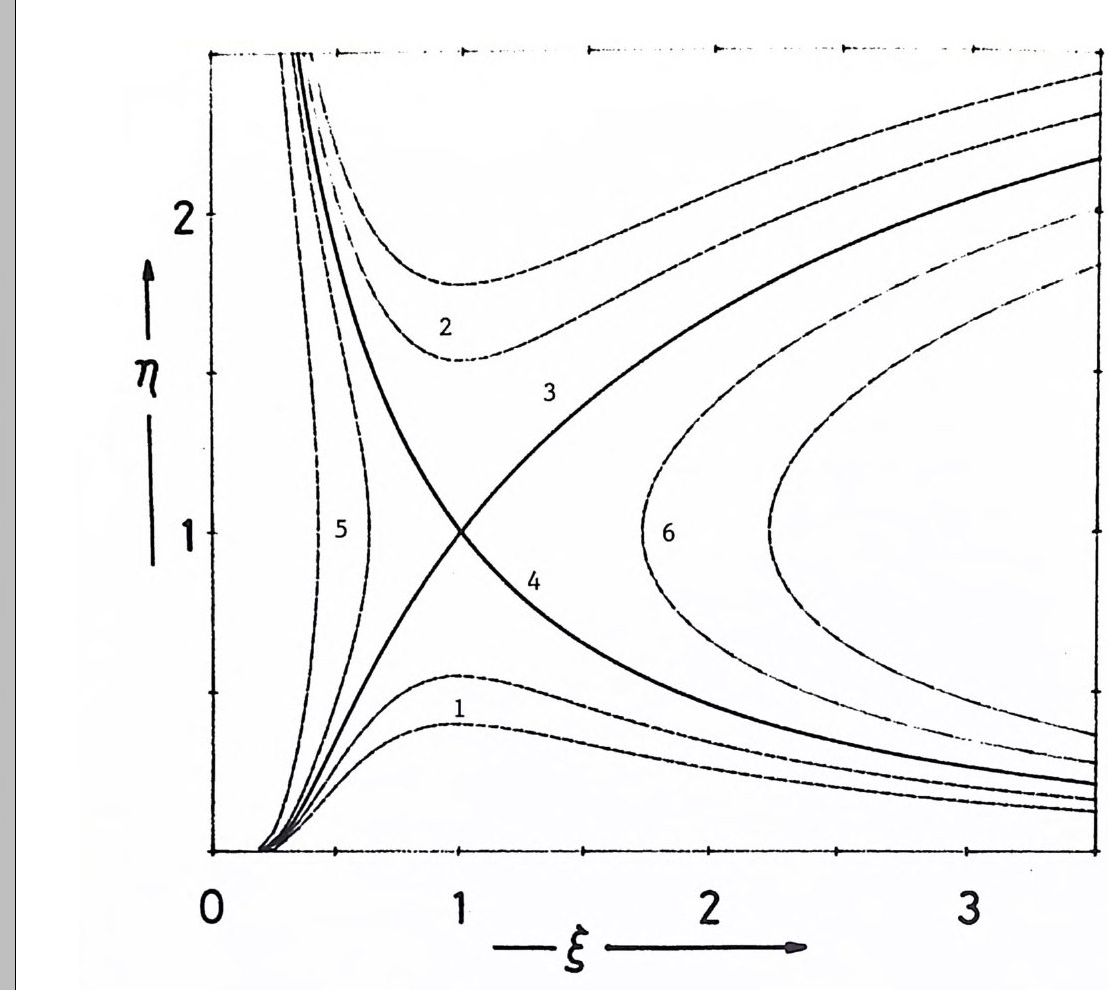 r-I」.l
Fig 4-1: Varia t ion of normaliz ed fl ow velocit y n = v/vc Saso lua t ifou nncs t oifo n f oa mf i nl yo rm1 aalirez edt h rea dsui ab slo ndii sc ta n nbcree e~z e =s r. /r C Solut ions of fa mi l y 2 are everyw here sup e rsoni c . Uni qu e solut ions 3 and 4 are th e tr anssoni c crti cal solut ions pa ssi n g th roug h th e crit ical po i n t (1,1) cont inuo usly. Double-valued fa mi l i e s 5 and 6 comp r ;i se pa rt of a comp l et e solut ion th at in cludes a shock tr ansit ion to mat c h boundary condi tion as ~ + co •
fam i l y of sup e rsoni c solut ions can easil y be excluded on a pu re observat iona l gr ound ; th ey pr edi c t v > v C_ as r + r 0_ but it is not observed fr om th e low corona. Ap a rt fr om th e double-valued solut ions , we are th en left wi th t h e fam i ly of subsoni c solut ions and th e uniq u e tr anssoni c solut ion of monot o ne in crease. In th e subsoni c case, v is less th an v _ and ever decreasin g as r + °'• hence we may have C asym pto t ical ly - ln n2 나 ln f. , or v a: r-2 fro m th e closed solut ion we obt a i n ed in Problem 4-9. Such a veloc ity field in conj u ncti on wi th t h e condi tion of st e ady mass-loss rate demands th at. nwnber densit y n, should remai n fini t e a s r + co; th en th e pr essure would fa r exceed th e ambi e nt in t e rste llar pr essure. Theref o re, th e subsoni c breezes are excluded on th e same gr ound as th e hy d rost a t ic solut ion was. Fi n ally, th e remai n i n g crit ical solut ion becomes asym pto t ica lly n2 ::: 4 ln E;,, or v: :: 2v_C (• ln r/• r_C) 1/2 as r + ', si n ce n2 and ln_~ are domi n ant te rms mat c hi n g each ot h er. In th i s tr anssonic wi n d, th e densit y n(a: r -2- v -1· ) ap pr oaches zero as r+ '; th e tr anssoni c solut ion of monot o ne in crease conf o rms to tlE pl ausib le boundary condit ion at in f ini t e d i s t a nce from th e Sun . 4.5.3 Energy Consi d erat ions The uniq u e solut ion of tr anssoni c behavi o ur is not ent irel y sat isf a ct o ry, because v/v_c in creases wi thou t bound as r/r~c ap pr ochi n g in f ini t y . Thi s unrealis t ic b ehavio u r is th e pr i c e we have to pa y for bein g allevi a t e d th e di fficul ty of solvi n g energy eq u at ion. One may pa rti all y overcome th e pr oblem of in f ini t e e xp a nsio n velocit y by relaxin g th e st r i c t is oth e rmal condi tion. For examp l e, Parker
(19 63) repl aced th e is ot h ermal assump tion by ei ther one of foll owi n g ones: (1) The coronal mat e ria l is is ot h ermal in sid e r = r* and undergo es an adi a bat ic c hang e P ~ pY beyo nd r = r* , (2) The pr essure and densit y of th e coronal mat e ria l sat isf y everyw h ere th e po lyt ro p ic relati on p ~ pY . He obt a i n ed a fini t e v eloc ity as r + co wi th y = 5I3 for th e fo rmer assump tion , and wi th y = 3/2 fo r th e latt er . Excep t fo r th e pr oblem of in f ini t e v elocit y, th e is ot h ermal model tu rns out to describ e rath er fa i thf u lly essent ial asp e ct s of th e coronal wi n d, in th e sense th at th e coronal mat e ria l exp a nds in t o in t e rpl aneta ry sp a ce as a sup e rsoni c fl ow. Problem 4-10: Const ruc t yo ur own model of th e coronal wi n d under an wasi stuhm p ot io~ no < th 1a. t thWeh att e mdpi fe freatreu nrec ecs hiann g te h efo slloolwuts iTon( r )c u=rv Te0s~ ((r~0- /,nr)) 1d-oo yo u have betw e en the is ot h ermal and yo ur ow·n results ? One should in clude th e eq u at ion of energy conservat ion along wi th th ose of mass and moment u m in order to deriv e th e te mp e ratu re varia t ion as a natu ral conseq u ence of th e give n sy s t e m. If conduct ion domi n ate s energy tr anspo rt over ot h er modes of tr ansfe r, th e eq u at ion of energy conservat ion becomes fo r a st e ady fl ow 습옮 [r2 p v(½v2+e 나)] = -p v( ;으) +검읊 (r% 惡) · It is readil y in t e g r ate d to yiel d 4 군 nv [½ 답 v2 + SkT - 쁘~] -4 ' IT r% 惡 = E, where E is th e const a nt of in t e g r at ion. Thi s in t e g r al im p l i e s th at th e to t a l energy fl ux th roug h a sp h eric al surfa ce is a const a nt of th e
fl ow. The subsoni c breeze solut ions are known to resul t when E= O; whi l e th e wi n d solut ions resul t when E > O. As Chamberlain (19 61 ) first in t r oduced , it is conveni e nt to work wi th d im e nsi o nless varia bles T, ljJ and A def ined fo r te mp e ratu re, ki n et ic e nergy and gr avi tat i ona l energy as T --- TT—。 U 드 Z1k T떄 。 v 2 A 三 GrM 。 7k1T 円。 • The resulti ng relat ions , all boxed, fo r mass, moment u m and energy conservat ions th en become in te rms of th ese di m ensio n less varia bles as n 방 [Tk근TH ] 1/2 47TG 仁M 。 三 c, ½( 1 -t )웅 = 1 무 -dd XT , and A ,s/2 $d>... = e:0 0 산1j, + ). -% -r . In order to in t e g r ate th i s set of eq u at ions , one needs to sp e c ify tw o const a nt s , e:00 三 E/2FkT0 and A = n K0 G~ 밈 T3:'/L2 /k2F. Si n ce th e const a nt e:。 repr esents th e resid ual energy pe r pa rti cle at in f init y and e: o__o > 0 fo r wi n d solut ions , one may fu rth er reduce th e number of arbi trar y const a nt s _to only one by def ini n g
T --- T— e cA * e8 lj,* 三 上O3 A* 三 —(X) . Then, th e energy eq u at ion tr ansfo rms in t o K -r5* /2 ~d-r * = 1_ - 21 1/J* +. A* - 主5 T* with th e moment u m eq u ati on bein g left in t a ct, and K 三 e:030 ·/ 2 A. A wi d e rang e of wi n d si tuat ions can th us be describ ed by a si n g l e pa ramet e r K. Durney and Roberts (19 71 ) repo rte d th ei r di m ensi o nless solut ions fo r th e rang e 75 S. K ,::. 200 and also exp l ain ed how to recover a uniq u e di m ensi o nal soluti on bei n g sp e ci fied T 。 and F. We now leave th e subj e ct here and fo r fu rth er det a i l s we refe r th e in t e reste d reader to revi e ws by Bi e rmann (19 74) , by Hi h alas (1978) and to orig ina l refe rences th erein . 4 . 6 GRAVITATIONAL INSTA.B I LITY A ga seous cloud may be unst a ble ag a i n st th e gr owt h of pr essure di s t u rbances as a result of self- gr avi tat i ona l at trac t ion of th e denser reg ion s. Thi s qu est ion of gr avi tat i ona l in st a bi l i ty is a fa mous, old pro blem of Je ans, who consi d ered th e pr oblem in an at temp t to op e n th e road leadi n g to th e fo rmat ion of celesti al condensat ions rang ing fr om st a rs to sup e r-cluste rs of ga laxi e s. 4.6.l Je ans Condi tion fo r Gravi tat i ona l Inst a bi l i ty We st a rt with th e basic hy d rody nam i c s eq u at ions : The mass cont inui t y eq u at ion is 쁘3t + V• (Pt ) = 0,
and th e moment u m eq u at ion wi th t h e sel. f-gr ay itat iona l fo rce becomes p [흙 + (;.v) 라 = -V P - pv o, where th e gr avi tat i ona l po t e nt ial t should sat isfy th e Poi s son eq u at ion v2~ = 4nG~. We let th e is ot h ermal eq u at ion of st a t e p = —µp~ kT = v2s P repl ace th e energy eq u at ion fo r si m p l i c it y. Let us now consi d er a hy po t h et ical medi u m of densit y P0, pr essure P 。, po t e nt ial field cfl0 , and velocit y 니v 。, and fo llow up a small pe rtu rbat ion P ' give n to th e medi u m and its c orrespo ndi n g pe rtu rbat ions P' , cfl ' and -v누 ' : p = p。 + p ' ; P = P,o_ +• P-1 '; f• = ~·on +• t• ' '• ;• = ?·o + 천 The li n eariz ed fo rm of mass cont inui t y eq u at ion is —3apt ' +v + 0 .vp ' +v+ , .vp o =-(p ' v•v+ O + p o v·+v , ), and th at of moment u m eq u at ion is 흐at 나 o .V• ?' 나 ’.v•t o = - (V~ ' + ~pv2 。 VP ' ) • The densit y pe rtu rbat ion is relate d to th e po t e nt ial pe rtu rbati on by
th e Poi s son eq u at ion V2~ ' = 411GP ' • In ge neral P_0 and 기v~ 0 are fu nct ions of po si tion, and th ese th ree eq u ati oiu are not - ea sil y solved. constTa no t eaansed tthh ee mdie fdfi ui mc uil st y aJt e arenss t m 니van 。d e= aO ' ibno il dt iaaslslu ym. p tioOnn tthh ia ts Pa s。~·s u ims p tion one may drast ica lly sim pl if y th e li n eariz ed cont inui t y and moment u m eq u c .tion s to —33pt , =·- p o V·-V+-' and —a3+Vt ' = -V •O - ' - —vP2 。s 'v p' • One th en ta kes th e di v erge nce of th e latt er eq u at ion to elim ina t e V•니v ' and v2~' by th e cont inui t y eq u at ion and th e Poi s son eq u at ion, respe ct ivel y. The resulta nt eq u at ion is - ~a2p I + V! 'i/2 p1 + 41TG p0 pI = 0. Seek ing a pl ane wave solut ion fo r th e densit y pe rtu rbat ion, we subst itute p ' = K exp [ i( 가k· •이~ + wt ) ] in t o th e above eq u 曰ati on , and o曰bt a i n a di s p e rsio n relati on ·g ive n by If th e wave number |kj assoc ia니t e d with th e si n usoi d al di s t u rbance is less th an a cr itical value lic JI
k J2 三 41군1Gs p ~0 = 4TIGp o —µkmT— H ' w2 becomes neg a t ive and th e di s t u rbance gr ows exp o nent iall y, th us, an in st a bi lity sets in . Thi s is called th e Je ans in sta bil ity. We have seen th at any pe rtu rbat ion wi th s cale-leng th gr eate r th an 2n / kJ would cause an in st a bi lity to a self -gra vi tat i ng sy s t e m. Thi s crit ical leng th is called th e Je ans le 껑t h J• and is give n by J = [ G lp1 。 Tk一 --1 / 2 『 Not ing (GP 。) -1 /2 has di m ensi o n of time, one may say_ tha t th e Je ans leng th is th e di s t a nce run over th e pe rio d ('IT/ G p。) 1/2 wi th t h e velocit y of th ermal mot ion. The mass associ a t e d wi th t h e Je ans leng th is a measure of maxi m um st a ble mass ag a i n st th e gr avi tat i ona l pu ll. Thi s maxi m um st a ble mass is call 쿄 th e Je ans c~i tical mass fo r ,gr avi tat i ona l, co Uaps e, and is give n by MJ 巨。 ).j = [*] 3/2 따 ]1/2 It is handy to remember MJ ' 104 M 。 [百늙 : ] 3 /2 [ 20 : cm..:~ 11 /2 。
Problem 4-11: Act u ally th e in i tial conf igu rat ion Je ans adop ted to make th e pr oblem si m p l e, ot h erwi s e in t r act a ble, does not sat isf y all th e basi c eq u at ions . Poi n t out th e in consi s t e ncy in th e assumed conf igu rat ion of Je ans. It should be po i n t e d out , however, th at carefu l tr eatm ent s of th e pr oblem yield essent iall y th e same results as th e Je ans orig ina l sim pl i fied analys i s . Modi ficat ions of only order unit y is requ i r ed to th e numeric al fa ct o r, not to th e fu nct iona l dep e ndence of MJ on T and p. Si n ce it is th e fu nct ion al dep e ndence whi c h really count s , not th e numeric al multi pl i c at ion fa ct o r, Je ans' pion eerin g st u dy has been of gr eat pr act ical use in underst a ndi n g of early ph ases in st a r fo rmat ion. 4.6.2 Gravi tat i ona l Insta bi l i ty cif an Inf ini t e D i s k Init ial conf igu rat ion of Je ans, as was po i n t e d out in Problem 4-11, has an in consi s t e ncy; we now exami n e , as an exact l y solvable pr oblem, th e.s t a bi l i ty of a one-di m ensi o nal ga seous slab or di s k of in f ini t e r adi u s . The di s k is assumed be at rest -v누_ 。 = 0 in i tiall y everyw h ere, whereas in i tial densit y p_0 and p• o t e nt ial <-I>0_ ar-e assumed be fu nct ions of z only, z bein g th e di s t a nce pe rpe ndi c ular to th e di s k mi d -pl a ne. Let us first det e rmi n e how densit y varie s wi th z under self- gr avit at i ona l at tra ct ion. For such a di s k, th e moment u m eq u at ion combi n ed wi th a n is ot h ermal condi tion becomes d—dz 『- —10 p 2。d -z -= - 4nGv2sp 。 It s solut ion is give n by p。 (z) = P,。, (O) sech2 (쭙
wi th t h e scale hei g h t H bei n g def ined by H 三 [—2n c—k Tµ p—。 (O) ]l /? On th e ot h er hand, mass pe r uni t area M(z) bet w een -z and + z of such a di s k becomes M(z) = 2 p0 (O)H ta n h (운 = M(') ta n h (웁 hence we may _ re writ e t h e densit y di s t r i b ut ion in th e fol lowi n g fo rm P0(z) = p。 (O)(l- 군) where i; = ta n h (z/H) = M(z) /H(~) . We th us repl ace th e in dep e ndent varia ble z by a fr act iona l column densit y i;. In th e case of Je ans analys i s we have fo llowed up a time- dep e ndent develop m ent of a small pe rtu rbat ion th roug h th e li n eariz ed pe rtu rbat ion eq u at ion. Inste ad, fo llowi n g Sp itze r (1978), we shall consi d er th e pe rtu rbat ion whi c h nei ther osci l late s nor gr ows exp o nent iall y, whi c h correspo nds to (I) = 0 in th e pl ane wave eq u at ion and to a time- in dep e ndent velocit y field . The reason fo r fo cusin g on such a st a t e of marg ina l st a bi lity is th at it usually sep a rate s reg ion s of st a bi l i ty, wherei n pe rtu rbat ions ge t qu i c kly damp e d, fro m reg ion s of in sta bi l it y, wherei n pe rtu rbat ions gr ow exp o nent iall y. We def ine kc as th e value of k givi n g a marg ina l st a bi lity to th e sy s t e m, and writ e f o r th e densit y pe rtu rbat ion p 1 (!;) in th e form p'(I;) = p。(I;) exp [ikc x] O(i; ),
whi c h is in dep e ndent of t and th e coordi n at e y . Put ting P ' (c,) in t o th e li n eariz ed cont inui ty eq u at ion , subseq u ent l y ta ki n g th e di v erge nce and maki n g use of th e Poi s son eq u at ion, one may fina lly obt a i n 醫근등農 + o[ 근건 - ~] = 0, where \) 三 k_ H. Thi s is a go verni n g eq u at ion of th e pe rtu rbat ion, C and its s olut ion is give n by 0(i;;) = \ [는] v/2 (v-i;; ) + A2 [틀] v/2(v+i ;;). Si n ce 0(1; ) must remai n fini t e f or th e marg ina l st a bi l i ty as z; ap pr oaches ±1, \I must be eq u al to unit y; hence we have kc = R1 = [r 27TG kµTp 。 (O) .l] 1 /2 Phy s i c ally one would exp e ct in st a bi l i ties li k ely to develop on th e long waveleng th si d e of th e marg ina l st a bi l i ty; an ifini t e d i s k becom~s unst a ble ag a i n st th e gr avit y fo r pe rtu rbat ions wi th ! kl < lk 니 · Thus, th e mi n i m um unst a ble leng th is about ,r times th e scale heig h t ,rH . On th e ot h er hand, th e scale heig h t is about an e-fo ldi n g th i c kness of th e densit y di s t r i b ut ion in th e di s k. We th us exp e ct ,rH is somewhat large r th an th e di s k th i c kness. Theref o re, one may conclude th at mot i~ns in th e z-di r ect ion alone can not pr oduce in sta bi l i ties in th e in f ini t e d i s k. Thi s is consi s t e nt wi th r esult s from li n eariz ed analys i s (Ledoux, 1951). A final collllllent may be in order. In th e Je ans case th e gr owt h raas te ,| 히 -iwge , t otfi ngp e srmtu arlblaetr iothn a nin crlkeJasI e,s wthoe rae acs oinns t at hn te vcaalsuee o f ✓ 4i ,nr Gf ipn 。i t e
di s k, -iw ri s es to a maxi m ul'. l value for Jk J about Jk,, J and fal ls to wards zero as jk j ap pr oachi n g zero. Thus, th e po t e nCt ial gr adi e nt pro duced by small densit y pe rtu rbat ion s in an in f ini t e d i s k does not in crease as th e waveleng th gr ows in def ini t ely . Problem 4-12: Deri v e th e eq u at ion fo r O(r; ) fro m th e linea riz ed cont inui t y eq u at ion by ta ki n g a pr op e r tr ansfo rmat ion fro m th e orig ina l varia ble z to th e fr act iona l column mass of r;. Problem 4-13: Est imat e th e scale heig h t of th e ga seous mat e ria l in th e ga lact ic p l ane. 4 . 6 . 3 Free-Fall P.p pr oxii r.a t ion of Gravi tat i ona l Collap s e Ret u rni n g back to th e Je ans pr oblem, we now consi d er a sp h eric al cloud wi th m ass gr eat e r th an th e Je ans mass fo r th e give n cloud condi tion. Thi s cloud th en undergo es gr avi tat i on al cont r act ion. We shall argu e th at once collaps e st a rts , it pr oceeds at an ever accelerat ing rate . The gr avi tat i ona l fo rce pe r uni t volume of mat e ria l GM p /r2 varie s di m ensi o nally as ~ M2 /R5 , whereas its m at c hi n g fo rce of pr essure gr adi e nt VP varie s as ~ MT/R4 . Therefo r e , th e im p o rta nce of pr essure is to di m i n i s h as R ge t s smaller; th ere is no way fo r th e pr essure to ret a rd th e-collaps e. In th i s respe ct, one ~ay find ju st ificat ions fo r vi e wi n g th e collaps e of a ,gr avi tat i on ally unst a ble cloud as a fre e-fa ll pr ocess . Let th e cloud be of uni form densit y p( O) and at rest in i tiall y. Consi d er a pa rti cu lar mass shell at in t ial di s t a nce a fro m th e cloud cent e r, and fo llow th e shell r(t) as a fu nct ion of time . We may writ e-d own th e eq u ati on of th e shell si m p l y as 후dt 2 = - 쁘r2묘 = - 4'13T Gr2P (O) a3,
where M(a) denot e s th e mass in t e rio r to th e in i tial radi u s a ( = r (O) ) of th e shell. Mul tipl y ing bot h si d es of th e eq u at ion of mot ion by dr/dt and in te g r at ing th e resulta nt eq u at ion we have th e energy in t e g r al 읊 ( ~) = -뚜 p (0) [~ - -1 ] 1 /2 Put ting r/a 三 cos2 8, we can cast th i s energy in t e g r al in t o a + 21 si n 213 = [ ~]l/2 t, or t = (~] 1 /2 • ¾( a + ½s i n 2a) In th i s collaps e th e shell is fu lly di s t e nded r = a at 6 = 0 , and has collaps ed to a po i n t when 6 = 7T/2 • The collaps e time fo r our shell -rff is th erefo re obt a i n ed by set ting 6 = 이 2 in th e above eq u at ion: 1 /2 Tf f = [~ ]112 ' 4.3 x 10⁷ ;rs [ ~] 。 After one fre e-fa U ti.me 'ff all th e mass shells of an initiall y homog e neous cloud reach th e cent e r at th e same time . If th e in i tial densit y di s t r i b ut ion is a fu nct ion of radi u s, th e fr ee-fa ll time is now di ffere nt fo r di ffere nt mass shells. In . ge neral denser in ner reg ion collaps es first , wi th t h e out e r shells fa llin g in at pr og r essiv ely late r times . It is readi l y seen th at
th e densit y di s t r i b ut ion wi thi n a cloud must become very pe aked to ward th e cloud cent e r. An analyt ica l st u dy by Penst o n (1969) shows th at th e densit y pr of ile fo r a cloud , in whi c h pr essure pl ays no sig n i fican t role, te nds to ap pr oach r -1·~2,/ 7'; whi l e th e densit y pr of ile fo r an is ot h ermal collaps e varie s asym pto t ica lly as r -2'- (Larson, 1977) As th e fr ee-fa ll collaps 'e pr oceeds th e densit y of th e cloud wi l l in crease st e adi l y . On th e ot h er hand, th e Je ans mass is pr op o rti ona l to ( T3 /p ] 1i 1/ 2'- and local densit y in crease aut o mat ical ly reduces tem p e r- at u re at least in i tial st a g e of th e collaps e, hence, wi thi n a collaps i n g cloud, masses smaller th an th e Je ans mass fo r th e in i tial cloud condi tion can now be gr avi tat i on ally unst a ble and st a rt to condense. Thi s pr ocess is called th e h i er 따 ch ic a l fra gme nta t ion. As long as th e te mp e ratu re st a y s low, th e hi e rarchi c al fr agm e nt a t ion is exp e ct e d to cont inue ·wi th a fr agm e nt condensin g in t o ye t smaller fr agm e nt s . Thi s pr ocess pr ovi d es an at tra ct ive mechani s m by whi c h many fr agm ent s of observed st e llar mass-rang e can fo rm fro m a mot h er cloud wi th a fe w th ousand solar masses. Fragm e nt a t ion wi l l cont inue unt il t h e ga s becomes so op a q u e th at th e radi a t ive coolin g time wi l l bt! no long e r shorte r th an th e fr ee fa ll time. The collaps e th en becomes adi a bat ic, and th e Je ans mass wi l l decrease no fu rth er. The op a cit y pe r uni t mass of th e collaps i n g cloud is nearly in dep e ndent of densit y; hence th e op tica l dep th th roug h a fr agm e nt varie s as P time s th e th i c kness of th e fr agm e nt . Si n ce th e fr agm ent si z e varie s as P- 1-/,3~ , th e op tica l dep th in creases as P 2••/' 3 ~ , and fo r suf fici e nt l y gr eat densit y th e op a c ity gr owt h will brin g th e fr agm ent to a halt. The ge neral pict u re of an op a c ity- lim i ted fr agm e nt a t ion out l i n ed here is to o si m p l e to comp l ete ly be tr ue, neverth eless, it pr ovi d es a -pl ausib e scenario fo r pr oduci n g st a rs fr om massiv e in t e rste llar cloud. Problem 4-14: $how th at th e te mp e ratu re in si d e a cloud undergo i n g an adi a bat ic c ont r act ion varie s as one-th i r d po wer of th e cloud densit y.
Problem 4-15: Assumi n g th at th e gr avi tat i ona l energy released durin g the collaps e is comp l ete ly u.3 e d up in heat ing th e cloud and th at th e collaps i n g cloud can not cool more ef fici e nt l y th an a black body Sp itze r (1978) adop ted 4nR2oT4 > G M2/R Tf f as th e condi tion fo r cont inui n g fr agm ent a t ion. From th i s condi tion show th at th e lowest mass ?-\, of an op a cit y-1.imi ted fr agm e nt is give n by 9/4 ml/4 % 궁 .(6) 1/4 ,r만) G3/;G1/2 Comp a re th i s value of M.F.,. wi th th e observed mi n i m um st e llar mass. For a more det a i l ed analys i s th an Sp itze r's, we ref e r in t e reste d readers to Ly n den-Bell (1973). 4.7 RAYLEIGH-TAYLOR INSTABILITY Int u i tivel y, it is qu i te c lear th at an in st a bi l i ty is li k ely to develop when a· lig h t e r fl ui d accelerate s a heavi e r one, or sup po rts a heavi e r one in a unif orm gr avi tat i ona l field . We shall give here th e th eory of th i s in sta bi lity, named af ter Ray l eig h and Tay l or, whi c h wi l l be anot h er examp l e of th e normal mode analys i s of in sta bi l it y. Let us consid er a st a t ic c onf igu rat ion in whi c h an in comp r e'Ss i b le fl uid of ~ densit y is arrang e d in horiz ont a l st r ata under a uni form , const a nt accelerat ion of g; th e pr essure and densit y are fu nct ions of th e verti cal ~oordi n at e z only. We now di s t u rb th e fl uid slig h t l y and fo llow its f u rth er develop m ent . We denot e th e densit y at any po i n t -r+ as a result of th e di s t u rbance by p + op and th e correspo ndi n g in crement in th e pr essure by oP. The relevant eq u at ions of mot ion and cont inui t y are, respe ct ivel y, p a니v /at = -VoP + 홍 oP and V• 랍 = O, where 럽 denot e s th e pe rtu rbat ion velocit y.
In addi tion to th ese tw o eq u ati on s, we should have a 0p /a t + (V.v)p = O. ~he last eq u at ion ensures th at th e densit y of every fl ui d element remai n s unchang e d as it chang e s its p o sit ion; th e densit y at a fixed po i n t should vary, even if th e fl ui d is in comp r essib le, as fl ui d orig ina lly at di ffere nt locat ions bei n g in t e rmi n g l ed to g e t h er due to th e mot ions set by th e give n di s t u rbance, si n ce th e densit y was orig ina lly a fu nct ion of po si tion. Taki n g coordi n at e s in such a way th at 1= (x,y , z) and g = (0,0,-g) and pu t ting th e ~ velocit y ; 三 (u,v,w), we sepa rate th e th ree vecot r eq u at ions in t o th ei r comp o nent s : p _aaut_ =- -. —aax oP p 꼬3t = - 노ay 6P ; p 百aw = - 죠a 8P - g 6p , 뿌3X +꼬3y +~3Z = 0, ~at oV Pt' +• w•• 쁘dz = o. An ap o log y fo r a conf u si n g not a t ion is in order; pl ease do not id ent ify u , v and w here with th e mag n i tude correspo ndi n g to th e pfeo cr ul0ipa r, voPe loancidt y-V, , fwl oew h va veelo cfir to ym atnh de atbo ot av el vfeivloec ietq y u ,a tr ieosXnp s e ctht eivy el y. Seeki n g normal mode soluti on s of th e fo rm exp [ i (kv x + k.., Y + wt) ] foll owi n g relati ons : i k x 6P = -iwP u ; i kVy oP = -iwP v ; dd z oP = -iwp w - g op , i k x u + i k y v + -ddwz = o, iu 6p + w _ddp_z = 0.
Multi pl y ing tw o leadi n g eq u at ions by -ikXv and -iky , respe ct ivel y, and addi n g th em., and maki n g use of th e fo urth eq u at ion 1 we obt a i n (k.X~ + kyD oP = -iwp dw/dz • On th e ot h er hand, combi n at ion of th e th i r d and fifth eq u at ions yield s anot h er relati on fo r oP, namely, d oP/dz = -iwPw + (g/iw) w dp /dz . From th e last tw o eq u at ions we may now elim i n at e oP to obt a i n 혹dz + 감 뽑 쁩 -k2 ( 1 + 출 : 器 ) w = 0 , where k2 三 k~X + ky~ . There are several si m p l e cases fo r whi c h a solut ion of th i s eq u ati on is po ssib le. Lord Ray l eig h consi d ered th e case of ~-If we pu t P = P。 ex p( az] in t o th e above eq u at ion, it reduces to 白+ 8 쁩- 난 (1 +:i-s) w = O, whose solut ion is w = A1 exp ( q1 z] + A2 exp [q2 z] . Here , q1l and Q2,, are th e root s of q2 + q13 -k2 (1 + g13 /w2 ) = 0 ari d A1 and ~ are tw o arbi trar y const a nt s . If we sup po se th e fl ui d is bounded betw een z = 0 and z = d, th e vani s hin g velocit ies at th e boundarie s demand A = -A2 三 A and (q?2 -q11 )d = 2i m '1T wi th m bein g an in t e g e r. If we rewrit e t h e solut ion in th e fo rm of w = A exp [ {q1 + q2 )z/2] {exp [{q1 - q2 )z/2] - exp [-{q1 -q 2 )z/2]}, and make use of q1 + q2 = -13 , we have an alte rnat ive fo rm of th e solut ion
w = const . exp [ - ½B z ] si n (m 11z/d) . q22 = S{-u8b s-t/ i[t8u2t i+n g 4 k2q 11( 1 =+ g{8- 8/w +2 )✓ ] [} 8 2/ 2+ 4ink 2t o( 1 +( qg1 8 -/w q22) ]) d} =/2 2i ma nnd, we fina lly obt a i n 52 +빠 멸) = -망 or w2 = -gs k2d2 (k2 + e2/4)d2 + m2n2 We th us conclude th at th e st r at ificat ion of ex po nent iall y var ying densit y is st a ble if th e densit y in creases in th e di r ect ion of gr avi tat i ona l fo rce (13<0), whi le it becomes unsta ble if th e densit y in creases in th e di r ecti on op po sit e t o th e. di r ect ion of gr avi tat i ona l, fo rce (l3>0) . Not e th at fo r give n d, k and m th e gr eate st gr owt h rate of pe rtu rbat ion results when 132a2 = 4(k2d2 + m2 규). Problem 4-16: Perfo rm a normal mode analys i s to show th at th e conf igu rat ion of an in comp r essib le f lu、 i d wherei n p is const a nt fo r Z 츠 O and zero fo r z < O becomes 1,1n st a ble under an in f l uence of uni form gr avit y act ing in neg a t ive z-di r ect ion. What is th e gr owt h rate of th e velocit y pe rtu rbat ion ? Problem 4-17 : Make the same normal mode analys i s ont o the conf igura- tion dep ict e d schemat ica lly in the fo llowi n g di a g r am to deriv e w2 = - kg (p ?2 - p 11 ) / (p 2., cot h kb + p1 cot h ka) .
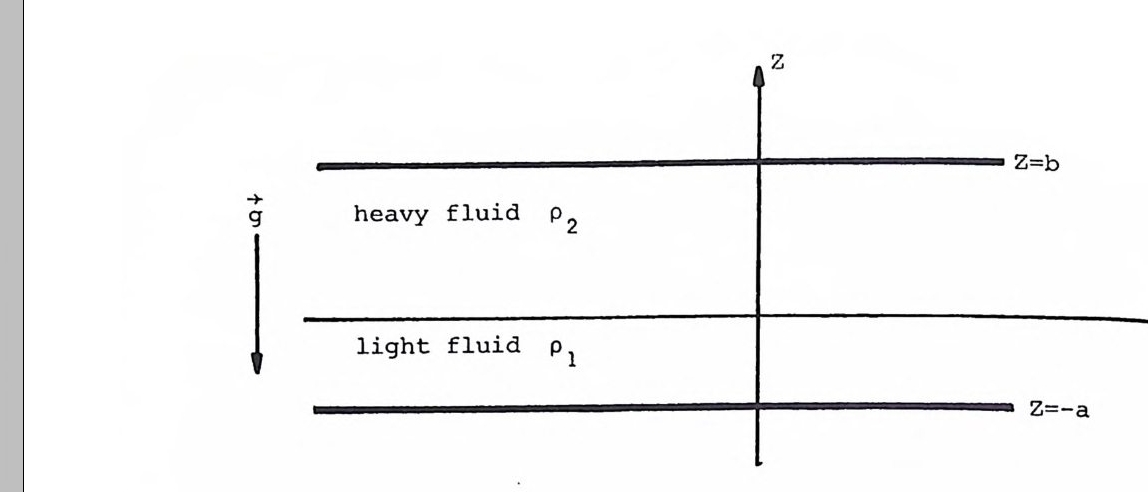 z
z
Problem 4-18: Read an arti cle writ ten by Frie man (1954) fo r an i:I.S tro p h y s i c al ap plica t ion of th e Ray l eig h -Tay l or in st a bi l i ty.
REFERENCES For th e di s cussio ns on th e Boltz mann tr ansp o rt th eory we fo llowed th e classic by Chap m Naonn, -Usn.i faonrdm CGowasleisn ,g , tTh i. cr d. e1d9i7 t0i, onT, hCe aMmabtr ih de mg ea t Uicnia v1 e四rs eito yr y Of Press. We alsRoe i fc,o nFf e. rr1e9d6 5l, asFut n dtah mreeen t ac hlsa p otef r sS t ao ft istht ei ctael xat n db y Thermal Phy s i c s, (McGraw-Hi ll : New York) . oFrf o mt h fe o Blloolwti z mn ga nrne ft er arennspc oe sr t c aenq u baet ifoon u, ndp a arstti c r oup l ha yr sl yi c ianl atph pe l ic oc antt ei xont s of dy n ami c al evolut ion of st a r clust e rs : Chandrasekhar, S. 1942, Pr>in aip Z.e s of St e Z .Z.a r Dyn ami c s, Dover, New York. Cohen, R.S., Sp itze r, L. and Rout l y , P. McR. 1950, Phy s , Rev., Li gh t 쁘m ,an , 2A30.P. . and Shap iro , S.L. 1978, Rev. Mod. Phy s ., Sp itz꼬e ,r, L43. 7a. nd Hart, M.H. 1971, Ap .J. , IB, 399. For tMh ei h dail sa csu, sDsi. o 1n9s 7o8n, tSh et e sZ .Zo.al ar rA wt mi on pd s hwee refos ,l low(Fedre etmh ea nt: e xSta nb Fy ranci s co), Chap 15. We alsBoi e rfmo lalnonw, edL . th1 e9 7l4e, citnu reC osnmoit ce Ggaivs e Dny nb aym i c s, ed. by M.S. Uberoi The Cosmi c (GJoa hs nD Wyni al meiy c : s New cYonotr ak )i n, s p m. 1a7ny7 . ast r op h y s i c al examp l es of ga sdy n ami c al pr oblems ot h er th an th e solar wi n d. For deLyt na id le end- Bdeelslc, riDp . t1io9n7 3o, f int h De y hn aim e ir ac raclh iS ct ra ulc tf ur aregm ae nndt a Et ivoonlu wt ie orne offe r to St e llar Sy s t e ms, ed. by L. Mart inet and M. May o r, (Geneva Observat o ry: Sei tzer land) , p. 115. Furth Cerh adnedtr aa is le sk hoanr , thS e. R19ay6 l1 e, ig Hhy - Td raoyd l oyn r a miin cs ta a nbdi l Hi ty yd r oamreag n gei vt ei cn b y St a bil .ity, (Dover) . For an astr op h y s i c al examp l e of th e Ray l eig h -Tay l or in sta bi l i ty we refe r to Frie man, E.A. 1954, Ap .J. , 120, 18.
Ot h er ref e rences qu ot e d are fo llowi n g s : Chall\ b erlain , J. 19611 ,Ap.J., 도브, 675. Durney , B.R. and Robert s , P.H. 1971, Ap .J. , .!l.Q_, 319. Ledoux , P . 19511 Ann. d 'Ap ~. 438 . Parker, E.N. 1963, Inte r pl aneta ry Dyn ami c al Processes, (Int e rsci e nce: New York). Sp itze r, L. 1962, Phy s i c s of Fully Ioni z ed Gases, (lnte rsci e nce: New York), p. 143, and p. 282. Pensto n, M.V. 1969, M.N. , ~. 425. Larson, R.B. 1977, in St a r Format ion, !AU Sy mp. //75, ed by T. de Jo ng and A. Maeder (Rei d el: Dordrecht ), p. 249.
5 Mag ne t oh y dr ody n ami cs 5 .1 INTRODUCTION Throug h th e last tw o chap ter s we have been exp o sed to basic concep ts of bot h th e hy d rosta t ics and hy d rody na mi c s, we now tu rn our at ten t ion to th e mot ion of pa rti ai l y io ni z ed cosmi c mat ter under th e in f l uence of mag n et ic f ield . The uni v erse is in deed ful l of ion i z ed ga seous mat ter pe rmeat e d by mag n et ic f ield ; th e mag n et o hy d rody n ami c s (MHD) is one of th e most im p o rta nt to ols in modern astr op h y s i c s . l硏 D has an ext r eme di v ersit y in its a p plica t ion : pl aneta ry mag n et o sph eres revealed by sp a ce pr obes, fa scin at ing ph enomena associ a t e d wi th t h e solar mag n et ism, dy na mi c al evolut ion of mag n et ized in t e rste llar clouds, mag n et ic s t a rs, pu lsar mag n et o sph ere, et c . In th i s chap ter , however, no at tem p ts will be made to di s cuss th e subj e ct in gr eat det a i l , we wi l l pr esent basic MHD eq u at ions and exp o se ourselves to only th ose basi c concep ts whi c h freq u ent l y ap pe ar in advanced astr op h y s ic a l litera tu res witho ut givi n g in t r oduct o ry exp l anati on s to readers . Ap plica ti on s of th e l1HD in astr op h y s ic al cont e xt wi l l be left to relevant tr eat ises qu ot e d in th e refe rence li s t give n at th e end of th i s chap tet ,
5.2 BASIC EQ U ATIONS OF MAGNETOHYDRODYNAMICS The mag n et o hy d rody n ami c s deals wi th th e mot ion of a hi gh ly conduct ing flu i d in th e pr esence of a mag n et ic f ield . The field act s on bot h elect r ons and io ns, whic h influ ences th e bulk mot ion of th e mediu m itsel f: The mot ion of th e conduct ing mediu m across th e mag n et ic f ield ge nerat e s elect r-ic current s whic h chang e th e mag n et ic_ f ield , and th e act ion of the mag n et ic f ield on th ese current s give s ris e to mechani c al fo rces whic h, in tu rn, modi fy th e flow of th e fl ui d. Conseq u ent ly we deal wi th a complic at e ly coup l ed syste m of eq u at ions fo r mat ter and field . In this sect ion we wil l deriv e basi c eq u at ions of th e mag n et o hy d rody namic s. 5.2.1 Maxwell Eq u at ions under MHD Ap pr oxi m at ion Sin ce we deal wi th o nly low fr eq u ency ph enomena in MHD , it is custom -ary to neg l ect th e displa cement current te rm in th e Amp e re's law. Fui: the rmore , th e conduct ivi t y of th e mediu m is consi d ered to be ext r emely large . These two rest rict ions compris e of th e MHD ap pr oxi m at ion. Wi th th e neg l ect of th e displ acement current , th e elect ric and mag n et ic f ield in an in ert ial fra me are describ ed by VxE-±= -..::.C1. 7aa' 홉:t' - and V X 홉 = 문 1, where +J denot e s th ~ elect ric current densi ty. • For simplici ty we have assumed th e mediu m to be non-pe rmeable, whic h is tr ue iri th e low fr eq u ency domain of our inte rest (cf . chap ter 5) . The condi tion r;.1 =0 whi ch is eq u iv alent 'to th e neg l ect of displa cement current s fo llows fr om th e second eq u at ion (Amp e re's law).
hofe re. VTh•B.e..= IOdt i vf coe arllngo e wnbces e i femr oqpm uo aseFt dia oranadss ayaam n' · so n i gnl a iw Mti aatxhlw a ect l ol ncdle q'iv tu- B.a.i. /otc nilo t =n o Ons , hthaa nved e m btahge een n e rt eoimcq i u tfi tri eeemdld e nt conf igu rat ion. Wi th t h e neg l ect of th e di s p l acement current , it is ap pr op r i a t e to ign ore Coulomb ' s law as well. The reason is th at th e electr i c field is comp l ete ly det e rmi n ed by th e curl eq u at ion s wi th t h e ai d of th e Ohm ' s law fo r -J+ . Even if th e di s p la cement current is reta i n ed in th e Amp e re's law and 'v• E니는 =4np ~e wi th •p _e bein g th e electr i c charge densit y is ta ken in t o account , as wi l l be .sh own shortl y , correct ions are only of th e order of 균 /c2 . To comp l ete th e sp e cif icat ion of dy n ami c al eq u at ions we must sp e cif y th e relati on bet w een th e current densit y j and th e field s 명 and 정. How·e v er it must 'be remembered th at th e elect r i c conduct ivi t y o , whi c h ent e rs in th e Ohm's law dep e nds on th e local st a t e of th e conduct ing . f l uid . So it must be evaluat e d in .th e movi n g fr ame of refe rence. Si n ce fl ui d velocit y 니v measured in th e in erti al fr ame is supp o sed to be small comp a red wi th t h e sp e ed of li gh t c, we may neg l ect te rms of th e order or (v/c)2 in tr ansfo rmi n g 명 and 홉 to correspo ndi n g qu ant ities in th e fr ame movi n g wi th a fl ui d element .• If we denot e by pr i m es th e qu ant ities measured in th e movi n g fr ame , we have +E’ = +E + 1k+)v x +B and B1 = B -.! t X 효 C The Ohm's law in th e movi n g fr ame becomes j' = CJ법’ = c( 홈 내t x 홉).
But in MHD we are dealin g wi th c onduct ing fl ui d fo r whi c h th e conduct ivit y is very large whereas 슈j•, should be fini t e. Conseq u ent l y 명' must be very small; i.e. th e electr i c field in a fram e movi n g wi th t h e bulk fluid velocit y is very nearly zero. The fl ui d under th e act ion of ,E± and- ➔B flo ws in such a way th at +E +-l= -+v xB+ : :: O C is sat isf i ed. Thi s giveI s정 ’i n =t 홉u rn_ 단a )v2 e정r y 니 im p o r ta nt result The in f ini t e. c o nduct ivi t y ap pr oxi m at ion of MHD th us makes th e mag n et ic field -B+ in varia nt under th e tr ansfo rmat ion. We may ta lk of a mag n et ic field wi thou t sp e cif ying th e fr ame of refe rence in whi c h it is measured, We now est imat e th e cont r i b ut ion of th e convect ive current by sp a ce ccohnadrig te iopn_e gtoi vet hn e bcy ur+EreI n't 0 dewnse it mya.y havFreo, m th e Coulomb's law and th e where L is a charact e %ris : ::t -i c志 s cavl·e 단lten xg 'Bt h') f:::o -r 감·ch a(n층)g e (훈o)f , -B-fi eld . Convect ion of th i s sp a ce charge by th e fl ui d mot ion yield s current densit y of th e order of IPe 이 = (합 (습 법)= (합 111. nCeogn ls ieg q uib enl et l yc ontht re i bc ount vioecn t tivo e니-J c ;u rtrh. een tt o ot af l thc eu rnreent t spd ae cnes it cyh airgs e mapi ne_ lmy a dkuese at o th e conduct ion- current , th at is to say, th e drif t of elect r i c charge s in
th e conduct ing fl ui d . This brin gs us anot h er conveni ent in varia nce 尸-p: whi c h enables us to have 3 = g (홈 + : ; 」) . Problem 5-1: show th at p'e = p• e - ;.3/c2 and th at 니v•니J/ c 2 is comp a rable to p e We now ju st ify th e neg l ect of th e disp la cement current . If -r rep re sent & a charact e ris t ic t ime scale of th e varia t ions in th e field qu ant ities, th e disp la cement current omi tted from th e Amp e re's law is of th e order of —5 —t ::: ....!... E 1 a+aE 41T T Thi s becomes neg ligible comp a red wi th ( c/41r) Vx정 , if —41TT -TE- <, <, -4c_TT _LB • Using Ii➔,i ' I,➔; x Bl /c condi tion again , we can chang e th e above relat ion in t o T >> 단) (~) . Thi s condi tion is easi ly sat isf i ed in most cases of our inte rest , sin ce th e time an elect r omag n et ic w ave ta kes to tr averse a reg ion of dimensio n L is usually short comp a red wi th t h e time fo r subst a nt ial varia t ions to occur to th e field conf igu rat ions . Neg l ect of disp la cement current is
th us ju st ified in th e mag n et o hy d rody mic s. In conclusi o n we call at ten t ion to th e fa ct th at th e time -dep e ndent eq u at ion VxE➔ = -(1/ c) a수B /at fixes aB/clt in te rms of E. The current is dete rmi n ed by th e Amp e re '·s relat ion , i. e . B가” det e rm in es j rat h er than ➔J det ermin es ➔S as under usual laborat o ry condi tions . S.2.2 Lorent z Force under MHD Ap pr oxi m at ion orig iBn e s-iFmd_ e s gtihv ee n gbr ay vi tat i on al fo rce, Lorent z fo rce of elect r omag n et ic 촙m =p·- e 홉+.!c. j x 정 has to be in cluded in th e fo rce densi ty F of th e momentu m eq u at ion deriv ed in sect ion 4.3. The first term due to th e act ion of elect ric fiei d on th e net sp a ce charge densi ty at tai n s mag ni tude in th e order of IPe 홉 1 ~ (志 풍 꾼) (풍 B) ~ 검 (합 『 . On th e oth er hand th e second te rm of th e mag n et ic o rig in becomes 四 x히 ~(:六푼 )B~ 志춘 Theref o r_e, in th e MHD ap pr oxi m at ion, th e elect ric fo rce is comp le t e ly neg ligible to th e mag n et ic f or ce. We th us have, with th e aid of th e Amp e re's law, | 총 m = 吉 潤) 나. Using a vect o r id ent ity A x (VxA) = (1/2) V(A•A) - (A•V)A, we tr ansf o rm th e mag n et ic f or ce into
-F ► _m = ,- 'v(B8~72l ) + —4l7 l (B- ► • 'v ) B... . The mag n et ic f o rce densi ty has tw o comp o nent s : the one act ing lik e the gr adi e nt fo rce of ga s pr essure orig ina t es from th e mag n et ic p r essure, Pm = B2/8n, and th e oth er from th e mag n et ic t e nsi on along th e lines of fo rce. For a bet ter fe elin g on th e mag n et ic p r essure and te nsi o n, let us calculat e th e tota l mag n et ic f o rce act ing on a small volume 6V fAV fm dv = fAV [ 같 걸: B 다 같 갑~ Bk Bi ] dV • By th e Gauss th eorem, we may ·tr ansf orm this volume integr al into Jt:,V Fm dV = JS [-志 - B2ni + 志· Bi Bk ] dS, where n~1 's are compo nent of th e uni t vect o r n dir ect ed outw ard normal to th e surfa ce S. From th e above surfa ce integr al th e fo llowi ng pict u re emerge s : The mag n et ic f o rce act s as a surfa ce fo rce of th e form -—B812T n^ + -4;1l: T:: +B (+B •n^ ) , of whic h th e first te rm is uni form and is ot r op ic ju st like t h e ga s pr essure, hence, is called th e mag n et ic p r essure, and th e second te rm is in th e dir ect ion of +B called th e mag n et ic t e nsi o n. One may also ta ke th e rubber-band analog y th at th e conduct ing fluid under mag n et ic field is lik e an ordi n ary compr essi b le ga s excep t th at it cont ain s fro zen-in rubber-ba 函 s in it,wh i c h run along th e lin es of mag n et ic field . Thi s analog y is usef u l in most cases to gr asp a qu al itat i ve underst a ndi ng of th e mag n et ic f ield ef fec t s on th e mot ion of th e conduct ing fl ui d , but it is somewhat dep e ndent on th e geometry of mag - net ic f ield itsel f.
Problem 5-2: How could yo u ap pl y th e concep ts of mag n et ic p r essure and 나 · ^ + te nsi.: :,:-: ~c th e mag n et ic f ield conf igu rat ion give n by B = axr ? What ki n ds of fo rce does th e mag n et ic f ield whose conf igu rat ion is give n by fJx -B+ = a-s+ exerci s e up o n a conduct ing fl ui d ? 5.2.3 Basi c Eq u at ions of MHD The MHD eq u at ions are comp r i s ed of th e basi c eq u at ions of hy d ro- dy n ami c s and th e Maxwell's eq u at ions : i) Cont inui ty Eq u at ion Di r ect l y fr om th e hy d rody n ami c s, we may have . a쁘t + 'v• (p°t) = .0 fo r th e mass conservat ion. ii) Moment u m Eq u at ion Mag n et ic f ield modi fies th e hy d rody n ami c moment u m eq u at ion as p [ 릅 + (t•'i/)t ] = -p'i/~ - 'i/ (Pg 틀) + 감(홉자)정, where th e gr avi tat i ona l fo rce is rep r esent e d by a gr adi e nt of po t e nt ial ~. th e ga s pr essure, denot e d here exp l i c i tly by Pg_ , is aug me nt e d by th e mag n et ic p r essure, and th e last te rm is th e mag n et ic t e nsi o n. Of course th e po t e nt ial ~ should sat isf y ' Poiv s2 s0o n= -e4q Tu Ga pt i• oIn : iii) _E nergy Eq u at ion The pr esence of mag n et ic f ield modi fies th e eq u at ion of energy conservat ion in tw o asp e ct s : Fi r st th e energ y densi ty B2 / Sir assoc iat e d
wi th t h e mag n et ic f ield should be added to th e in t e rnal energy densit y pe . Second, th e pr essure now has tw:o comp o nent s one fro m ga s, Pg_ , and th e ot h er fr om mag n et ic f ield , Pm_. Thus, th e eq u at ion fo r in t e rnal energy and pr essure relat ion now becomes ~3a t( pe + —B812T ) + 'v• (pe + ~B812T) v+ + (P_g + ~B8T-2T ) 'v• +v = 0, where we have ign ored th e heat loss by th ermal con~uct ion. The mechani c al energy conservat ion becomes 습(½ 교) + v· (½ pv 2t ) + ;.,:;(pg 를) = ; . 습(정자)정, where th e gr avit y has been ign ored. Please not e th at only te nsi o n te rm is give n on th e rig h t hand si d e of th e eq u at ion, because th e mag n et ic pr essure te rm is added to th e ga s pr essure. Summi n g th e tw o eq u at ions we fina lly obt a i n th e energy eq u ati on for conduct ing flui d under mag n eti c field as 습[½ 교 + pe 틀] + V• [(½ pv 2 + pe + Pg +탑] = t.2묘 •V) 정, iv ) Eq u at ion : of Mag n et ic F i e ld Evolut ion Wi th t h e use of Ohm' s law, j내 = cr (거E + '기t x 정 /c) , we may elim ina te th e electr i c field E거 fr om th e Faraday ' s law, 'i/ x홍 = -(1/ c) a 정 /a t, and th e Amp e re's law, 'ilx+B = (-4' 1T /.c.) +J . We th us exp r ess th e time -depe ndent varia t ion of th e mag n et ic f ield as ~3 t = V x ( 경) + 으41T:a 려.
We wi l l call th i s eq u at ion as th e eq u at ion of mag n et ic f ield evolut ion, Normally th ese fo ur eq u at ions are sup pl ement e d by an eq u at ion of st a t e whi c h relate s p , T and P~g • For th e det e rmi n at ion of te mp e ratu re one has to exami n e th e heat ing - coolin g balance in det a i l , and th i s comp r i s es a rath er di fficul t pa rt of th e pr oblem. 5.3 DISCUSSIONS OF THE MHD EQ U ATIONS Obvi o usly th ere is no ge neral solut ion to th i s set of _eq u at ions . We wi l l di s cuss only very basi c pr op e rti es of th e MHD eq u at ions in th i s sect ion. 5.3.1 Mag n et ic R ey n olds Number and Decay of Mag n et ic F i e ld The ki n emat ic M HI) is concerned wi th s olvi n g th e eq u at ion of mag n eti c field evolut ion under a pr escrib ed velocit y field . The fl ow is of ten assumed to be in dep e ndent of time and, im p l i c i tly , th e eq u at ion of mot ion is supp o sed to be unaf fec t e d by th e 니l戶x 홉 fo rce. The first te rm Vx( 꿉정) on th e rig h t hand ·si d e of th e 니B> -evolut ion eq u at ion describ es th e convec- tion of 여B戶 by th e fl uid mot io,n ; th e second te rm repr esent s di ffusi o n of th e field th roug h th e fl uid . Relat ive im p o rta nce of th e convect ion wit h respe ct to th e di ffusi o n in shap ing th e mag n et ic f ield of th e give n flow can be measured by th e mag n et ic e q u i v alent of th e Rey n olds number Rm def ined by Rm 三 準)/(들 픕 where L is th e characte ris t ic l eng th scale over whi c h 정 chang e s by an ap pr ecia ble amount . Let us consid er a di ffusi o n domi n at ing case of Rm_ <
In order to have an id ea about th e time -dep e ndent dey e lopm ent of B, we wi l l consid er a si m p l e si n usoi d al conf igu rati on dep ict e d by 거B노 = B0_ z^ + BX O si n z/L x^ . The solut ion to th e di ffusi o n eq u at ion wi th t h e give n 정 field is Bx = Bxo exp [ - 一요 2 t] . 41ToL The z-comp o nent of th e field st a y s const a nt ; whereas th e x-comp o nent di ffuse s out P.x p o nent iall y with time. We th us def ine th e decay time scale by Td. ee = 4'1TCc 2L 2 ~ (J균 • The decay time is pr op o rti on al to aL2 and bot h a and L are very large fo r almost all cases in astr op h y s i c s ; th e decay of th e mag n et ic field pr oceeds ext r emely slowly. Si n ce any field confi gu rati on can be describ ed by a sup e rpo sit ion of si n usoi d al comp o nent s of di ffere nt leng th scales, th e field ge omet r y we have emp l oy e d is sim p l e, neverth eless, has fa r reachin g im p o rta nce : The sharpe st field has th e smallest L, hence, th e di s sip a t ion of mag ne t ic f ield occurs most readi l y to th e sharpe st comp o nent . The sharpe st confi gu rat ion th us ge t s rounded fa st e st . Problem S-3 : . Est imat e th e decay time of th e mag n et ic f ield in a typica l sunspo t and comp a re it wi th t h at correspo ndi n g to a cop pe r ball of radi u s lm. Havi n g def ined th e decay time Td., e__e ,' we may rewrit e t h e mag ne t ic Reyn o lds number as
Rm = V tL dee = vdVe c Thus, th e Rm_ may be consi d ered as th e rat io o f fl uid velocit y to th e decay velocit y vdec· In ast r op h y s i c al pr oblems Tdec is large and Rm becomes much large r th an unit y; tr anspo rt of th e field li n es by th e fl ui d mot ion domi n at e s dy n ami c al develop m ent of th e mag n et ic f ield over th edi s sip a t ion and mag n et ic f ield is consid ered to be froz en in th e fl uid . 5.3.2 Alfv en's Theorem: Flux-Freezi n g Due to th e hig h conduct ivi t y cr-+ o> and large leng th scale in volved in astr op h y s i c al pr oblems, th e develop m ent of th e mag n et ic f ield is well describ ed by 브at = 'v X (i X 정) . To ge t a bet ter fe elin g fo r th e above eq u at ion, let us consid er an in i tiall y uni form field of 니B = B。~ z^ at t= O. Then, we sup e rpo se a non- unif orm ve;t oc it y field dep ict e d by +v -I `.O、 zz^0x 0^ .x '.,zO 。. S< ,. zzZ .
As sket c hed in Fig u re 5.,..1, th e mag n et ic f ield moves wi th t h e local fl ui d velocit y as if th e field is comp l ete ly fr ozen in th e medi u m.
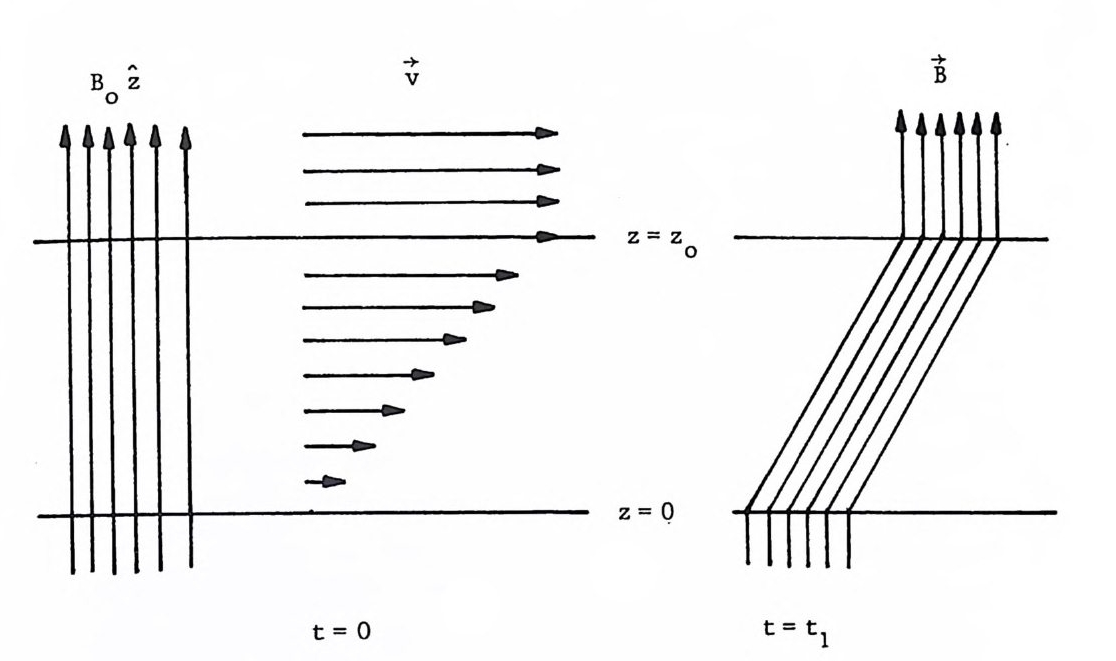 +v +B
+v +B
Fi g 5-1: Ti m e-dep e ndent develop m ent of mag n et ic f ield comp l ete ly fr ozen-in a medi u m under a non-uni form mot ion. We now show th at th e mag n et ic f l ux th roug h a surfa ce movi n g with th e fl ui d remai n s consta nt : ~onsi d er th e surfa ce S bounded by th e closed circ uit C and movi n g wi th t h e fl ui d . Then th e to t a l rate of chang e of th e fl ux th roug h th e surfa ce is a combi n at ion of th e Euleria n time- deriv at ive and th e fl ux ent e rin g th e surfa ce as a result of its m ot ion : -ddt I s 홉 .d 경 = f s 프a냐t • d 경 + f c 홉.; x d1 = f s 효at .d경 - f c -;나 ·d t
J s {~a3 정t - 'v x (-v+ x-B+ )}•dS = 0 The fl ux th roug h any loop movi n g wi th t h e local fl ui d velocit y is consta nt in time; we may pict u riz e th e field develop m ent as if th e field li n es are fr ozen in t o th e fl ui d and are carrie d along wi th t h e fl ow. Thi s result of Alfv en's th eorem finds its c ount e rpa rt fr om th e Kelvi n -Helmholtz th eorem of th e vorcit y 거w conservat ion in an in vi s cid flui d , i.e. a-w+ /.a t = 'J X (.-v+x w-+ ) • 5.3.3 Conseq u ences of Flux-Freezi n g We have seen th at a tr ansverse mot ion across th e field di s t o rts th e uni form field . Anot h er examp l e of th e field di s t o rti or, may be a ge nerat ion of an azi m ut h al field fr om a dip o le field owi n g to di ffere nt ial rot a t ion. We wi l l exami n e ge neral conseq u ences of th e fl uid mot ion to th e fr ozen-in mag n et ic f ield . We fo rm th e Lag r ang ian deriv at ive of th e field 맡 컨 + (;.V) 정 = -v x 詞) + (炳)정 = (정 .v) t -홉 (v·;) under th e fl ux-fr eez ing condi tion. The te rms on th e rig h t hand si d e of th e above eq u at ion re~resent th e st r etc hi n g , shearin g and exp a nsi o n of th e fl ux with th e mot ion. Combi n i n g th i s wi th t h e cont inui t y eq u a- tion ½dt == -_p_ .v .,·_Vt ,
we obt a i n —ddt ( -=-pB- ) = 따 v];. Thi s eq u at ion yield s th e Lag r ang ian in t e g r al ¾ = [<¾)。 .v 。] ?, ➔woB f0h =eB+tr h0e e(.- +rr►= _L0 + ,ar O g( -rr )누 a~ o. n , gt) i a; n v• 'a/~or iai bs leth 1수e· 0 g; r adP=iP e n(+1t , ot)p e, ra정t국o (r ?w,tit)h , resp po= e pc ot (+rt· oo ,0v)a riaa ntdi on Problem 5-4 : Use th e Lag r ang ian in t e g r al ju st deriv ed to 0sh ow th at B in creases as p 3~/, 2~ fo r is ot r op ica lly cont r act ing sp h eric al cloud of uni form densit y . We now deriv e anot h er usef u l pr op e rty of th e fl ux-fr eezin g condi tion: Consi d er a tw o-di m ensi o nal confi gu rat ion where all qu ant ities are in dep e nd- ent of one di r ecti on , say , x and B.X . = O bot h in i tiall y and fina lly . Thi s conf igu rat ion dep ict s . a large scale di s t r i b ut ion of th e mag n et ic f ield in th e ga lact ic p l ane rath er well, because th e non-uni form ga lact ic r ot a ti on wi ll i n evi tab ly st r etc h th e fr ozen-in field in th e azim ut h al di r ecti on and wi l l make th e field run pa rallel to th e pl ane. For such a case, 니B can be writ ten in te rms of a vect o r po t e nt ial A=A(y , z)i: 흡 = 'v x A = ( 0, 計 許 ) and V•A-t = —aaAx- = o. The current s 1=(c/41T)'Q x 흡 mai n t a i ni n g th e field run in th e x-di r ect ion. The relati on
(B니 •'i/ ) A니 = 0 holds at all time s durin g th e mot ion fr om th e in i tial in t o th e fina l st a t e whi c h im p lies A is const a nt on th e field li n es. Furth ermore, fr om th e fl ux-fr eezi n g condi tion we can have 건 -v x (검) = v x [ 망 +(;•J )A} 요] = o. One th e ot h er hand A does not dep e nd on x, th erfo re, we obt a i n an im p o rta nt result 7aa7At +. (,+v• V)A = O. The Lag r ang ian deriv at ive of th e qu ant ity A is zero , i. e . dA/dt = O , im p l y ing A(y , z) is a const a nt of th e mot ion. .If th e fl ux-fr eezin g condi tion is sati sf i ed, each field li n e remembers its i n i tial value of A. Thi s pr op e rty was used by Mouschovi a s (1974) in deriv i n g an eq u i l i b riu m confi gu - rati on of mag n et ic f ield in a pl ane gr avi tat i on po t e nt ial field and its subseq u ent develop m ent . S.3.4 Mag n et o hy d rost a t ic E q u i l i b ria i) Pressure Balanced Eq u i l i b ria The mag n et o hy d rost a t ics is concerned wi th t h e eq u i l i b riu m of a conduct ing fl ui d in th e pr esence of a mag n et ic f ield . Act ion of th e mag n et ic f ield on th e electr i c current s fl owi n g in th e fl ui d in ge neral give s ri s e to mat e ria l mot ions . However, in certa i n cases in mag n et ic fo rce ei ther vani s hes or ge t balanced by th e fl ui d pr essure/gr avit y, so th at Wthh een fal uifld u aidt tiasi n as t a r_se st at t , i-vc= Oe q, u ti hl ie b rreilu emv acnont f iegq uu arat tio ionns wwie thh avn oe to deal . mat e ria l mot ion. with are
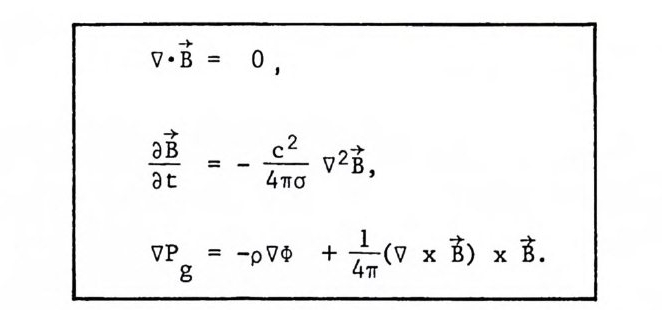 v· +B = 。 ’
The mag n et ic f o rce vani s hes ei ther because no current s flo w in th e fl ui d ('vx 거B =O) or because th e field is of fo rce-fr ee nat u re, i.e. , ('f/ x 홉) x 럽 =o. In th i s case th e mag n et o hy d rost a t ic e q u i l i b riu m is th e same as in th e absence of a mag n et ic f ield , excep t th e fo rce-fr ee field decay s in accordance wi th t h e di ffusi o n eq u at ion . Under an in comp r essi b le flu i d ap pr oxi m at ion, we may have 志 (Vx효) x 홉 = V(Pg + pc!>). Theref or e, -B+ and 'i/x B-+ must be pe rpe ndi c ular to 'i/( P_ + p4>), in ot h er words, 홉 ~nd 1 li e on th e surfa ~e ~here P_ + p4> is ~ons.ta n~. As an examp l e of such cases, we may ta ke +B =+B _。 ^z g fo r th e qu asi e q u i l i b riu m conf igu rat ion of th e mag n et ic f ield deep in si d e a sunsp o t , where i po i n t s ant i-pa rallel to th e gr avi tat i on al accelerat ion of th e sun. For th i s field th e mag n et ic t e nsi o n te rm vani s hes and we obt a i n v (P g + p0 + —B872T ) = o. If we assume th ere is no di ffere nce in p~ at a give n dep th bet w een in si d e and out s i d e th e sunsp o t , th e di ffere nce in ga s pr essure bet w een normal ph ot o sp h ere and th e sp o t must comp e nsat e th e mag n et ic p r essure B2/& rr. Problem 5-5: The sunsp o t is known to be cooler th an th e ph ot o sp h ere by about 1,500 K. Est imat e th e typica l st r eng th, B。_ , of th e mag n et ic
-259 -
field in sunsp o t s . What , do yo u th i n k, causes th e sunsp o t cooler th an th e ph ot o sph ere ? As anot h er examp l e of th e mag n et o hy d rosta t ics, we consi d er an eq u i l i b riu m of th e in t e rste llar mat ter in th e ga lact ic p l ane. We assume th at all qu ant ities are fu nct ions only of z, th e di s t a nce fr om tl1 e pl ane, and th at th e mag n et ic l i n es of fo rce are st r aig h t and pa rallel to th e pl ane. For such field th e te nsio n along +H vani s hes and we obt a i n v (P C + PR + —B812T ) = -pv o, where P_ repr esent s th e macroscop ic tu rbulence pr essure associ a t e d wi th C random mot ions of in t e rste llar clouds and P0R is th e cosmi c ray pr essure. We have ign ored th e th ermal pr essure of ga s pa rti cle s, because th e mean sq u are random velocit y of in t e rste llar clouds Subst itut ing clg / clz = -2.2xl0--1l11 cm/sec2/pc and An im medi a t e conseq u ence of t홉h e. Vaco n=d Oi t • iIon 'vx B냐 ·= a 냐B嗣 is 'v • (aB냐 ) =O or Thus th e scalar fu nct ion a should be const a nt along each li n e of fo rce, however, it may st ill be exp e ct e d to vary fr om one li n e of fo rce to th e next . Ap pl y ing now th e curl op e rati on up o n 'v x 홉 =a 경 and maki n g use of th e di ffusi o n eq u at ion, we obt a i n 노c2 효at = -홉+홉 XVa. If we fu rth er restr i c t ourselves to th e case where th e mag n et ic f ield decay s by Ohmi c di s sip a t ion wi thou t di s t or t玲 field conf igu rat ion, we can writ e 흡웁 0,;( t) wi th 홉 。 bei n g th e field at t= O and r;(t) a fu nct ion of th e time only. Subst itut ion of th i s di s t o rti on- fr ee eq u at ion in t o j;/홉 relati on give s VxB0= a 정 0 im p l y ing a is in dep e ndent of time. On th e ot h er hand subst itut ion of th e same di s t o rti on- fr ee relat ion in t o th e relati on for a 정 /a t yiel ds 홉。 [몬 픕 + a2i; (t)] = i;(t) 홉 O X Va C Because th e left hand si d e of th e above eq u at ion is pa rallel to 정 o, whi l e th e rig h t pe rpe ndi c ular to 정 。 , bot h si d es must be zero. Theref o re; we have anot h er condi tion fo r a; 두 whi c h im p lies , with 정 0• 'J a=O, a is a consta nt . The eq u at ion of field -evolut ion now reduces to _aa 정t = - c42ira a. 2 -B;t; whose solut ion is -B = 니B ~。 exp [-:--t/t) wi th t h e decay time bein g give n by t = —4c1T-Gf· -C:: 1l½ - · We wi l l deriv e th e ge neral soluti on for th e for ce-fr ee field wi th const a nt a: Op e rat ing curl up o n th e jJ/홉 relati on and subst itut ing th e di s t o rti on- fr ee field for 경 we have a vect o r wave eq u at ion 겁。 + a2 정 0 = 0. The ge neral solut ion of 'vx B0 = a 홉 0 may be fou nd in th e class of all solut ions of th e vecto r wave eq u at ion but not all solut ions of th e latt er wi ll sa t isfy th e j;/접 condi tion. The solut ion of th e vect o r wave eq u at ion can be fo und in te rms· of th e solut ions of its a ssocia t e d scalar wave eq u at ion v2'I ' + a2'I ' = o. Three in dep e ndent solut ions of th e vect o r wave eq u at ion are 기L = VY, t = v x Ce'!'), 경 = ¼v x 춘, where e is a const a nt uni t vect o r. Si n ce Vx홍 =a 市, we can have Vx (T+경 ) = a 윤용) . Theref o re, th e most ge neral solut ion, besid es th e time fa cto r , of 'iJx B-누 =aB- is 흡 = V x (e'I' ) + (1/Cl) V xVx (e'I '). Problem 5-6: Show th at Vx+S =a+T . Verif y th e above exp r essio n fo r 니B sati sf i es 'vx +B =a·+B .
Problem S-7 : Solve th e scalar wave eq u at ion V2'1 ' + a2'¥ =O fo r th e case where '¥='¥(x) • and deriv e th e st air -case field 니B = B~(0, sin ax, 。 cos ax) as a fo rce-fr ee field . Thi n k of any ast r op hysic al phenomena to whic h th e stair -case field has relevance. Problem 5- 8: Solve th e scalar wave eq u at ion in cylin dric al coordi n at es (w, r.; ,z) -01 一dd0( . 0. -ddl0J) I + a2Y = o to obt ain axi a lly sy rrane tric solut ion fo r 'I' th at is fini t e o n th e axi s and deriv e 니B =B 。 {o, J1, ( cxw), J,0 . .(cxw)} as a fo rce-fr ee field , where J' s are Bessel fu nct ions . Dep ict th e fo rce-fr ee field in a schemat ic drawi ng . What charact e ris t ics of th e field conf igur at ion is relat e d to siz e of the const a nt ex? Force-fr ee field can be po st u lat e d a p쿄 or i as a way to exp l ai n a give n ph enomenon, however, one may wonder wheth er th ere is any reason to bel ieve th at th e fo rce-fr ee field occurs wid ely in nat u re . We will show th at th e fo rce-fr ee conf igu rat ion has m i n i m 中 rat e of energ y dis sip a t ion. Let us consi d er varia t ions in th e magn et ic e nergy W.M._. and and dis sip a t ion rat e D due to th e varia t ion 6B of th e field conf igu rati on . By minim izi ng 6WM and 6D we want to find th e kin ds of field th at develop as a result of Oh mic . d is sip a t ion. Sin ce th e mag n et ic e nerg y W.M._. in some volume element and th e Oh mic dis sip a t ion rat e D are pr op o rt iona l to f 점.정 dV and / (V 쵸)• (Vx 정 )dV, resp e ct ive ly, we have fo r th ei r varia - tX ons V oWM a: J 법 .6 점 dV V and oD a: J ('i/x-B +-) • ('i/xo - B+-) dV . V
Put ting oWM=O an d 6D=>O we have fr om th e tw o volume in t e g r als f [(vx 홉) • (Vx/l B ) + a2 정. 6 경] dV = 0, V where a2 is an arbi trar y const a nt . Now maki n g use of th e in t e g r al th eorem f군•'v xb dV = fv b•vx1 dV - r5 Tl• cix b )dS, we tr ansf o rm th e first pa rt of th e volume in t e g r al in t o fv (vx홉 )•(Vxo 점 )dV = fv o 홉 .Vx(VxB)dV - f n•( 'v x 경 )x6 홉 dS. The surfa ce in t e g r al vani s hes , if th ere are no current s '(n • ('i/쵸 )=0) out of th e volume or 15 홉 vani s hes at th e boundary . Thus th e volume in t e g r al fo r ISWM., + a2 ISD becomes JV 8 홉. [vx( r:; x정 ) + a2 장] dV = O_. Thi s exp r essi o n must be tr ue fo r any arbi trar y . ol니i . , th eref o re Vx(Vx정 ) + 6 쟁 = 0, or Vx 홍 =a 홉 should hold. We th us have shown th at in th e long :i:;u n th e fo rce-fr ee field s wi l l pr edomi n at e due to th ei r slow rat e of mag n et ic e nergy di s sip a t ion. Problem 5-9 : Take a time -deriv at ive of the mag n et ic e nergy w.M. = J .V. (니B • 거B노 } /Brr av wi thi n the volume V to show aw _3 t = -I (3 자 )/c dV -I v ;· (jxB )/c dV. The first te rm results fro m Ohmi c di s sip a t ion. What ph y s i c al cause is resp o nsi b le fo r th e second te rm ?
5.4 THE VIRIAL THEOREM To deriv e th e vi r i a l th eorem under self- gr avit y and mag n et ic f ield , we fo rm a scalar pr oduct of th e moment u m eq u at ion give n in sect ion 6.2 with th e p—o sit ion vect o r 니r and in t e g r ate over th e volume V: J v p:r t. dd2t 2; • d.V.. = -J. r+ •'_v ( , P_ g +. _B,,2 /,8~ ,r ,) d.V.. - f. Vv -r1-• p'- v~· d,V .. +, 눕1 l. +r · (,B'!; ·V_,)±B dv where d/dt= a/at + (+v •'v ). Up o n in t e g r at ion by pa rts th e left hand si d e of th e exp r essio n becomes fv P+r • 죠d2군; V = 2l 죠d2 2 fV P+r2- d V - JV p+v 2- d V 三 了1 굶d2j I - 2K, where I is a ge neraliz ed moment of in erti a a nd K th e ki n et ic e nergy associ- at e d wi th t h e fl ui d mot ion. We now si m p lify th e vario u s volume in t e g r als on th e ri gh t hand si d e: Ag a i n in t e g r at ion by pa rt and use of th e di v erge nce th eorem tr ansfo rm th e first te rm on th e rig h t in t o -Iv 나°·f •V (P2g + B2/8n)dV = - fss ( P2g + B2/8n) t •d 경 + 3J ( Pg2 + B2/8n)dV. The surfa ce in t e g r al can be pu t zero because th e to t a l pr essure is exp e ct ed to vani s h on th e surfa ce . Hence we have -J 거r 자 (P_g + B2/8,r ) dV = 3(y- l)U + 3 WM ' where U is th e to t a l in t e rnal heat energy with y bein g th e rat io o f sp e ci fic h eat s and WM., is th e mag n et ic e nergy . Si m i l ar alge braic man ipu lat ion tr ansfo rms th e th i r d volume in t e g r al si m p l y to —8l1T J +r• - (+B •V)B+ dV = -WM .
Problem 5-10: Verif y th e above relati on. On th e ot h er hand, th e gr avi tat i ona l po t e nt ial
te rm can not be neg l ecte d. For examp l e, surfa ce te rms pl ay im p o rta nt roles in th e eq u i l i b riu m of dense and cold in t e rste llar c.i. o ud in a pr essure eq u i lib~i u m wi th h ot in t e rcloud medi u m of low densit y. For such cases, tw o surfa ce in t e g r als one fr om th e in t e g r al in volvi n g th e mag n e~i c te nsio n (cf. Problem 5-9) and th e ot h er fr om th e pr essure gr adi e nt should be in cluded on th e left hand si d e of th e above exp r es- si o n: _12 dd_2t2I = 2K + 3(Y-1)U + wM + w + -4l, r f S (+r ·+B )+B ·d경 - f,S .( P g + ―8B12T )+r .d 경 Thi s is a ge neraliz ed fo rm of th e vi r i a l th eorem wi th s urfa ce te rms ta ken in t o account . For more po werfu l te nsor vi r i a l th eorem we refe r th e re 후 der to th e classic by Chandrasekhar (1961). We now give a fe w iU ustr ati ve exa mp1,es of th e use of th e vi r i a l th eorem. If_an is olate d sy s t e m is in eq u i l i b riu m wi th n o in si d e mass mot ion (K=O), th e vi r i a l th eorem give s th e fo llowi n g relat ion among vario us energ ies 3(y -l)U + WM + W = 0 as a necessary condi tion. Elim i n at ing th e in t e rnal energy U in fa vour of th e to t a l energy E = U + WM + W, we have E = \固 [W - WM] A necessary condi tion fo r st a bi l it y is th at E < O, ot h erwi s e th e sy s t em ex pa nds , hence Y > 4/3 and Iw j > WM are to be sati sf i ed fo r st a bil ity si n ce Y > 1 in ge neral. As a sim pl e case, let us consi d er a sp h eric al cloud of uni form densit y in balance with ambi e nt in t e rste llar medi u m havi n g pr essure P_。 . For sim plicity we ass\JID e 니B =O. Then th e vi r i a l th eorem give s
4TIR3 P 。 = 3µM mkTH 3G5RM 2 where µ is th e mean molecular weig h t of th e ga s pa rti cle , 떄 hy d rog e n mass, T te mp e ratu re of th e ga s; R radi u s of th e cloud and M to t a l mass of th e cloud. Fi x i n g M, T and µ, we may consid er th e eq u i l i b riu m radi u s R of th e cloud as a fu nct ion of th e ambi e nt pr essure P。n . When R is suf fici e nt l y large th e gr avi tat i ona l te rm is neg ligibl e, and th e ext e rnal and in t e rnal pr essure are in balance; th e pr oduct of P_。 and th e cloud volume is th en nearly const a nt . As P。,, in creases, R decreases unt il f ina lly th e gr avi tat i on al te rm becomes large , decreasi n g R somewhat fu rth er. Fi n ally th e gr avi tat i ona l te rm becomes so gr eat th at fu rth er decreases in R would requ i r e a decrease (ins t e ad of in crease) in P 。 ; no solut ions are po ssib le. Thus, we may pu t an up pe r lim it on P 。 : P o -< Pm ax = 3.15 (µ—kT門 ) ,t + G3 1M 2 . If P_o exceeds P m__a_x_ no eq u i l i b riu m is po ssib le, and th e sp h ere wi l l collaps e. Thi s is eq u i v alent to Je ans condi tion when boundi n g ambi e nt pr essure is ta ken in t o account . Problem 5-11 : Show th e numeric al const a nt 3 .15 becomes 1. 40 when the densit y·c oncent r ati on of an is ot h ermal sp h ere is ta ken in t o account . Consult th e Lane-Emden eq u at ion fo r is ot h ermal sp h ere bounded by a medi u m at const a nt pr essure but havi n g neg l ig ibl e densit y. (cf . Sp itze r 1968) . Problem S-12: Essence of th e mag n et ic f ield ef fec t s on th e cloud equ i libri u m is clearly pr esent e d by Sp itze r (1978) . Read the book by Sp itze ~ (1978) , th en consult th e pa p e r by St r it tma t ter (1966) fo r an ap pl i c at ion of th e te nsor vi r i a l th eorem to mag n et ized sp h eroi da l clouds.
5.5 MAGNETOHYDRODYNAMIC WAVES We have seen th at in a flui d of very large conduct ivi t y th e fl uid pa rti cle s are tied to th e li n es of mag n et ic f ield , so th at th e li n es may be consi d ered to po sses in erti a. At th e same time th e mag n et ic field exerts te nsio n along th e field li n es and pr essure of mag n et ic natu re. The latt er can be balanced by a dim u ni tion in th e ga s pr essure, so th at th e field li n es behave ef fec t ivel y as rubber-band under some te nsi o n. We may th us exp e ct , as was po i n t e d out first by Alfv en in 1942, th at when th e flui d is sli gh t l y di s t u rbed fr om th ~ rest th e field li n es wi l l pe rfo rm tr ansverse vi b rat ions . We call such vi b rat ion as th e Alfv en wave. 5.5.1 Alfv en Waves in an Incomp r essib le Flui d Let an in comp r essib le fl uid be pe rmeat e d by a uni form mag n et ic field -B_= Bn^z , and give a small pe rtu rbat ion wi th v elocit y +v and its a ssocO ia t0 e d varia t ion 니b in th e mag n et ic f ield . We ign ore th e second order te rms fro m th e moment u m eq u at ion and obt a i n a li n eariz ed eq u at ion of mot ion p —3 t = - v(Pg + -87T) + -47(TB ·V)B, a; _ ,_ . B2, . 1 ,± _,-± where th e body fo rce fro m th e self- gr avit y has been neg l ecte d fo r si m - pl i c it y. If th e fl ui d is in deed in com pr essib le, th e to t a l pr essure, PP~gu t+ Bti2n/8g 1 r+B, =m Bu 。st 墓 b e icno ntsht ae n et ,q u haet niocen , vwane ifshi ni nd g pr essure gr adi e nt te rm. paa~+ t = ―411(r 정 o .V)t ' or a거v B。 ah p죠-=石죠:.
Now, pu t ting ag a i n ➔B =B 。 z^ +-b► in t o th e eq u at ion of mag n et ic f ield evolut ion wit h a n in f ini t e c onduct ivi t y aB-->-/ .c lt= 'vx (_v-->- x -B► ), we have —3a-bt+ = -Bo -a3-vt, . Combi n i n g th ese tw o li n eariz ed eq u at ion s, we obt a i n 릅 B『02 p4 aa2z b2 , whi c h is th e di ffere nt ial eq u at ion of a vi b rat ing st r i n g wi th p r op a g a t ion velocit y B2 _ 1 /2 VA = ± [걸 ] Thi s velocit y is known as th e Alfv en velocit y. Three comment s are in order : 1) Every pe rtu rbat ion can be analys ed in t o tw o modes, one pr op a g a t ing wi th p o sit ive velocit y of vAA and th e oth er wi th t h e same sp e ed in th e- op po si te d i r ecti on . 2) If th e_ d i s - tu rbance is give n pe rpe ndi c ularly to th e uni form field , th e mag n et ic ethn ee rkgyi n deet nics it e yn,e rbg2y / 8d1ern, sait syso coif a tt he de wwia tvhe mt ho te iodni s, t u½ rbep dv i ,f iei.ld e . i, s eeq qu uip aal rttoi tion of energy holds. 3) It is conveni e nt to have vA = 2.18 Km/sec [~] [~] 112.
5.5.2 Mag n et o hy d rody n ami c Waves in a Comp r essib le Flui d Let us ge neraliz e th e last results and exami n e th e case of wave mot ion in comp r essib le medi u m when th e di r ect ion of wave pr op a g a t ion is in clin ed to th e mag n et ic f ield as sket c hed in Fig u re 5-2.
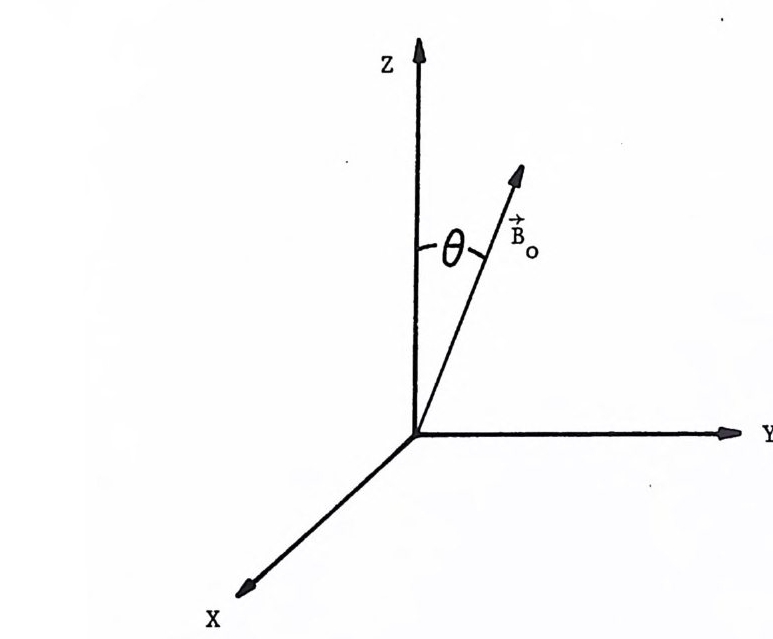 z
z
wFii gth. 5r e-s2p: e ctT hte o mtagh en ept ri oc p af gi ae tl d i onh a ds i ra enc it ni ocnl i nz .a t ion ang l e e Once ag a i n we assume all th e pe rtu rbat ions are small: 정=%+접; ;=짜 p g= Pg o +6Pg ·; p=p o+ 6p . Up o n li n eariz at ion th e noment u m eq u at ion becomes p o 표at = -V6P g + .4.!n... CVxb) 고 o , where th e gr avi tat i ona l fo rce has been left -o ut fo r si m p l i c it y. Elim ina t ing cSPg_ with th e ai d of th e adi a bat ic a ssump tion fo r th e .pr essure and densit y, cSPg_ =v~a cSp , we obt a i n
% 릎 = - v: V6p + 志('v xb) x B0, where va is th e adi a bat ic s ound sp e ed. The eq u at ion of th e mag n et ic field evolut ion is easi l y li n eariz ed in t o 건 =VX (포), and th e cont inui t y eq u at ion now becomes -3;a;-t; : c-Sp +. P-_o V_-•+v = 0. As a tr i a l solut ion we supp o se th at pl ane waves of same ki n d can pr op a g a t e in tw o op po sit e d i r ect ions as was th e case fo r th e Al fven wcaanv ed. ecomIpf otshe i st h ies lasos,t athl lre eth le i vn aerairai bz eleds vdecept eo nrd eqo un azt iaonnds ti n ot on lyt.h ei r We comp o nent s . Allowi n g deriv at ives with respe ct to z and t only , we obt a i n fo llowi n g si x eq u at ions : ~3at b x = Bo cos e —aaz v x' fat v xBo = co~。s 8 aaz hx, _31t_ b _y_ = Bo cos 8 ~az v _y_ - B_0 si n 8.' -!a-z:: vz_ , _aat vy =. B。4 :rr ~po 。s e _aaz- ,b_ y, .
3a_t v z = -v-—a2 p o —aa z op + B。4 n spi n。 0 같 %] , and _aa t 6-.p- + •p o -aat v z = o. Not e th at th e first and second eq u at ions are id ent ica l to th e case of in comp r essib le flui d excep t th at t~ e Al fven velocit y [B~/41r p。] 'I2, has been rep l aced by [B~o cos2 /41r·po 0 ] 등2 . Thus th e wave pr op a g a t e s ~n th e z-di r ect ion wi th t h e Alfv en velocit y correspo ndi n g to th e comp o nent of mag n et ic f ield pa rallel to th e di r ect ion of pr op a g a t ion. The remai n i n g fo ur eq u at ions comp r i s e si m ulta neous eq u at ions fo r fo ur unknowns b y.. , v y.. , v_z and op . Seeki n g pl ane wave solut ions of th e form exp [ i( wt - kz)] for all th e fou r unknowns , we may rep l ace th e op e rato rs a/at and a/az in th ese eq u at ions by iw and -ik. We th en have fo ur sim u lta neous li n ear homog e neous eq u at ions /A~= 0: -w, -k B。 cos 8 , k B。 si n 0 , 。 b YI = 0 kB 。 cos e/41r, p。 u, 0, 。 V y -k B。 cos e/4 , 0, p0 w, -kv2a V z o, 0, p 0 k ' u 8p In order fo r th e homog e neous eq u at ion tA»c =O to have solut ions , det e rmi n ant of IA must be zero . From I tA J =O , we ge t th e fo llowi n g di s p e rsio n relati on 안 -(v ; + v2a) (합 + v! v! cos2 8 = .O .
Denot ing th e ph ase velocit y w/k by U, we rewrit e t h e di s p e rsio n relati on you ju st deriv ed as [ u' - 硏A +• 균·a ') u- 2 +• 균·A v·2a cos2 e = 0 Thi s eq u at ion has fo ur real root s . Si m p l e sp e ci a l cases _re sult from 8=0 and 8=1r/2 . The case e=O has tw o wave modes : one Al fven wave wi th u2 럭#A and th e ot h er sound wave U.2 =va~ . The pu re Alfv en mode obt a i n ed here is a sp e c ial case of th e same Alfv en wave modes we have deriv ed fro m th e first two li n eariz ed eq u at ions of th e si x eq u at ions give n befo r e. The case 8=1r/2 has only one type of wave pr op a g a t ing pe rpe ndi c ularly to th e mag n et ic f ield with pr op a g a t ion veloc ity U=± ✓v i2 + va2! . The pa rti cle movi n g pe rpe n- di c ularly to th e mag n et ic f ield wi l l exp e rie nce th e mag n et ic p r essure in addi tion to th e normal ga s pr essure, th us th e to t a l pr essure becomes th e sum P=P_g+ B2 / 81r . On th e ot h er hand _th e mag n et ic f ield varie s as B=B0_ (•p.• /.p 0_ ), si n ce th e field lines are comp l ete ly froz en-in th e medi u m. The pr essure pe rtu rbat ion oP now has tw o correspo ndi n g comp o nent s : oP_g and (Bo_ /41r)(op /p o_ ) . Put ting oP=U2op and oP g= v~a op , we recover th e pr op a g a t ion veloc ity u2=v1국 · If we rewrit e t h e di s p e rsio n relati on as (u2 -v~)(U2 -vf) = v! 멋 si n 2 8, wgre eacatn e r eaofs ivl ya! noant di cev iAt h aat n do nteh reo oott h oefr Ut~2h e iesq u laet siso n t Uh ~a n etxh ce eesmdsa ltlhe er of v2a and vA~ . In conclusio n, th ere are fo ur di s t inct modes of wave: th e Alfv en wave, th e pu re sound wave, and tw o mag n eto -acoust ic w aves. One of th e mag n et o -acoust ic w ave is fa st one movi n g with sp e ed exceedi n g th e gr eate r of vaa an. d vA; th e ot h er is slow one movi n g with sp e ed less th an th e smaller of vaa and vA.
5.5.3 Self- Gravit y Included We shall fol low Chandrasekhar (19 61) for th e di s cussio n of MHD waves in th e pre sence of self -gra vit y: When th e body -for ce of gr avi tat i ona l orig in is in cluded, th e relevant li n eariz ed eq u at ions fo r th e sy s t e m pe rmeate d by a uni form mag n et ic f ield are 홉 = f; (Vxb)x 홉 - v: V6p .+ pv 6¢ 픕 = V X( 皇) ~aat o-p +. pr:_J-• +v = 0 ; and v26¢ = -4,r G 6p , where suf fix n aug h t s repr esent ing th e eq u i l i b riu m conf igu rat ion are drop pe d in t e nt ion ally fo r clarit y. The last eq u at ion is th e li n eariz ed form of Poi s son eq u at ion st e unni n g from th e self -gra vit y. Followi n g exact l y th e same pr ocedure of decomp o sin g in t o comp o nent s and evaluat ing th e vani s hi n g det e rmi n ant , one ge t s th e fo llowi n g di s p e rsio n relati on: • ' w4 - (vi 난 + vi 균 -4 nGP)w2 + vf k2(vi k2 -4nG p) cos2 6 = 0 Problem 5-1 3: Deriv e the above exp r essio n fo r th e di s p e rsio n relati on. Besi d es th ~ pu re Alfv en mode we ex pe ct in ge neral tw o modes of wave pr op a g a t ion. If w.11 and w2 are th e fr equ enci e s of th e tw o modes , we rewrit e t h e di s p e rsio n relat ion as U21 + u22 = VA2 k2 + v2a k2 - 41TG and U21 U22 = vi 난 (v2a 난 - 4,r Gp ) cos2 8 .
It is now clear th at bot h root s 認 an ci 訖2 ar e re a l if c7k 2 - 4 갑迫 0. If Je a n s cr> i ter i o n c2k2 -4 11Gp < O is sat isf ied , th en one of t~ e tw o root s w~ or w~2 becomes neg a t ive. Thi s im p lies th at th e Je ans con- di tion fo r gr avi tat i ona l in st a bi lity is unaf fec t e d by th e pr esence of uni form mag n et ic field . Problem 5-14 :_- Show th at th e same Je ans crit eri o n fo r gr avi tat i on al in st a bi l it y holds when th e medi u m is subj e ct to a uni form rot a t ion. con~ult Chandrasekhar (1961) fo r det a i ls. 5.6 STABILITY ANALYSES We wi l l fol low Krall and Triv elpi ec e (19 73) in di s ussin g th e st a - bi lity analys i s based up o n th e energy -pr i n c ipl e consi d erati on s. They cat e g o riz e met h ods commonly used in th e st a bi lity analys i s in t o th ree classes: in t u i tive ap pr oach, normal mode analys i s and energ y- pr i n cip l e consi d erat ion. The in t u i tive ap pr oach is th e si m p l est one; a give n eq u i libri u m is subj e ct to a small pe rtu rbat ion, whi c h al ters th e for ces act ing on th e fl ui d , and see in t u i tivel y whet h er th e modi fied .fo r ces act to in crease th e in i tial pe rtu rbati on . If so, th e give n eq u i libri u m is concluded to be unst a ble. Usually th i s ap pr oach in volves sucb fa ncy names li k .e ki n k , sausage , flu t e , et c . In th e normal mode analys i s , somet imes called met h od of small oscil lati ons , assumi n g a time -dep e ndence exp [-iwt ] fo r th e time- develop m ent of pe rtu rbat ions , one obt a i n s a eq u at ion fo r w by exami n i n g linea riz ed MHD eq u ati on s under ap pr op r i a t e boundary condi tion s. Solvi n g th e eq u at ion one can det e rmi n e normal modes w in te rms of eq u i l i b riu m pa ramet e rs. If w's are all real, th en all th e pe rtu rbat ion varia bles osci l late harmoni c ally and th e give n eq u i libri u m is st a ble; if any or all th e w's have po sit ive im ag ina ry pa rts , th e give n sy s t e m is unst a ble.
- 27 7 -·
In th e energy -pr i n cip l e one checks whet h er th e give n sy s t e m locate s at th e po t e nt ial mi n i m um: One calculate s th e chang e in po t e nt ial energy of th e sy s t e m as a result of pe rtu rbat ion, and exami n es th e sig n of th e chang e . If it is po sit ive fo r all pe rtu rbat ions , th e sy s t e m is st a ble; ot h erwi s e unst a ble. Thi s met h od is usef u l in det e rmi n i n g th e values of eq u i l i b riu m pa ramet e rs th at driv e th e sy s t e m in t o in st a bi l it y, not usef u l in det e rmi n i n g th e gr owt h rate of a pa rti cul ar mode of in st a bi lity. These th ree met h ods are not on eq u al fo ot ing s ; th e in t u i tive pr obe pr ecedes th e latt er tw o analys es in order to have an in sig h t in t o th e po ssib le modes of th e in st a bi lity th e give n sy s t e m is li k ely to develop . The normal mode analys i s give s th e gr owt h rate of th e pe rtu rbat ion wi thi n th e li n ear domai n , as we are somewhat fa mi l i a _r wi th i t th roug h Je ans analys i s of gr avit at i ona l in sta bi l it y -an d th e Ray l eig h -Tay l or in sta bi lity. Unf or t u nat e ly, it of ten po ses an arduous ta sk in solvi n g th e normal mode eq u at ion fo r comp l i c ate d sy s t e ms . For th i s reason resort is of ten made to th e energy -pr i n c ipl e analys i s . We wi ll b rie f ly di s cuss in th i s sect ion th e normal mode analys i s and th e energy -pr i n cip le consi d erat ions on th e st a bi l it y of mag e nt o hy d rody n ami c conf igu rat ions . 5 、 6.1 Pertu rbat ion Eq u at ion -。 We st a rt wi th a n eq u i l i b riu m conf igu rat ion give n by v_=O, p_O =p_O (+i-O_ ') , and. -;BtO_- =B;t_O ,(i+-_O )' • •. -T·h e gr avi. t at i ona l field is assumed to be an ext e rnal field ; self -gra vi tat i on ef fec t s of th e fl ui d medi u m are neg l ecte d . Eq u i libri u m st a t e of in t e rste llar ga s and mag n et ic. field in th e pr esence of th e gr avit at i ona l field of th e st a rs· i s a go od examp l e of such confi gu rat ions . We fu rth er assume th at · t h e medi u m sat isf i es th e po lyt ro p ic relat ion P a: pY , so we may emp l oy 읊 (P/ py) = 0
wi thO L ,t ex p::.icic1y con si d eri ·1 g th o Ct Jic•r v .Y trc 1r,s f cr ec,, . ;:. c i n:. :.r, ~.-.e sta bi li ty analys is . Her e ci/ dc imp l i es :,/ :, E + w ••. ) ` an0 P oen o c es th e ga s pre ssure Pg, . kepr e s ent ing th e pe rEurbec qua n t iti.cs by subscrip t l ' we lin eari ze! che :-JH D o:?Cj.ic.:c i or,G : —3a;:>t .l = - 'v• • (,. P _oV-·r ;. ) , po ~ = - 'vP l + 志 (VX 홉 1 ) x B0 + -l; (vx 內 )x 감, - 2 `V Q —30Pt 1 = -( .v ➔ .1 •'i/)P _0 -yP 。n ('v • -v+ 1), —33 점t 1 = V X (.+v l x+B o ). Taki ng a pa rti al time -deriv at ive of th e momentu m eq u at ion and mak ing use of th e oth er lin eari z ed eq u at ions , we combi n e all th e }fiID eq u at ions in to % 言a2}; = v [(;1.V)P 。 + Y P 。 (V· 합)] + 감 (Vx정 0) x[ V x( t 1x흡 o)] + 志 [v x{Vx( t 1xB 。)}] X 거B 。 + [파 V)P 。 + p0 (v-t 1) ] v~.
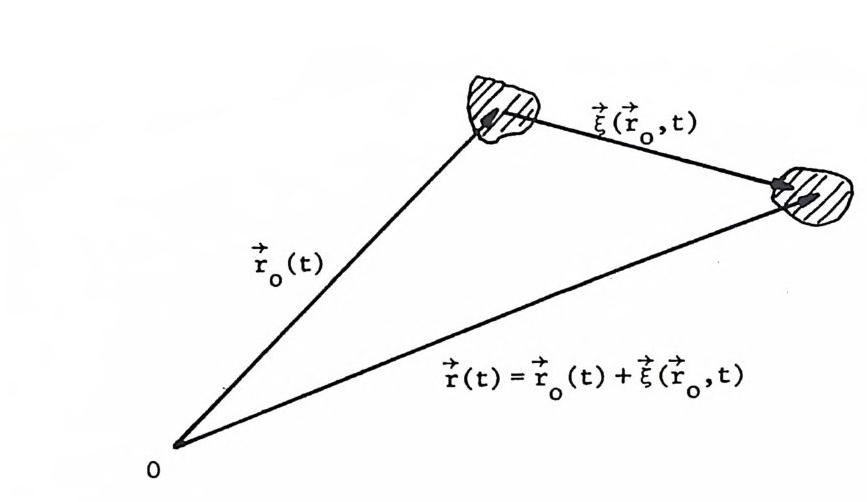 +r· (t) = 구ro 。 (t) + 구t· (나r·o ,t)
fao'ibfg o va5 eW f-lee3 u q n ui: oda w t eiLwloeanamgn rtie nan ttn ofg af rveioaolminu m r ii d tno isaf ts etep hql uet a hi c Llee i am vbg rere ailnonu mctg iit pa니Ey;no s opidtf ie sir potf unl l a r uc b기re_ i。am t d aeiont e nt l t eoim-mvf ,1ee n-tff+t;. r ( . o -i.+m- 。_ ,tt)h e As il lustr ate d in Fig u re 5-3 th e coordi n ate of a fl ui d element a time t is denot e d by -r+ _。 (. t). and. i-ts d- i s p l-a ced- l-o cat i-on b-y -r+ (t) ; th en we have -;(t) = ~。(t) + 麟。,t) l? 。 I~> l!I and E; (;。 ,O) · = 0. The fl uid veloc ity in te rms of 니t is now give n by +v 1. (+r, t). = +v 1. (+r0 ,t). + (.+ E. .v.) +v 1.( +r° ’ t) +
. . where -~+= <.l ➔s /,a . t . S-i. n ce th- e te rm (. ➔t •V .) ➔v 1 is second-order in th e pe rtu rbat ion varia bles, we can have -v+- l (,-r+ , t-), = -v+ 1 (,-+r- 0 , t-), = —3at- -E± (,-r+ o ,t) to th e first order ap pr oxi m at ion. Theref o re, it is pe rmi s sib le to Lreapg rl aacneg iatnh ed iE su pl le arciea m n evnet loc우 Hit yr~0 ➔v, t_1) (. ➔,r ,tw) hbi yc h tht re a ntsimfo er- m dse ritvh aet b ivoex e do f eqt hu ea - tion in t o th e fol lowi n g s : p ° —a32t 2 +E = +F (+E ), 詞) 三 V [C t •V)P 。 + yp。 (V 홍)] + 志· [(Vx홉 0) X 전 + (VxQ ) x 정 0] + VHV• 강) , +Q 三 V x (_g+ x +B 。 ). The solut ion of th i s di ffere nt ial eq u ati on subj e ct to ap pr op riat e boundary condi tions det e rmi n es 니( , whi c h in tu rn fixes th e pe rtu rbed velocit y and all th e ot h er pe rtu rbed varia bles. For th e boundary condi tion we wi l l ta ke n^ •+E; = 0 on th e surfa ce, where n denot e s an out w ard normal uni t vect o r of th e boundary.
5.6.2 Normal Mode Analys i s ..l..< ..r.. o- ,Wt)e = .s.l..
w2 = fJ tP _。r t.•tt 탸d 3r However, act u ally solvi n g th e eig e nvai ue eq u at ion is in ge neral a di fficul t jo b for th i s reason resort is of ten made to th e energy - pr i n c ipl e analys i s . At any way , it should be po i n t e d out th at th e sig n of w2 is soley det e rmi n ed by th e numerat o r because th e denomi n at o r is po sit ive def ini t e. Phy s i c al sig n i fican ce of th e sig n th e numerat o r has wi l l be ap pr eci a t e d in th e foll owi n g di s cussio n of th e energy - pr i n c ipl e analys i s • 5.6.3 Energy - Prin cip l e Analys i s When th e sy s t e m is sli ght l y pe rtu rbed from its e q u i libri u m con- figu rat ion, th e ki n et ic e nergy 6K resulte d fro m th e pe rtu rbat ion is give n by oK = ½/ P0 룹-)t 2 d 휴, where th e in t e g r ati on is ta ken th roug h out th e whole sy s t e m. Taki n g a deriv at ive of th e ki n et ic e nergy chang e 6K wi th r espe ct to time , we have _aa t 6K = f p_。 t.• .t. d3t = -J t.: .O ct )• ! d 휴, where 니E.; im p lies at/ at. Consi d erin g th e self -ad j o i n t pr op e rty of 표-u, we may rewrit e t h e above exp r essio n as (-) 습 oK = I 놉8 這 d 휴 = I 霞(i)·i d 휴 = ½습 I 霞(t)훗 d3t ,
sliiW n cre12 s tuhl e t edla sftr o mi n tt eh ge r pael ritus rbeaq ut iaoln t o- ~ haals f th e sum of th e first tw o in t e g r als. Thertf or e, if one def ines th e po t e nt ial energy chang e 6W 내 J t福).t d 휴, one obt a i n s th e energy conservat ion 습 [oK + o~] = 0 as a natu ral consequ ence. W_e now consid er th e ph y s i c al sig n i fican ce of our def ini t ion fo r W as fo llows: It is clear fro m th e orig ina l eq u at ion of mot ion fo r th e small di s p la cement !, p_。 ! =흥(t) (三 각C t) •t) , th at 市(!) can be in t e rpr ete d as a fo rce pe r uni t volume give n fro m th e pe rtu rbat ion. In a small di s p l acement {+ of . th e uni t volume element th e work done by th e for ce is (1 /2)! 휴(t) , and hence th e ga i n of th e po t e nt ial energy pe r uni t volume is (-1/2)!. 詞). The to t a l chang e in th e po t e nt ial energy resulte d from such small di s p l acement is obt a i n ed by si m p l e in t e g r ati on of (1 /2) t:nc t這 th roug h out th e whole volume V: 6W = ½f d3t [YP 。 (v• t )2 + 毛 + (V·t) (t자 )P 。 같 (vx홉 o)•( 國) - )(V•P0!)] Thus th e qu est ion of st a bil ity can be anmsw ae rsemd ablyl dceavlci au tl aiotn in !g fthr o em c hanan g e in th e po t e nt ial energy th at results fro allowed eq u i libr i um soluti on . If 6W tu rns out to be po sit ive, th e sy s t e m is st a ble, si n ce th e eq u i libriu m has ·le ss· p o t e nt ial energy th an
th e di s t u rbed conf i g u rat ion . If oW < 0, th e give n eq u i libri u m st a t e is an unst a ble one . Th i s is in ag r e em ent wi th t h e results based on th e sig n of w2 in th e normal mod e an alys i s . Problem 5-16: Deriv e th e ab o ve in t e g r al exp r essio n fo r oW, th e po t e nt ial energy chang e due to th e di s t r ubance 니t . 5. 6 . 4 An Examp l e : Parker Inst a bi lity Emp l oy ing th e met h od of small osci l lati ons , in a serie s of classic al pa p e rs , Parker (19 66 , 1969) has consi d ered th e st a bil ity of in t e rste llar medi u m consi s t e d of ga s, cosmi c rays and mag n et ic f ield under an ext e rnal gr avi tat i on al field give n by th e st a rs in th e ga lact ic p l ane. He sim p l i fied th e pr oblem by assumi n g th at th e field lines run pa rallel to th e ga lact ic p l ane, and th at all th e ph y s i c al qu ant ities dep e nd only on th e heig h t above th e pl ane. Hi s linea riz ed st a bi lity analys i s has shown th at under certa i n condi tions whi c h are easi l y met by th e medi u m such tw o-di m ensi o nal eq u i l i b riu m st a t e is unst a ble to def o rmat ions of field lines pe rpe ndi c ular to its l i n e of fo rce. The ph y s i c al reason for Parker in sta bi l i ty is essent iall y as fo llows: Any dense reg ion of ga s te nds to si n k th roug h th e surroundi n g te nuous ga s, drag ging th e field lines wi th i t, th en, th e neig h borin g ga s finds itsel f on slop ing lines of fo rce and so slid es down in t o th e dep r essio n, addi n g its. weig h t and causin g fu rth er sag ging . Mouschovia s (19 74) foll owed th e in st a bi lity th roug h in t o th e non- linea r domai n maki n g use of th e fa ct th at th e vect o r po t e nt ial is const a nt of th e mot ion whi c h results , as was di s cussed in sect ion 5.3, from th e comp l ete fl ux-fr eezi n g assump tion . Hi s results on th e in st a - bi l it y condi tion are in ag r eement wi th P arker's condi tion. Asseo, Cesarsky , Lachi e ze-Rey and Pellat (19 80} emp l oy e d th e energ y-princ ipl e analys i s to te st th e Parker in sta bi lity. Thei F results on th e ins t a - bil ity condi tion are also in ag r eement with Parker's. Lachi e ze-Rey ,
-285 -
Asseo, Casarsky and Pellat (19 80) consi d ered ef fec t s due to a mi c ro- tu rbulent comp o nent in th e mag n et ic f ield and demonstr ate d th at th ey te nd to lead to ward an overall st a bi l i z at ion of th e sy s t e m. Si m i l ar conclusio n was reached pr evi o usly by Zwei b el and Kulsrud (19 75) on th e st a bi l i z i n g ef fec ts of th e ga lact ic_r ot a t ion as well as th e ta ng l ed comp o nent of in t e rste llar mag n et ic f ield s. Problem 5-17: Ap pa rent l y readers are not sat isf i ed wi th t h ese po or sket c hes of Parker in st a bi l it y, however, we are th oug h t to have mi n i m um re qu i r ement s fo r fo llowi n g th e act u al pr ocedures of th e st a bi l it y analys es give n in th ose classic al works ju st ci ted. Please have pl easures. o f readi n g Parker's orig ina l work and its s ubseq u ent develop - ment s by ot h ers. 5.7 MAGNETOHYDRODYNAMIC DISCONTINUITIES Di s cont inui ties in vario us fl ow-varia bles are an avoi d able conseq u ence of th e non-lin earit y in th e go verni n g eq u at ions of fl ui d mot ion. One usually doesn't need to bot h er with di s cont u nui ties when comp r essib i lity of th e fl ui d is not im p o rta nt , ot h erwi s e st a t e d, when th e fl ow ts subsoni c . However, as th e fl ow velocit y becomes • comp a rable to th e sound velocit y, th e non-li nea rit y of th e go verni n g eq u ati on s· p l ays an in creasin g l y im p o rta nt role and di s cont inui ties aris e durin g th e fl ui d mot ion. Consi d erin g th e fa ct . t h at sup e rsoni c fl ow is a rule rath er an excep tion in ·co smi c MH1) fl ows, we exp e ct to meet vario us di s cont inui ties in astr op h y s i c al pr oblems of fl ui d mot ion. In th i s secti on we wi l l exp l ain qu alit at i vel y how such di s cont inui ties develop , and th en der ive exp r essio ns whi c h relate ph y s i c al condi tions on bot h si d es of th e di s cont inui ty laye r.
-286 -
5.7.l Format ion of Shock Di s cont inui t y we. h ave seen in chap ter IV th at in comp r essib le ap pr oxi m at ion can not be ap pl i e d to sup e rsoni c fl ows. Let us consi d er th e give n fl ui d comes to exhi b i t ent irel y di ffere nt charact e ris t ics dep e ndi n g whet h er th e flow ·ve locit y is less th an or gr eat e r th an th e velocit y of sound . Let us sup po se a di s t u rbance of a fini t e a mp l i tude is give n to some vpio ie w n te d oif n tha e lafbl uoirda t. -o ry P fror apm a ge a to fi orne vfee rloencict ey, oisf ctho en spie s tr te ud rboaf t itwo no , cowmhpe on nent s : One comes fr om th e fl ui d mot ion itsel f whi c h carrie s th e d:I. s t r ubance with its v elocit y, say , -;, and th e ot h er is th e sound. w ave whi c h pr op a g a t e s th e di s t u rbance wi th t h e sound sp e ed in all di r ecti on s. Thus a small pe rtu rbat ion give n at po i n t O , see Fig u re 5-4 , . will pr op a g a t e with velocit y 니v + 니v~ a t^ i, whose di r ect ion is oug h t to be di ffere nt dep e ndi n g on th e di r ect ion repr esent e d by a uni t vecot r n. If we sup po se th at v < va' i . e . , a subsoni c fl ow, th en th e vect o r 기v + 니v~ a n^ can have any di r ect ions in sp a ce; a di s t u rbance fr om any po i n t in a subsoni c fl ow will event u ally reach every po i n t s in th e fl ui d . On th e ot h er hand if th e fl ow is rseups ie dr seo noin cl y, io.ne a. , cVon>e v haa, vit hn ge dcoi rn eec-atn igo ln e o f2 av =ec 2t o sri 기v n --+1•v 구 aa( vn^a j v i) s; liam diit es dt u trbo ance st a rti ng fr om any po i n t in a sup e rsoni c fl ow is pr op a g a t e d only do 먀 sf;z >e am wi thi n a cone whose ap e rtu re becomes smaller as th e rati o vaj v ge t ting smaller. Thus, a di$ tru bance fr om O does not af fec t th e fl ow out s i d e th i s cone. The. ang l e a is called th e Mach ang l e, and th e rati o o f th e flow velocit y to th e sound sp e ed is called th e Mach number M( 三 v./ •v ~a ) . The surfa ce boundi n g th e reg ion reached by a di s t r ubance st a rti ng from a give n po i n t is called th e Mach surfa ce or charact e ris t ic s urfa ce.
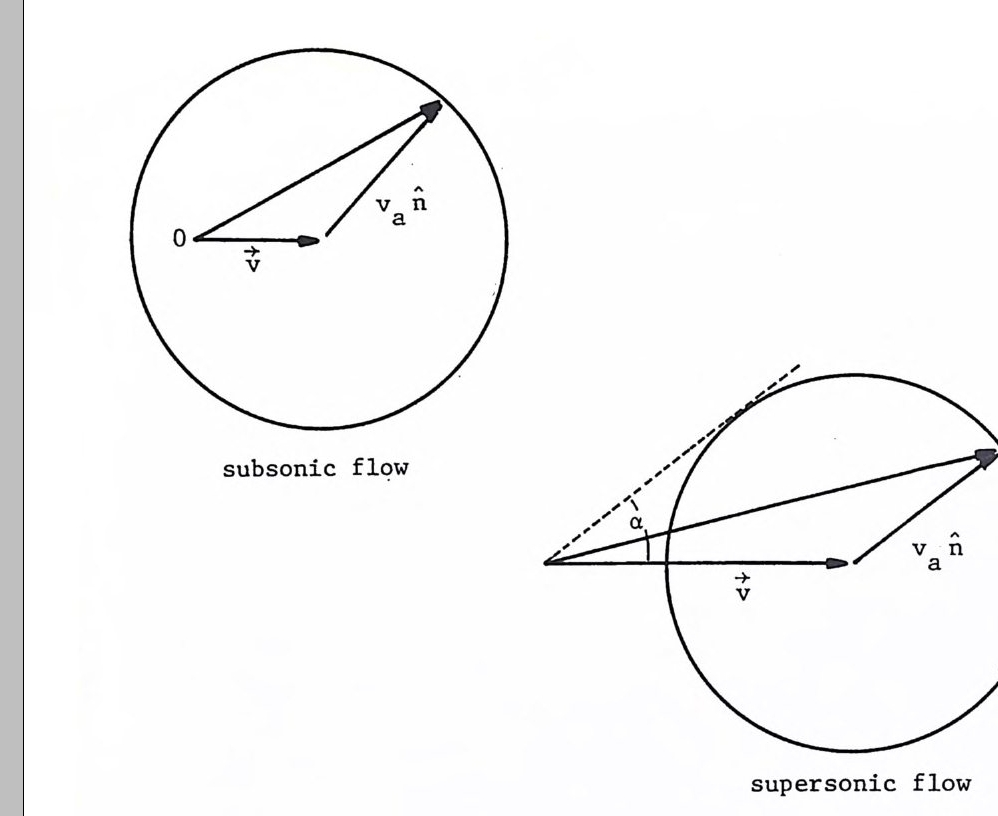 subsoni c fl ow , /' , ,,, ,, ’a\ , , ’ ? ’ / ,4
Fi g 5-4: Illustr ati on of th e charact e ris t ic d i ffere nce bet w een subsoni c and sup e rsoni c fl ows. It should be po i n t e d out here th at in hig h velocit y fl p w s th e Mach surfa ce is not a same-siz ed cone th roug h out th e fl ui d even in cases of st e ady flo ws because th e sound sp e ed varie s wi th t h ermody n ami c qu ant ities of whi c h it is a fu ncti on . We should fu rth er po i n t out th at in MHD fl ows th e pr op a g a t ion velocit y of mag n et o -acousti c w ave is not is ot r op ic. We now di s cuss non-lin ear ef fec t s : Let us con•s i d er a wave of densit y pe rtu rbat ion wi th a fini t e a mp l i tude and exami n e its f u rth er developm ent . Si n ce any pe rtu rbat ion in a fl uid tr avels with th e sound velocit y and th e velocit y varie s as p('y' -1- ), ,/2- , th e comp r essed reg ion A of th e densit y wave shown in Fig u re 5-5 pr op a g a t e s fa ste r th an th e rarefi ed reg ion B. Thi s leads to a st e ep e ni n g of th e wave, and as time go es on th e wave pa t tern th us st e ep e ns fu rth er and fu rth er unt il t h e
adi a bat ic r elat ion becomes no long e r ap plica blt· . Whe n th i s st a g e is reached, heret o f o re ign ored heat conduct ion and vi s c osit y become more and more im p o rta nt • Event u ally a wave of pe rmanent fo rm develop s in whi c h th e ef fec ts of non-lin earit y ge t balanced wi th t h at of di s sip a t ion . such balance ta kes pl ace over a reg ion of th i c kness wi th a fe w times th e mean fr ee pa t h of pa rti cle s in th e fl ui d . The tr ansit ion reg ion call~d th e shook laye r> is so narrow th at it can be consi d ered si m p l y as a surfa ce of di s cont inui t y; th ermody n ami c pr op e rti es and fl ow velocit ies assume qu i te d i ffere nt values on bot h si d es of th e laye r.
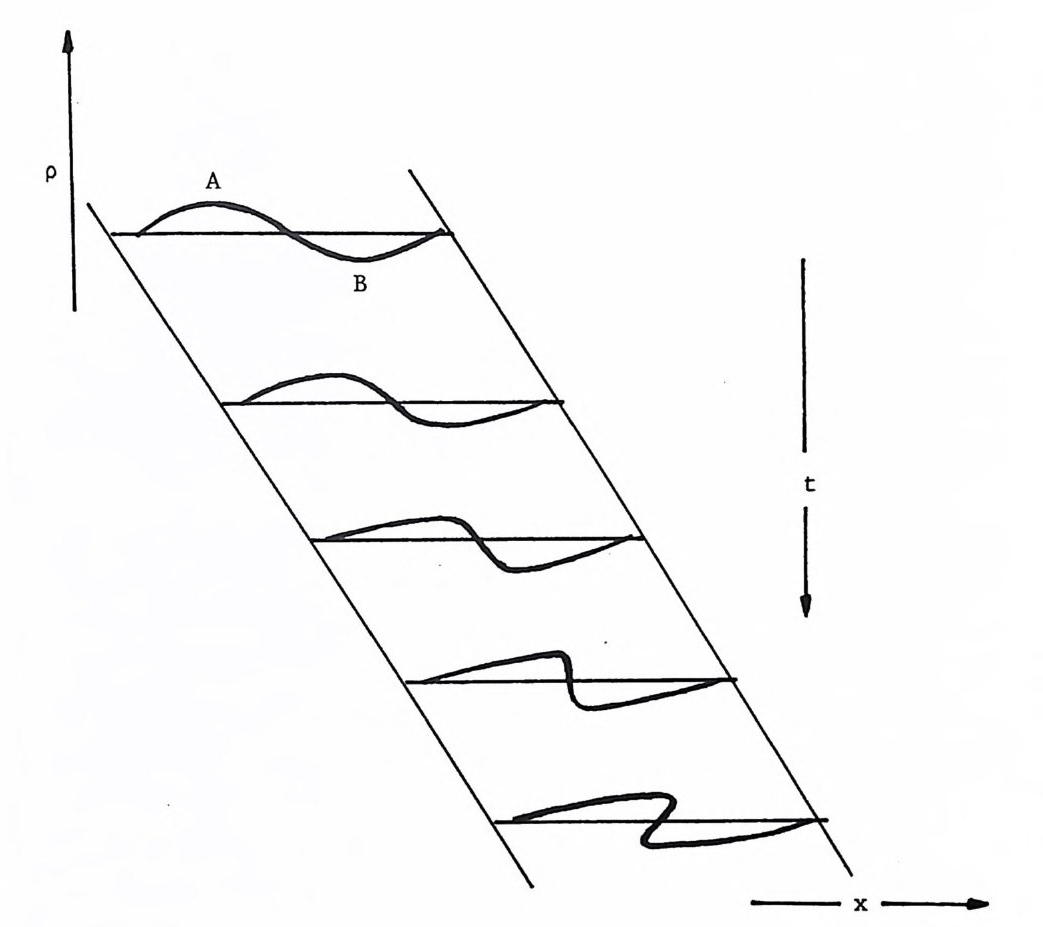 p
p
Fig 5-5 : St e ep e n~ng of a fini t e a mp l i tude densit y wave leadi n g to a di s cont inui ty .
Prob lem 5-18: From eq u at ions of cont inui ty and moment u m, deriv e th e fo llowi n g one - di m ensi o n a l wave eq u at ion a2t a_x2 = v!( 죠a2 Tx- ). (,a죠x― ), -(y+i) 0 0 fo r th e mot ion of a laye r of pa rti cle s in a uni form undi s t u rbed ga s under no body fo rces. Here x repr esent s th e absci s sa of th e laye r at time t wi th x ,.。., denot ing its i n i tial value, and va is th e adi a bat ic sound sp e ed in the undi s t u rbed ga s. Show th e fo llowi n g exp r essio n fo r velocit y 릎 = f [x - {vi;i + ½(y+ l)v} t] sati sf i es th e wave eq u at ion. Adop ting a si n usoi d al fu nct ion fo r an in i tial (t=O ) velocit y pa t tern · o ver x, fo llow numeric ally th e develo p men t o f veloc i답 c.h a ng e in time fo r tw o cases v_a >>v and v_a ' v. What would yo u do af ter th e velocit y has a verti ca l ta ng e nt ? Deta ile d st r uct u res in th e shock laye r are dete rmi n ed by th e nat u re of di s sip a t ive pr ocesses. It is obvi o usiy di fficul t to know what is go i n g on in si d e th e tr ansit ion laye r because th e whole concep t of fl ui d as a cont inuo us mat ter .b reaks down in scales of pa rti cle mean fr ee pa t h . It is , however, fo rtu nate enoug h th at th e conservat ion laws of mass, moment u m and energy yiel d relat ions betw een st a t e s of th e fl ui d on bot h si d es of th e di s cont inui t y. Si n ce th e tr ansit ion zone is ext r emely th i n in comp a ris on to any scale-leng ths of th e fl ows we are in t e reste d in , we will id ealiz e th e shock laye r si m p l y as a one di m ensi o nal di s t u rbance. For si m p l i c it y we will consi d er th e pr op a g a t ion of such di s t u rbance th roug h a homo- ge neous medi u m with a aonsta nt veto a i ty v1 . The si tuat ion is
conveni e nt l y analyz ed in a fr ame of ref e rence tr avellin g wi th t h e const a nt velocit y; in th i s fr ame th e fl ow is st e ady and all qu ant ities are fun c- tion s of po si tion only. In th e fo llowi n g sect ion we deriv e condi tions relati ng ph y s i c al qu ant ities on each si d e of a st a t iona ry pla ne sh .oa k. such relati ons all called th e Ranki n e.,.Hug o ni o t relat ions or si m p l y jw rrp aondi tions . It is a convent ion to call th e si d e fr om whi c h mat e ria l flo ws as th e fro nt of th e shock and th e ot h er si d e as th e back of th e shock. Thus, we may say th at mat e ria l undi s t u rbed ye t by th e shock ent e rs th roug h th e fr ont si d e. We wi ll le t th e suf fix 1 refe r to th e fron t and th e suf fix 2 th e back si d e (see Fig u re 5-6). reg ion 1 reg ion 2 fl ow of mat ter fr ont back st a t iona ry shock Fig 5.:..6 : Front ref e rs to th e I'.e g ion ye t undi s t u rbed by th e shock; back means shock-di s t r ubed reg ion . 5.7.2 Ranki n e-Hug o ni o t Relat ions For.t h e st a t iona ry shock th e time -deriv at ives in all t4 e basi c equ at ions of MHD give n in sect ion 5.2.3 become zero. Hence, th e conservat ion eq u at ions fo r mass, moment u m, mag n et ic f l ux and energy assume fo llowi n g fo rms, respe ct ive ly:
-291 -
'v • (p-v+ ) = 0 , p (;•'v)t + 'v( P g + 一B872T) - -4l7( TB +·V )B+ = o , v x (춘홉) = 0 ' v· [단 pv 2 + pe + Pg + 붕 }t ] = t. 나(정.潭] . Here we have drop pe d of f th e self- gr avit y te rm fo r si m p l i c it y, and used ag a i n th e ap pr oxi m at ion based on th e in f ini t e c onduct ivi t y. We now fo rm in t e g r als of th e above conservat ion laws over a small cy r i n dric al volume element t:.V across th e st a t iona ry shock fr ont with its fl at ci r cular fa ces pa rallel to th e shock fr ont . Then we tr ansfo rm th e volume in t e g r als in t o surfa ce in t e g r als, whi c h wi l l give us relati ons of ph y s i c al pr op e rti es betw een bot h si d es of th e fr ont . The volume in t e g r al of th e mass conservati on eq u at ion becomes f AV V • (p-v ) dV = O , where th e in t e g r al ext e nds over th e cy l i n dric al volume /1V . By Gauss th eorem th e volume in t e g r al can be tr ansfo r med in t o fsn P냐v •n^ dS = 0, where n is a uni t vecto r normal to th e shock fr ont po i n t ing to wards th e back si d e of th e shock. Now if th e fl ow is uni form , so th at 거v= 니v_ 。 n^ , th en th e surfa ce in t e g r al is zero everyw h ere excep t on th e ends of th e cy l in d er. Hence th e surfa ce in t e g r al becomes
ls p-v) •n^ dS = (pl vl -P2v2)A = .0. where A is th e surfa ce area of th e cy lind er end. Let ting ( Q ] (三 Q l- Q긴 denote th e di ffere nce in Q on ei the r sid e of th e shock, we may rep re sent th e ju mp condi tion resulte d fr om th e eq u at ion of 프프으 conservat ion as I[p~ .n ]I = 0 . The volume integ r al of th e ~ eq ua t ion is consi d ered term by te rm. The first te rm becomes, in in dex not at ion, p (+v -v,)+v = p_ v j ~.aj vi = ~aJ (pv jvi ) - vi, ~3xJ. (pv J, ) The last te rm in this exp r essi o n is zero because 'v • (pt)= O holds for th e stat iona ry flo ws. Thus we have f AV p( -v+ ·V)' ?.... d-V-- = fr AV —3xa—J . (pv ~J v4l. )dV = f s (a.~) P~ dS. The second te rm in volvi ng th e pr essure gr adi e nt becomes Jt:iV V(Pg + 릅 )dV = J s (Pg + 一B8l T2) n^ dS, and th e mag n et ic t e nsi o n term can be tr ansf ormed into f AV 一4-l1; T; (+B •V)B+ dV = f s 上411( 麟) 홉 dS,
as was done in sect ion 5.2.2. Combi n i n g th ese th ree surfa ce in t e g r als all to g e t h er we obt a i n th e ju mp condi tion fo r th e moment u m: I[ (麟 )P °t + (Pg + 틀)~ -志 냐) 1 = 0 For th e ma gn et ic f lu x we ag a i n use th e in dex not a t ion to obt a i n v x(v니x니B ) = Ei jk a atJ (Eklm vl 밑 = 호aJ (v i B j - vj B i ) • Hence we may have rAV v x( ;홉 )dV = JS [;(麟) _ 홉店)] dS = 0, fr o1ti whi c h th e ju mp condi tion fo r th e mag n et ic f l ux results as I[@ 麟 -( 나)정] = o. Fi n ally th e energ y eq u at ion give s JA V [V•{(½ pv 2 + pe + Pg + 駒 -志 ;. (점 .V) 홉] dV = 0, of whi c h th e first pa rt in volvi n g th e di v erge nce becomes rs (나) { ½군 + pe + pg + 릅 }d S = 0. For th e second pa rt we not ice
나 ·V) 정 = vi B j 급-=-J- Bi = 검J (Bj- B i v i ) - Bi 급J (vi B j) = _3_x3J _. Bj BiV i ' hence, we may tr ansfo rm th e volume in t e g r al in t o -—41, r J, ~s (n^ •B+ ) (+'v •+B )dS = o. Combi n i n g th ese results we fina lly obt a i n th e ju mp condi tion fo r th e energy as I[ 呼 { ½군 + p e + Pg + 릅 } -志 (려)詞)] = 0 . In summary conservat ions of mass, moment u m, mag n et ic f l ux and energy pr ovi d e th e fo llowi n g fou r condi tions whi c h wi l l describ e th e chang e s in correspo ndi n g ph y s i c al pr op e rti es across th e pl ane of shock di s cont inui t y: I[ 조] = 0, I[( 詞) & + (Pg + 릅 )n - (鬪 밉 0, I[;( 냐) _ 흡(詞)] 0, [(나) (½ 군 + Pe + Pg + 른) 갈려) (경.에)] 0. For normal shocks where 니v is alway s in th e di r ect ion of n, we may fu rth er sim p l if y.t h ese ju mp condi tions , we will di s cuss in th e next sect ion tw o di s t inct l y di ffere nt type s of mot ion ; 정//~ and 홉표.
5.7.3 Di s cussio ns of th e Ju mp Condi tions i) Normal Shocks wi th -v+ /./.-: +B When th e fl uid mot ion is pa rallel to th e di r ect ion of mag n et ic field , mat ter can not carry any field li n es , hence B 1=B2 • For such a flo w th e mag n et ic f ield does not af fec t th e fl uid mot ion at all, and th i s is th e case of ordi n ary . hy d rody n ami c shock. The ju mp condi tion fo r mass becomes p1 v1 := P.2, v,2, = m, where m is th e rate of mass fl ow th roug h th e di s cont inui t y. The ju mp condi tion fo r moment u m assumes mv 1 +P 1 =mv2 + P2 or m2/pl + pl = 급/p 2 + p2 For clarit y we have drop pe d th e subscrip t g fr om Pg_ . Wi th t h e use of th e th ermody n a mic relat ion P = (Y-1)Pe betw een th e pa rti cle ga s pr essure and th e in t e rnal energy densit _y we may writ e t h e ju mp condi tion fo r th e energy as Ll2v 21+ 4I p—1p l =- _21 v 22.+ 솝p—22
Itnh et r o addui ca bi na gt iXc 三s po u2_ n/p•d 1_ s ,• p e Ye=dP _a2 t/ P.1t h ean dfr Mona tc ho nf umthb ee r sMh1.o = cvk.1, /• vw_ae ·, swimh pe rleif yv a th ei s above th ree ju mp condi tions as v.1 ./ v_2 = X, M~ (X-1) /X = (Y-1) /y , 1 M~l (X2-1)/x2 = 2(Y/X-l)/(y- 1 ). Problem 5-19: Deriv e th e above fo rm of ju mp condi tions and ex pr ess th e densi ty and pr essure rat ios in te rms of Mach number M1 and th e sp e ci fic heat rat io y : x =_ p—l2 p =- 껍 v2_ = (Y-(yl)+M l)21M ~+1 2 x = P—2P = 2 y Mf -(Y -1) Ly+ 1) X - (y- 1) l y六 (y+ l) - (Y-l) X . Y must be po si tive, hence (y- 1)/(y+ l)< X< (y+l)/(y-1) should hold. The lower limi t of X should be rep la ced by 1 in order to have an ent r op y in crease across th e shock: 1 < X< yy +- 11 For monoat o mi c ga s, we th us have a condi tion X< 4.
Problem 5-20~ Evaluat e th e chang e in ent r op y , S= c .V. log (P/ p Y' ) , across th e shock fr ont , th en show th at X > 1 fo r s2-s1 > 0. Problem 5-21 : Show th at fo r X >l, M1 > 1 and M2 < 1. The densit y rati o c an not exceed (Y+l)/(Y-1), and th e pr essure rat io in creases roug h ly as sq u are of th e Mach number. Hence, th e te mp e ratu re rat io , T_2 ·/ T-1. = (·P-2j p .. 2_ ·) /• (•P ,l /p• ,1 ) , in creases as M21 : 스T = 2Y(Y-l) M2 . T1 (Y+l) 2 1 Problem 5-22: Est imat e th e te mp e ratu re in an in t e rste llar ga s heat e d by a sup e rnova shock. Problem 5-23: Def ine a crit ical velocit y v_C as th e velocit y at th e po i n t where th e fl ui d velocit y is eq u al to th e local sound sp e ed. Show th at th e crit ical velocit y sat isf i es th e relati on v~C =v.1,v •, 2., . In conclusi o n we may give fo llowi n g tw o comment s on th e shock di s cont inui t y: (1) Shock waves are comp r essio nal; pr essure ri s es as itih) e gNa os rcnraols sSesh otchk es shwoi ctkh f-r~ o n. tl . 럽 (2) The fl ow in th e fr ont si d e of th e shock is sup e rson ic; whi le th e flow in th e ~ack si d e is subsoni c . When mag n et ic f ield li n es are pe rpe ndi c ular to fl ow velocit y th e pr esence of such a mag n et ic f ield wi l l in crease th e to t a l pr essure by B2/81r and th e in t e rnal energy densit y.b y B 이 81r. From th e ju mp . condi tions we th us have fo llowi n g fo ur relati ons : p v =p v, 1 1 2 2 B V = B V , 1 1 2 2
p 1v•12 +• p-1 +• ;B81L21 = Pr2 •v22 +• p-2 +• 우8B121 ½균+근 PP—ll + i그曰+亡 乃2LP + 4 Bp22 T2 · We have fo ur eq u at ions to det e rmi n e fo ur rat ios p_2 /p_1 , v 2 /v1 , P2 /P 1 and B,2, /B1, . Wri ting X 건 2/p1 =v1 /v2 =2B /1B and Y 三 P,2, /P1. , as bef o re, and in t r oduci n g new pa ramet e rs N and Q def ined , resp e ct ivel y, by N2 = y짜 = Y( 군V1 2 a and 2B1BnP1 Q = ’ we may rewri te t h e ju mp condi tions fo r moment u m and energ y as N2 (1 - 支) = (Y-1) + Q (X2-1) , N2 (1 - 높 = 훑 cl -1) + 4Q C Y-1) • Please not e th at th e pa ramet e r Q is th e rat io o f th e mag n et ic p re ssure to th e ga s pr essure on th e fr ont si d e of th e shock. El imi n a t ion of Y from th e tw o eq u at ions give s a qu adrat ic e q u at ion Q( 2-Y)X2 + {y (Q+l ) + ½(y- l)N2 } X ~21 ( Y+l) N2 = 0.
Thi s eq u at ion fo r X should have tw o root s one po sit ive and th e ot h er neg a t ive. The nega t ive root is a meani n g le ss solut ion. From th e condi tion th at th e po si tive root must large r th an uni ty we have a condi tion fo r th e velocit y vf > vi + v!- Theref o re, a shock can develop only if th e velocit y at th e fr ont si d e of th e shock. is large r th an th e sp e ed of com p ress i on 님 1 waves in a conduct ing ga s, in whi c h th e mag n et ic f ield is tr ansverse to th e di r ec- tion of pro p a g a t ion. It is th en, nat u ral to def ine th e mang e t ic M ach nwnber M1* at th e fr ont of th e shock by th e eq u at ion M 도 __V 1_ T l ✓v 2A + v a In te rms of N and Q th e mag n et ic M ach number becomes N M1* = 乃 and th e qu adrat i_c e q u at ion. fo r X can now be writ ten as Q( 2-Y)X2 + {y( l+Q ) 나(y -1) (2Q + Y)Mf 2 } X - ½(y+l) (2Q +Y )Mf 2 e: 0, whereL eMt 1~ X2 0> b1e. th eT hve apltoi es i ot fi vXe inr otoht e abdseepn ec ne dos f oan mQag, n Met1~ 2i c af nide ldy ._(Q = O), th en th e qu adrat ic e q u at ion fo r X can be writ ten as 냐(y -l)N2 + 합 (X-X0) = -QX { (2-Y)X + y} .
Si n ce y < 2 in ge neral and X > 0 , X must be less th an .. X_n : Thi s clearly shows th at when 니B l -v누 th e ri s e in pr essure i~ smaller th an when ➔B =O. or -B► •/•/ ➔v . In ot h er words th e in t r oduct ion of mag n et ic field s reduces th e shock st r eng th in th e sense th at ge t ting small p2_ •/•P .1. Problem S-24: Solve th e qu adrat ic e q u at ion fo r X, and pl ot th e results in a X vs M* di a g r am fo r th ree cases of Q= O.l, 1, ;inr 1 10. Comp a re th ese pl ot s 1 wi th t h e correspo ndi n g pl ot in th e absence of mag n et ic f ield (Q= O) . From th e above exerci s e we may not e fol lowi n g po i n t s : (1) The shock st r eng th decreases wi th i n creasin g mag n et ic f ield , i.e. Q-+'. (2) For a fixed value of M1* , X is rath er in sensit ive to th e chang e s in Q. (3) For very st r ong shocks, M1 ~»l, X varie s as (y+l)/(y-1 ) like th e hy d rody n ami c shocks. (4) Velocit y of th e ga s may be sup e rsoni c wi th respe ct to th e local sound velocit y on bot h si d es of th e shock. iii) Obliq u e Shocks There is no concep tua l di fficul t y in gn eral izi n g th e j ump condit ions fo r normal pl ane shocks to th ose. f o r obliq u e shocks, where mat e ria l fl ows obliq u ely in t o th e shock fron t . If we let u n d~not e th ~ velocit y of th e shock refe rre<:l to a set of coordi n at e axes and 니v denot e th e velocit y of th e fl ui d refe rred to th e same coordi n at e s , we may wri te d own th e ju mp condi tion fo r an obliq u e shock as [P (vn-u)] = 0, I[ P (vn-u)t + (P + 릅) a -亡 % 홉] = 0, I[BJ = 0, [ (v0-u) { 1P v2 + p e + P + 릅. } - 감 만기 = o,
where vn_ =니v •n^ , Bn_ =어B •n^ and P is th e ga s pr essure. If v_n- u=O, i. e.,no ga s crosses th e fr ont , we call such case as th e cont a ct di s cont inui t y. The cont a ct di s cont inui t y is usually an unst a ble conf igu rat ion. Si n ce analys es of th e obliq u e shocks can be done si m i larl y to th e case of th e normal shocks wi th s ome alge brai c comp l i c at ion s, we wi l l refr ain ourselves and only ref e r Inte rste llar Gq. s Dyn ami c s by Kap l an ( 1966) fo r some shock relate d astr op h y s i c al examp l es. Problem 5-25: Inf r ared emi s sio n in th e fu ndament a l and first overto ne vi b rat ion bands of H2 has recent l y observed in th e Orio n Nebula by Gaut ier et al. (1976) , and Beckwi th et al. (1977) . These observat ions in di c ate exci tat i on te mp e ratu re about 2,000 K fo r th e rot a t iona l levels wi thi n th e first vi b rat iona l st a t e ; models based on shock heat ing were pr op o sed fo r th e excit at i on. Read, fo r examp l e, th e pa p e r by London et at . (1977) and enj o y learni n g how th e st a t iona ry shock id eas are act u ally ap pl i e d to a real pr oblem. What are th e di fficul ti es of th ese model of hy d rody n ami c shocks ? Gi v e yo ur op ini o ns whet h er an in clusio n of th e mag n et ic f ield helps ease th e di fficul ti es in volved in shock model .
RE FERENCES General te xt s on th e mag n et o hy d rody n ami c s are: Al fven , H. and Falth ammar, C.-G. 1963, Cosmi ca l Elect r odyn a mi cs (Oxf or d Uni v . Pr : London) . Cowl ing , T.G. 1957, Ma g n et o hyd :t>o d y na mi c s (Int e rsci e nce: New York) . Dung e y , J. W. 1958, Cosmi c Electr odyn amics (Cambri d g e Uni v Pr: London) . Ferraro, V.C.A. and Plump ton , C. 1966, An Intr oduct ion to MAGNETO- FLUID MECHANICS, second edi tion (Oxf or d Uni v Pr : London) . Most of th e mat e ria l in th i s chap ter is from th e last ref e rence. Essent ials of th e mag n et o hy d rody n ami c s wi l l be fou nd from chap ter 10 of th e E. & M. te xt by Ja ckson , J . D. 196 2 , CLASSICAL ELECTRODYNAMICS (W iley ; New York) . Ap pl i c at ions , on an advanced level, of th e mag n et o hy d rody n ami c s to a varie t y of cosmi c pr oblems are give n by Mest e l, L. and Wei s s, N.O. 1974, MAGNETOHYDRODYNAMICS, lectu re not e of th e Swi s s Soci e t y of Ast r onomy and Ast r op h y s i c s Fourth Advanced Course (Geneva Obs.: Swi s s). Mag n et o hy d rody n ami c s ph enomena occurrin g in in t e rste llar sp a ce are tr eat e d in foll owi n g books: Sp itze r, L. Jr . 1978, Phy s ic al Processes in th e Inte rste llar M 函i wn. (Wi ley : New York) , chap 10 ~ 13 . Kap l an, S.A. 1966, In t ers t eU 따, Gas Dyn ami cs (Perga m on: Oxfo r d) . We now li s t key refe rences on a sp e ci fic s ubj e ct dealt in each sect ion of th e chap ter : TensoCr hvain r dir aa ls etkhh eaorr,e mS . is1 9g61iv, e nH yb dy rodyn ami c and :.. ,•oma gne t ic S t a bi U ty (Dover: New York) , p. 577-595. • Orig ina l ·de riv at ion of th e vi r i a l th eorem wi th m ag n et ic f ield in a conveni e nt . f o rm in astr op h y s i c al uses was done by Chandrasekhar, S . and Fermi , E. 1953, Ap .J. , 브호, 116. Hi s t o ric al develop m ent and 크 st ro p h y s i cal ap plica ti on s of tl.2 vi r i a l t .,1 백 are clearly pr esent e d in a small book by Collin s, G.W. II 1978, '.fhe Vi n al, '.fhe orem in St e Uar Ast rop h y s i c s (Parchart: Tucson). An ap pl i c at ion of th e tE_!n sor vi r i a l th eorem was made in th e pr oblem of st a r Sfto rr mi tatt mioant t beyr , P. 1966, M.N.R.A.S. , .!E, 359.
For tKh re amlal ,g n eNt.A o h. y da nrodd Ty nr aimv ie cl psi te ac bei, l iAt .yW . an19a7ly3s, ePs rwine cifp o ll elosw oefd Plasma Phy s i c s (McGraw-Hi l l: New York). Or i g i n al deriv ati on of th e energy -pr i n cip le analys i s is give n by Berst e i n , I.B. , Frie man, E.A. , Kruskal, M.D. and Kulsrud, R.M. 1958, Proc . Roy . Soc . (London) , A ~' 17 . Classic al Pap e rs on th e Parker in st a bi l it y are: Parker, E.N . 1966, Ap. J. , ~브., 811 . Parker, E.N. 1969, Sp a ce Sci . Rev. , 으, 651 . Ot h er pa p e rs qu ot e d in th i s chap ter are as fo llows: AsseoA, p E.J.,. , Cne.zs_a,r sk7y5 2, . C.J ., Lachi e ze-Rey , M. and Pellat, R. 1980, Beckwi th, S., Becklin , E.E., Neug e bauer, G. and Persson, S.E. 1977, B.A.A. S . , §_, 564. Gaut ier, T.N., Fi n k, U., Tref fer s, R.R. and Larson, H.P. 1976, ~p.J. , 뿌, L129; Lachi e ze-Rey , M., Asseo, E., Cesarsky , C.J . and Pellat, R. 1980, LondoAnp, .JR.. ,, 으M완c~G.r ay1 ,7 5R. . and Chu, S.-I. 1977, Ap .J. , 요모, 442. Mouschovi a s, T. Ch. 1974, Ap .J. , 1_92, 37. Oort, J. H. 1965, in Galact ic S t rue 國 e (St a rs and St e llar Sy s t e ms, vol . 51 edi ted by A. Blaauw (Uni v . of CM~ag o Pr: Chi c ag o ) , p. 455. Sp itze r, L. Jr . 1968, in Nobulae and Int e rste llar Mat ter (St a rs and St e llar Sy s t e ms vol . 7) edi ted by B.M. Midd lehurst and L.H. Aller (Uni v Chi c ago Pr: Chi c ag o ), p. 42-48. Sp itze r, L. Jr . 1978, Phy s i c al Processes in th e Int e rste llar Medi u m Zwei b e(Wli , lEey. G: . aNnewd YKourlskr)u, dp, . R2.M4.1 -214947.5 , Ap .J. , ·20 1, 63.
Inci r.x
Adi a bat ic c ont r act ion , 235 flow, 211 Al fvpe, rn o' cs etshs e, or1e2m6 , 254 veloc ity, 271 wave, 270 Auxi l i a ry ci r cle, 64 Black body , 1 radi a t ion, 1 Blue st r agg l er, 74 Bolomet r i c correct ion, 21, 34 mag n i tude , 34 Boltz mann's tr ansp o rt eq u at ion, 197 Boy l e's law, 167 gr avit y-m odi fied , 167 Bulk mot ion , 195, 244 Chandrasekhar limi t , 137 Colli sio n , 96 Color-color di a g ra m, 23, 29 Color excess, 31 Color in dex, 22, 27-28 Comp r essib i lity, 192 Conduct ive heat fl ux, 197, 208 Coni c sect ion, 62 Cont inui ty eq u at ion, 205, 213, 219, 236, 273 Convect ive current, 246 Crit ical radi u s, 220 Current free field , 261 Deby e shi e ldi n g leng th, 216 te mp e ratu re, 38 Decay time scale, 253 Def l ecti on ang l e, 94 Deg e nerat e elect r on ga s, 127 Deg e nerat e dwarf, 142 Di ffere nt ial gr avi tat i on, 78 Di ffusi o n eq u at ion, 252 Di m ensi o nal analys i s , 3-6 Di s p e rsio n relati on , 228, 274 Di s p l acement current, 244 Di s rup tion of op e n cluste r, 90
Di s t r i b ut ion fon cci o n, 193 D-solut ion, 142 Dy n ami c al fric t ion , 107 Eddi n g ton 's st a ndard model, 124 Ef fec t ive radi u s , 96 Elect r i c current densit y, 244, 251 Emden curve, 147, 154, 161 Emi s sio n nebula, 40 Emi ttanc e, 14 Encount e r, 92 Energy conservat) .on, 59, 244 eq u at ion, 251, 294 Energy pr i n cip l e analys i s , 283 Enskog ' s eq u at ion of chang e , 202, 204 Eq u ati on of field evolut ion , 262 st a t e , 126, 156, 167 to t a l·e n ergy conservat ion, 209 Eq u ip a rti tion , 175 Eq u ip o t e nt ial surfa ce; crit ical -, 68 E-solut ion, 135 Evap o rat ion, 105, 112, 176 time scale, 176 Ext inct ion, 29-31, 114 Fermi - energy , moment u m, 128, 129 Flux, 17 Flux-fr ee zin g condi tion, 257 Force densit y, 207 Force free field , 259 Fowler solut ion, 150 F-soluti on , 142 Galact ic r ot a t ion, 90 Globular cluste r, 171, 174, 183 Gravi tat i ona l collaps e, 170 eq u i libri u m, 170 Gravi tat i ona l energy , 140, 225 Green house ef fec t, 40 HHaeramt ocnoi nc dluacwt i, o5n3, 289
Heat fl ow vect o r, 197 Heat ing coolin g balance, 237 Heat ing rate , 38 Hi e rarchi c al fr agm ent a t ion, 235 Homolog y consta nt , 142 tr ansfo rmat ion, 143 in varia nt varia ble, 143 HII reg ion , 42 Hy d rody nam i c eq u i libri u m, 162, 186 Hy d rosta t ic e q u i libriu m, 123, 131, 186 Imp a ct pa ramet e r , 93 , 108 Incomp r essib il ity, 215 Insta bi lity gr avit at i on al-, 171, 182, 277, 285 Parker-, 285 Ray l eig h -Tay l or, 92, 236, 240, 278 Int e ract ion di s t a nce, 95 Inte rnal energy densit y, 196 Inte rste llar cloud, 162 dust 35-38 ext inct i on , 29-31 Ioni z at ion, 40-42 Isentr op ic flow, 211 Isoth ermal sp h ere, 352 tw o comp o nent -, 183 Je ans crit eri o n, 277 crit ical mass, 229. in sta bi lity, 229 leng th, 229 mass, 235 Ju mp condit ion, 291, 294 Kelvi n -llelmholz th eorem, 256 Kep l er's emp iric a l law, 50 eq u ati on , 66-67 Kirc hhof f's law, 2 Lag r ang ian deriv at ive, 200 di s p la cement , 281 po i n t , 69 Lane-Fmden eq u at ion, 131-187
Lorent z fo rce, 248 pr of ile, 8-~ Mach ang l e, 287 number, 288 surfa ce, 287 Mag n et ic ? -1ach number , 300 Mag n et ic t e nsi o n, 249,. 2 93 Mag n et o -acoust ic w ave, 275 Mag n et o hy d rody n ami c al wave, 268 ?-1ag n et o hy d rody na mi c s (MHD), 243 MDH ap pr oxim 'a t ion , 244 eq u at ion, 258 Harg ina l st a bil ity, 231 Hass conservat ion, 132, 292 Mass-cont inui t y relati on, 154 Mass exchang e , 68-72 Mass-radi u s relati on, 136 ?-1axwell di s t r i b ut ion, 104, 127 eq u at ion, 243 Mean anomaly, 63, 65 Meanf low mot ion , 209 Mean fr ee pa t h , 103, 283 Mean in t e nsit y, 15. Mi lne-s olut ion, 150 Moment u m eq u ati on , 207-219, 227-230, 250 , 272 , 293 Moment u m sp a ce, 14 Monochromat ic e nergy densit y, 15 Obl iqu e shock, 301 Op e n cluste r, 90, 103 Parabolic mot ion , 67 Peria str on, 83 Perih elio n , 52 Pertu rbat ion eq u at ion, 278 Phase sp a ce, 193 Phase velocit y, 275 Phot o elect r i c ph ot o met r y sy s t e m, 225 Phot o io n i z at ion, 40 Planck curve, 18-19 law, 6-14 Polyt ro p e , 124 comp o sit e-, 156, 162 Polynt reog pa ti ci v ein dine dx,e x1-8, 0 179-182
Polyt ro p ic relati on , 124-127, 224, 273 Pot e nt ial energy (po lyt ro p e s), 75, 84, 95 Pressure, 166, 218 cent r al-, 139 electr on deg e neracy -, 137-138 ga s-, 124, 139, 210, 302 mag n et ic-, 249 radi a t ion -, 73, 139 Pressure te nsor, 176 Ranki n e-P.u g o ni o t relati on, 291 Ray l eig h ap pr oxi m at ion , 37 Ray l eig h -Je ans ap pr oxi m at ion, 2, 4 Ray l eig h -Tay l ol.' in st a bi lity, 92 , 236 , Relaxati on , 102 240 Rey n olds .nu mber, 252 mag n et ic-, 252 Roche limi t, 84-85, 90 Roche lobe, 68-72 Runaway st a r, 75-76 Scale hig h t , 218, 231, 246 Schwarzschi l d radi u s, 6 Schuler fr equ ency , 85-87 Self -ad j oi n t , 282 Shock di s cont inui t y, 288, 295 Shock laye r, 288 Sl ing -s hot model, 75 Solar corona, 216 Solar wi n d, 216 Sound sp e ed, 214, 286 adi a bat ic-, 273 is ot h ermal-, 214 Sound wave, 192, 212 Sp e c ific h eat , 125, 210 Sp itze r's refe rence time , 101 Sp e cif ic i n t e nsit y, 14 St a ndard model, 125 S~at iona ry pla ne shock, 291 St e f a n-Boltz mann's law, 2-5, 21, St r c”im g re n sp h ere, 41 38 Subsolar te mp e ratu re, 39 Sy n chroni z at ion, 86 Sy n chronous rot a t ion, 80
Temp e ratu re, 20 big h t n ess•- , 21 color-, 22, 28 cont inuu m-, 20 ef fec t ive- , 22 gra di e nt -, 22 radi a t ion -, 21 Hi e n-, 22 Thermal conduct ion, 214 Thermal energy conservat ion, 205-207 Ti d al di s rup tion , 88 evolut ion, 81 for ce, 78-31 Ti m e charact e ris t ic-, 215 crossin g -, SS di s rup tion -, 111 . evap o rati on -, 116-117 free -fa l l-, 233-234 relaxat ion- , 98-102, 104, 174 resid ence-, 171 self -co llis io n -, 102 slowi n g -d own-, 107-110 refe rence-, 101 Tot a l deriv at ive, 200 True anomaly, 52, 59, 63 Velocit y Alfv en-, 271 areal-, 51 crit ical -, 210, 298 escape -, 61, 116 pe cul iar- , 199, 237 vi r i a l-, 95-96 Veloc ity di s t r i b ut ion, 176 Vi r i a l th eorem, te nsor-, 266 Vi s cosit y, 288 Vi s -viv a eq u at ion, 60-61 Wave eq u at ion, 290 Waveleng th ef fec t ive- , ·23 is op h ot a l-, 23 Wave number, 228 Wi e n's ap pr oxim a t ion, 3,6 Wi e n's di s p la cement law, 25-, 6
洪承樹 서울대학교 문리대 졸업 뉴욕주립대학원 졸업, 이학박사 캠브리지대학 천문학연구소 객원연구원 뉴욕주립대학 우주천문실험실 객원연구원 和蘭 레이벤대학 천체물리연구소 초빙연구원 미국 풀로리다대학 우주천문실험실 객원연구원 노.... . tCEl A Unif ied Model of Inte r ste l lar Gra i ns” 外 20 여 편 현재 서울대학교 자연과학대학 부교수
 -ll -[
Astr o p h y si c s I1998844 년년 I젠 월 IIO5 일일 터臼
著發 行者人 朴洪民 音孟承 浩樹發行處 社干 ll0 대체구좌 010041-31-523282 서울 종로구 관철동 44 의 l • 724-2000 • 724 자 234 • 725-8524 출판등록 1966.5. 19 1-142 값 4,700 원 파본은 교환해 드립니다대_우학 술총서 자연과학 1 소립자와게이지 상호작용 김진의 2 動力學特論 이병호 3 室素固定 송승달 4 相轉移와臨界現象 김두철 5 觸媒作用 진종식 6 뫼스바우어分光學 옥항남 7 극미량원소의 영양 승정자 8 水素化湖素와 有機湖素化合物 윤능민 9 抗生物質의 全合成 강석구 10 국소적 형태의 Ati ya h-Sin g e r 지표이론 지동표 11 Mucop ol ys a ccharid e s 의 生化學 및 生物理學 빅]..준우 12 Astr o p hy s i c s 홍승수 13 우天원然식物 化學硏究法